
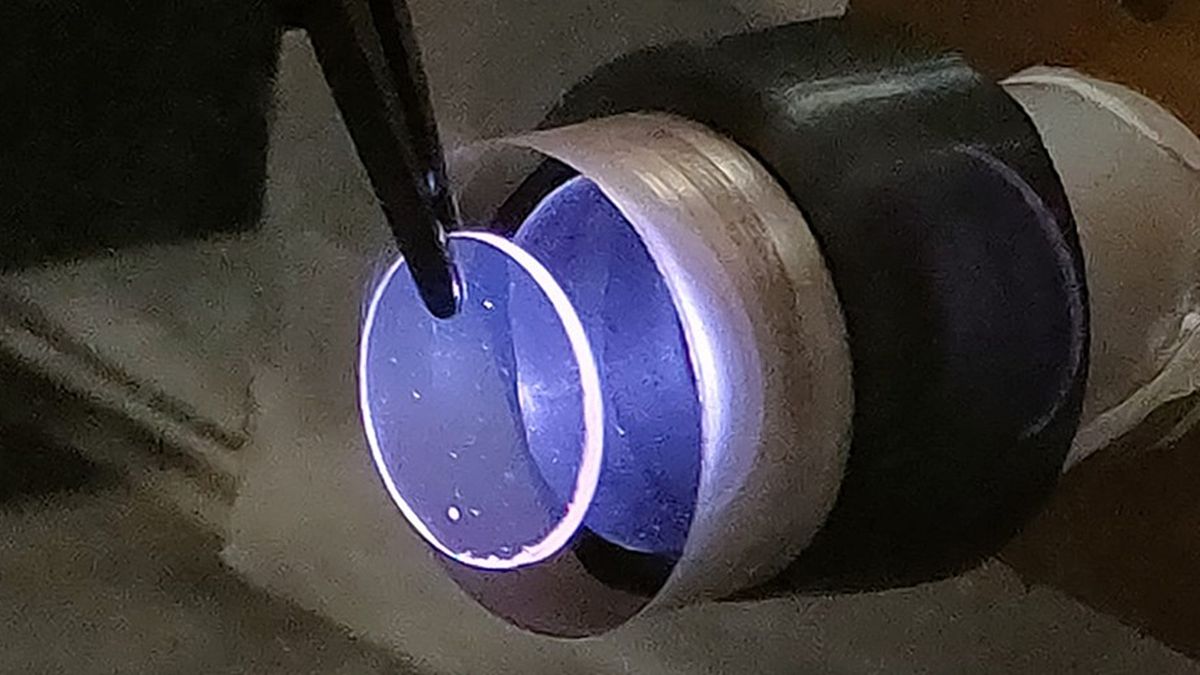
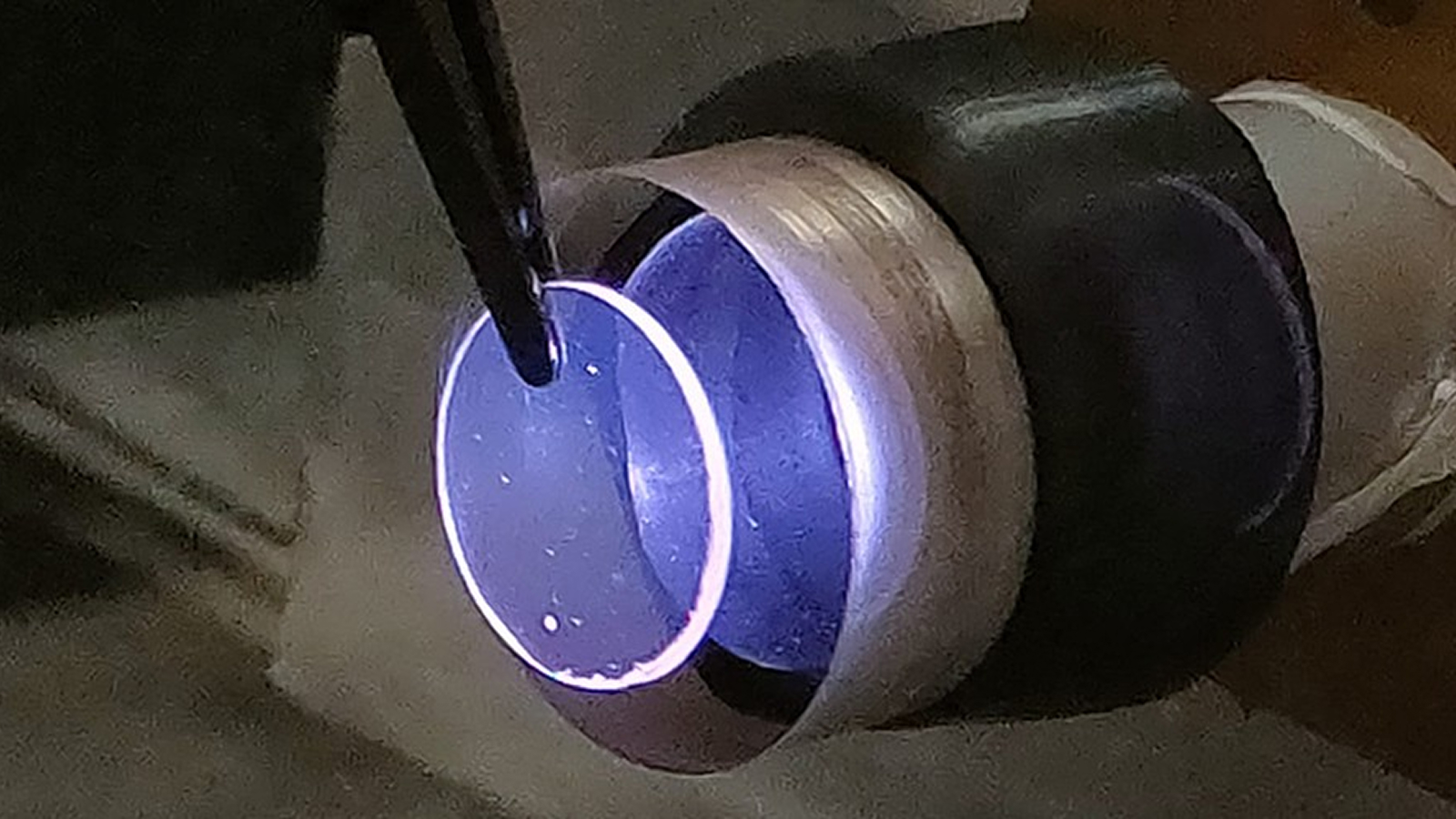
Scientists have devised a way to store and read data from individual atoms embedded in tiny crystals only a few millimeters in size (where 1 mm is 0.04 inches). If scaled up, it could one day lead to ultra-high density storage systems capable of holding petabytes of data on a single disc — where 1 PB is equivalent to approximately 5,000 4K movies.
Encoding data as 1s and 0s is as old as the entire history of computing, with the only difference being the medium used to store this data — moving from vacuum tubes flashing on and off, tiny electronic transistors, or even compact discs (CDs), with pits in the surface representing 1s and smoothness indicating 0.
The hunt is now on for even denser data storage, which is leading scientists to the subatomic world. In a new study published Feb. 14 in the journal Nanophotonics, researchers have used an electron trapped by a defect in a crystal to represent a 1 with the lack of a trapped electron indicating 0.
The work was inspired by quantum techniques, the scientists said. In particular, they integrated solid-state physics applied to radiation dosimetry with a research group working strongly in quantum storage — but this specific work builds classical computing memory.
The technology works by shining a laser with a specific amount of energy that will excite an electron. At this point, a reading device may register the presence of light. No light means no trapped electron.
This only works when the crystals include defects, such as an oxygen vacancy or a foreign impurity. “These defects present very nice characteristics,” first author of the study, Leonardo França, postdoctoral researcher in physics at the University of Chicago, told Live Science. “One of them is the ability to store charge.”
Related: Human genome stored inside near-indestructible ‘5D memory crystal’ that could survive to the end of the universe
Knowing this, the team used rare earth ions as dopants — impurities added to a material to alter its properties — with the key lying in devising a way to excite an electron from a specific rare earth ion so it then becomes trapped. If imagining how a CD works, this would be equivalent to creating a pit.
“We have to provide sufficient energy to release an electron from a rare earth ion and the defect — a nearby defect — will sense that,” said França. “So you capture the electron by an intrinsic electric field. This is the writing part.”
Then you come to reading the data. “Basically, you have to use another light source so that the electron will be released from the defect,” said França. “And that leads to a recombination of charges, and that leads to emission of light.”
Building data storage of the future
If the process worked exactly like this, the data would be erased every time it was read, but using lower amounts of light would only “partially erase information,” said França. So it would fade over time, in a similar way that data held in tapes fades over 10 to 30 years.
While the team used the rare earth element praseodymium and an yttrium oxide crystal, the work could equally extend to other non-rare earth element crystals with other non-dopants. But rare earth elements have the advantage of providing known and specific wavelengths that enable us to excite electrons using standard lasers.
The researchers’ initial aim was to address individual atoms. They haven’t yet achieved this goal, but França believes that the technique the team has pioneered puts them on the right track.
Appetite for further research is attributed to how scalable this technology is, potentially ushering in low-cost, high-density storage formats in the future for various applications, França said.
The good news is that the optical, laser side of the equation is already well understood and cheap. Likewise, the crystal would cost little money to produce at scale. That leaves the cost of acquiring the rare earth elements and devising a way to introduce defects using mass manufacturing methods.
If these obstacles can be overcome, the crystal could be fabricated as a disc, he added, and be read by inexpensive readers. The final question would be around how densely you can store data on a hypothetical disc.
“In our crystal, where we have around 40mm3 [0.002 cubic inches], we could store a few hundred terabytes,” França told Live Science. After performing some calculations, he put the figure at approximately 260 TB.
That figure is based on the crystal the scientists investigated, but França sees a future in which you could easily increase the defect density. This naturally leads to the possibility of PBs of data stored on a single device the size of a disc.
