
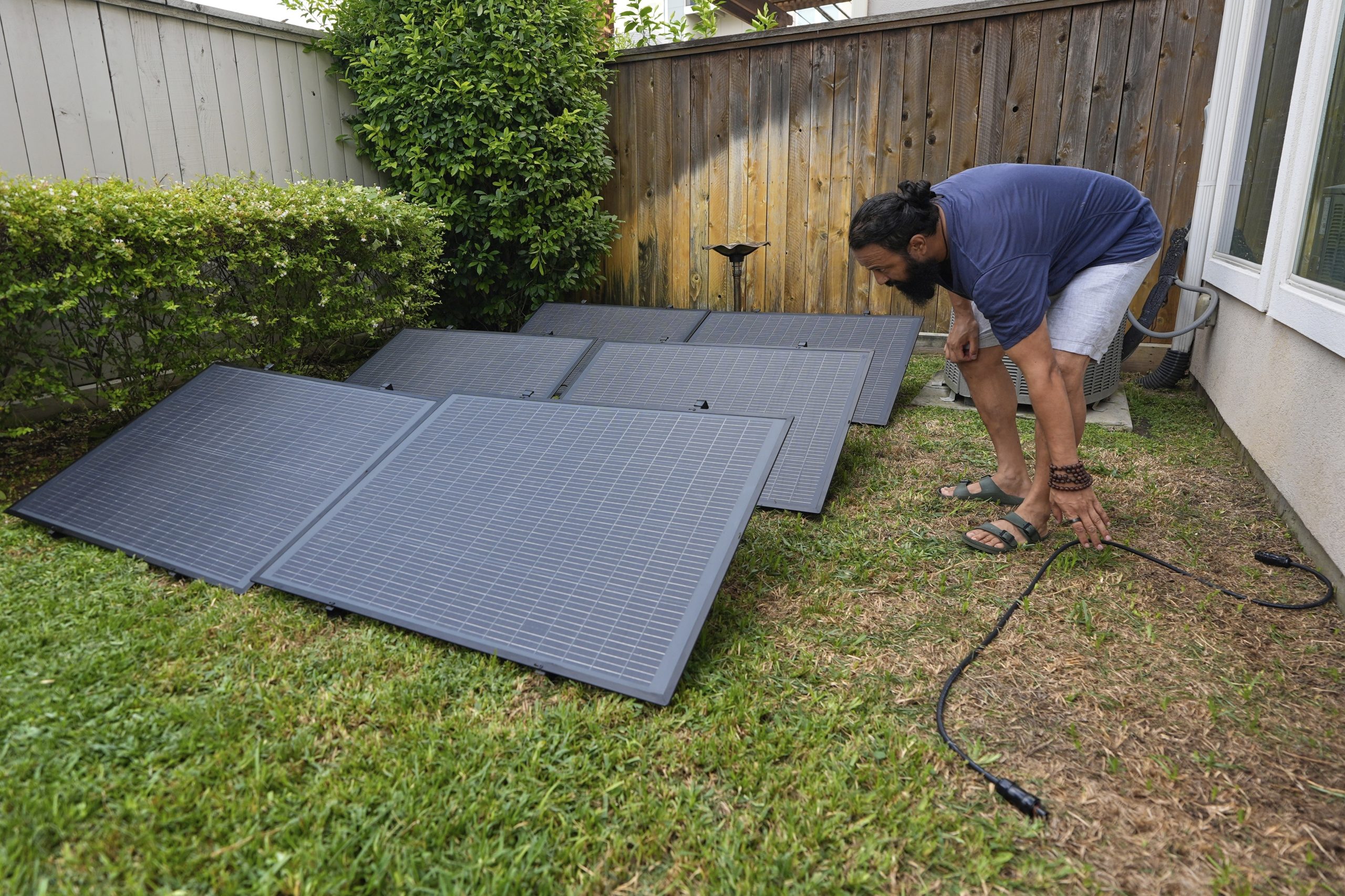
If a bill introduced in the Legislature passes this session, a small solar array would be a mere plug in away for Minnesotans.
The legislation would establish regulations for installation and operation of plug-in solar devices. Also known as balcony solar, homeowners or renters could place units outside near an outlet as a way to harness solar energy and cut down on surging electricity bills.
The idea is to “democratize” solar, making renewable energy more accessible, said Sen. Rob Kupec, DFL-Moorhead, the bill’s author in the Senate.
“Solar is expensive,” he said of rooftop arrays. “This is a much more low-cost option for people to get in on and save a little money on their electric bill.”
Utah became the first state to approve plug-in solar regulations in 2025, passing them unanimously on a bipartisan basis. Minnesota is one of dozens of other states considering similar laws.
Rep. Larry Kraft, DFL-St. Louis Park, first introduced the bill in the House. At a House Energy Finance and Policy Committee hearing in February, he estimated plug-in solar can reduce energy usage in a residence by 5% to 25%.
Related: Minnesota is emerging as a hub for microgrid technology, unlocking cleaner, more reliable local power
“We’re talking about savings of between $35 and $55 per month,” he said. “The thing that’s exciting about this is there are dramatically lower up-front costs.”
Rooftop solar arrays can cost tens of thousands of dollars, while plug-in devices have dollar ranges in the high hundreds to low thousands. Both systems are designed to have users come out ahead on energy savings over time.
The latter option is also attainable to people who don’t have a roof suitable for solar panels and renters who don’t own their roof. Kupec described his home as having three peaks on the roof, difficult architecture to lay an array. But at ground level he knows a south-facing wall would be a sunny spot for a panel.
What does the bill say?
The bill sets a maximum output for units at 1,200 watts, which advocates say is similar to common household appliances.
“It’s about the same wattage as your household blender and usually less than your household hairdryer,” said Patty O’Keefe, Midwest regional director at Vote Solar. “So we’re not talking about a lot of wattage here.”
As currently written, the legislation lays out a mostly plug-and-play, or do-it-yourself, process for the using the devices without the need for a utility’s approval or an electrician’s installation. Someone could buy a solar device that meets the standards, plug it in, and be good to go by law, a similar approach to what is apparently all the rage in Germany.
A recent addition to Kupec’s bill adds one possible step. A utility could require users to notify them about the usage, more as a courtesy than a request for permission.
Is there opposition to the bill?
There is, and it comes in the form of utilities and lawmakers.
As other states pursued plug-in solar legislation, utilities tried to zap it. In Georgia, for example, utilities raised safety concerns related to installation and operation of the systems.
The argument there was if solar units are generating electricity during an outage, line workers could be in danger. The bill in Minnesota seeks to address this by requiring devices to meet standards that would cut them off from the grid with a switch if an outage occurs.
Utilities in Georgia also opposed exempting plug-in solar from requirements imposed on larger solar units, like those found on roofs. Rooftop solar users in Minnesota need to enter into an interconnection agreement requiring utility approval before using the arrays. One reason for this is these types of arrays may generate more energy than the home needs, with the surplus flowing out into the larger grid.
Plug-in solar units aren’t designed to act in the same way, said Will Mulhern, director of clean electricity at Fresh Energy, a group advocating for the legislation. They provide a portion of power to a home rather than producing it in excess of what a home needs.
Minnesota’s bills are also likely to encounter lawmaker opposition, as displayed in committee hearings. House Republicans brought up how many solar arrays are built in China, and how people could take advantage of the law by plugging multiple solar panels into the same outlet.
Sen. Jason Rarick, R-Pine City, speaking at the Senate’s Energy and Utilities Finance and Policy Committee on Tuesday, raised concerns about the standards set in the bill.
Rarick, an electrician by trade, brought a copy of the National Electric Code book to the hearing. While the bill requires plug-in units to meet certifications established by Underwriters Laboratories, a testing lab recognized by federal regulators, Rarick said that shouldn’t be the final say on compliance.
“In order to meet code, they must meet some type of standard, like a UL listing or equivalent, but that in and of itself does not make it code compliant,” he said, adding that the legislation is going out ahead of its skis by not going through the NEC.
Related: Solar power gives resort ‘new blood, new life’
Underwriters Laboratories recently put out “UL 3700” standards for plug-in solar devices, which serve as a guide for manufacturers to build products meeting specifications for safe use. This should be enough to establish the safety of the units once they hit the market, said John Goeke, a Duluth electrician whose business, Star Power Electric, specializes in solar units.
“As long as people are buying UL equipment and staying under the 1,200-watt limit, I’m in favor of the plug-it-in approach,” he said.
What’s next for the solar bill?
Following Tuesday’s hearing, Kupec checked with the Minnesota Department of Labor on the standard requirements for plug-in solar units. He said the agency confirmed that there is no need to alter electric code to allow these devices if they meet UL standards.
He’d like to see the bill make it out of energy committees and go to a floor vote or be included in an omnibus bill this session. He’s feeling optimistic about it, a sentiment echoed by advocates who testified at the Capitol.
Bipartisan support for plug-in solar in other states will hopefully carry over into Minnesota, O’Keefe said.
“I have been a clean energy advocate for 14 years and I don’t think I’ve ever seen so much organic excitement about a solar solution,” she said. “It’s something that people can visualize and understand and wrap their mind around.”
As an electrician who helps people tap into the benefits of solar panels, Goeke said he wants legislators to see the light.
“I want people to experience that,” he said. “I’m excited for that. This technology really works, and it feels like magic, but it’s just physics.”
