Close Menu
  • Home
  • UNSUBSCRIBE
  • News
  • Lifestyle
  • Tech
  • Entertainment
  • Sports
  • Travel
Facebook X (Twitter) WhatsApp
Trending
  • Assassin’s Creed Valhalla game cited in Minnesota murder lawsuit
  • Safest Countries in South America Updated on 2024| GoVisaFree
  • Wanda Sykes says comedians scared to tell certain jokes on stage, still should
  • Another 23 People Died “Without Fixed Abode” in OC in February, Continuing Downward Trend
  • Scientists discover potentially huge freshwater reservoir hidden beneath Great Salt Lake
  • Iran war fears erode Trump’s support as gas prices and stocks fall
  • Eurovision, the glitzy contest where music meets politics, is adding an Asian edition
  • A Definitive Guide to Moving to Seattle in 2024
Facebook X (Twitter) WhatsApp
Baynard Media
  • Home
  • UNSUBSCRIBE
  • News
  • Lifestyle
  • Tech
  • Entertainment
  • Sports
  • Travel
Baynard Media
Home»Lifestyle»Over 400 gold and silver Roman-era coins unearthed in the Netherlands depict rulers from Rome, Britain and Africa
Lifestyle

Over 400 gold and silver Roman-era coins unearthed in the Netherlands depict rulers from Rome, Britain and Africa

EditorBy EditorJanuary 27, 2025No Comments3 Mins Read
Share Facebook Twitter Pinterest LinkedIn Tumblr Reddit Telegram Email
Share
Facebook Twitter LinkedIn Pinterest Email

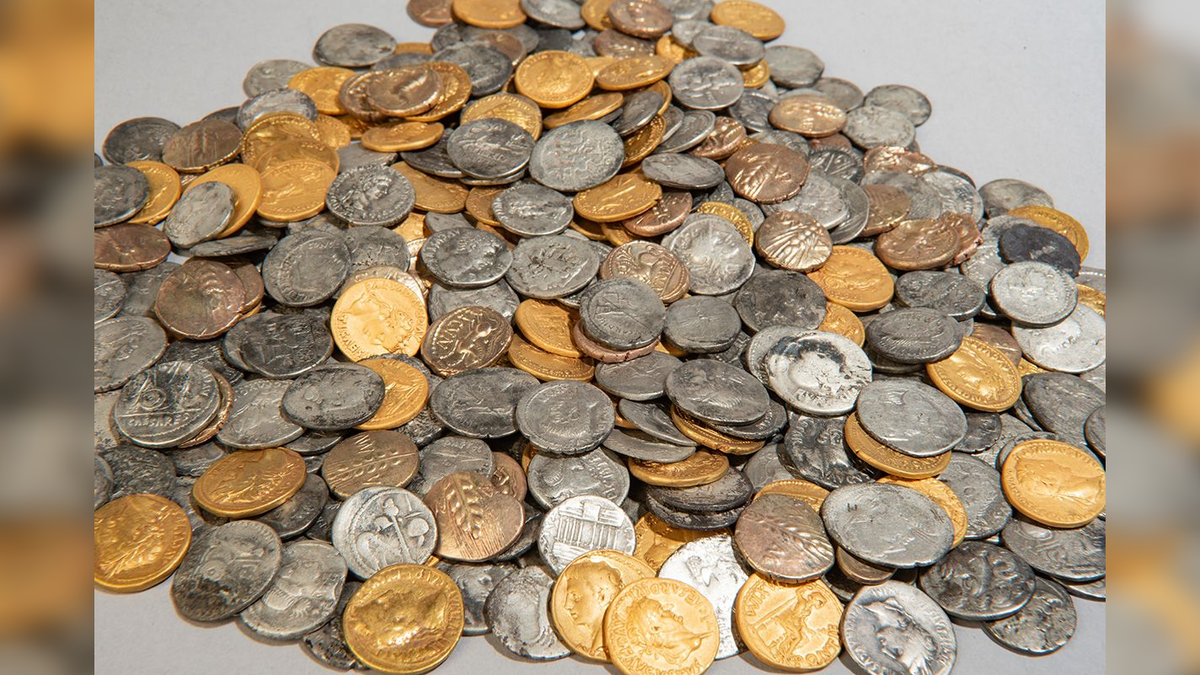
Two metal detectorists in the Netherlands have found a hoard of first-century gold and silver coins. The rare mix of Roman and British money features portraits of emperors and kings who ruled from Rome, England and Africa.

The 404 coins were discovered in the fall of 2023 in the town of Bunnik, about 24 miles (39 kilometers) southeast of Amsterdam. The hoard was purchased by the National Museum of Antiquities of the Netherlands, which recently placed them on display in an exhibition called “The Netherlands in Roman Times,” according to a translated statement published Monday (Jan. 27).

Many of the coins were minted between A.D. 46 and 47, during the reign of the Roman emperor Claudius. During this period, the northern limit of the Roman Empire was the Rhine River, where Roman troops were set up to fend off attacks from Germanic tribes and to launch forays into Great Britain.

Of the more than 400 coins, 116 were gold. These gold coins included 72 Roman aurei dating from 19 B.C. to A.D. 47, as well as 44 gold alloy coins, called staters, that were minted in Britain. The staters included the name of the Celtic king Cunobeline (known in Latin as “Cunobelinus”), who ruled from A.D. 9 to 42. The Roman historian Suetonius called Cunobelinus — whose name literally means “strong as a dog” in the Celtic language — the king of the Britons, and the Greek geographer Strabo wrote that Cunobelinus traded precious metals, grain and dogs with the Romans.

Also in the hoard were 288 silver coins, all struck between 200 B.C. and A.D. 47. One depicts Julius Caesar, and there is also a rare example of a coin with Juba, king of Numidia (present-day Algeria), on it.

Related: More than 1,300 coins buried during Roman emperor Nero’s reign found in England

Reverse and obverse of a gold-alloy coin; one side has a stalk of wheat with the letters CAM, and the other has a horse with the letters CVNO.

A first century gold alloy coin from Britain with CVNO (Cunobeline) on one side. (Image credit: National Museum of Antiquities of the Netherlands)

Dutch archaeologists who studied the coins and the spot of discovery think the hoard was likely buried in A.D. 47, according to the statement. A Roman soldier returning from Britain may have collected the Roman coins as his pay and the British coins as war booty. The soldier may have planned to dig the coins up later, or perhaps he buried them as an offering of gratitude to the gods who allowed him to return safely from battle.

Get the world’s most fascinating discoveries delivered straight to your inbox.

This coin hoard is the largest from the Roman period ever discovered in the Dutch province of Utrecht, according to the statement, as well as the first on the European mainland to have a mixed Romano-British composition.

The coins have been added to the National Museum of Antiquities’ National Archaeology Collection and are available for further research.

Source link

Share. Facebook Twitter Pinterest LinkedIn Tumblr Email
Previous ArticleHere’s what DeepSeek AI does better than OpenAI’s ChatGPT
Next Article Deepseek AI says ‘large-scale, malicious’ cyberattack is limiting registration
Editor
  • Website

Related Posts

Lifestyle

Safest Countries in South America Updated on 2024| GoVisaFree

March 31, 2026
Lifestyle

Scientists discover potentially huge freshwater reservoir hidden beneath Great Salt Lake

March 31, 2026
Lifestyle

A Definitive Guide to Moving to Seattle in 2024

March 31, 2026
Add A Comment

Comments are closed.

Categories
  • Entertainment
  • Lifestyle
  • News
  • Sports
  • Tech
  • Travel
Recent Posts
  • Assassin’s Creed Valhalla game cited in Minnesota murder lawsuit
  • Safest Countries in South America Updated on 2024| GoVisaFree
  • Wanda Sykes says comedians scared to tell certain jokes on stage, still should
  • Another 23 People Died “Without Fixed Abode” in OC in February, Continuing Downward Trend
  • Scientists discover potentially huge freshwater reservoir hidden beneath Great Salt Lake
calendar
March 2026
M T W T F S S
 1
2345678
9101112131415
16171819202122
23242526272829
3031  
« Feb    
Recent Posts
  • Assassin’s Creed Valhalla game cited in Minnesota murder lawsuit
  • Safest Countries in South America Updated on 2024| GoVisaFree
  • Wanda Sykes says comedians scared to tell certain jokes on stage, still should
About

Welcome to Baynard Media, your trusted source for a diverse range of news and insights. We are committed to delivering timely, reliable, and thought-provoking content that keeps you informed
and inspired

Categories
  • Entertainment
  • Lifestyle
  • News
  • Sports
  • Tech
  • Travel
Facebook X (Twitter) Pinterest WhatsApp
  • Contact Us
  • About Us
  • Privacy Policy
  • Disclaimer
  • UNSUBSCRIBE
© 2026 copyrights reserved

Type above and press Enter to search. Press Esc to cancel.