Close Menu
  • Home
  • UNSUBSCRIBE
  • News
  • Lifestyle
  • Tech
  • Entertainment
  • Sports
  • Travel
Facebook X (Twitter) WhatsApp
Trending
  • Actor Awards 2026: Nominations Full List
  • When Disability Rights Exist Only on Paper, A Tenant’s Fight With Corporate Housing in Orange County
  • The ‘sweet spot’ of overconfidence — project a bit to be perceived as competent, but don’t be ‘too seduced,’ a cognitive neuroscientist explains in a Q&A
  • Honor launches Magic V6 foldable phone, MagicPad 4, MagicBook Pro 14
  • Live Commentary – Fulham vs Spurs
  • Get a Close-Up of the Best Actors Awards Fashion Moments Ever
  • 2028 Democratic hopefuls slam Trump for Iran strikes
  • MWC 2026 live blog: Announcements from Honor, Xiaomi, more
Facebook X (Twitter) WhatsApp
Baynard Media
  • Home
  • UNSUBSCRIBE
  • News
  • Lifestyle
  • Tech
  • Entertainment
  • Sports
  • Travel
Baynard Media
Home»Lifestyle»New ‘quasi-moon’ discovered in Earth orbit may have been hiding there for decades
Lifestyle

New ‘quasi-moon’ discovered in Earth orbit may have been hiding there for decades

EditorBy EditorSeptember 12, 2025No Comments3 Mins Read
Share Facebook Twitter Pinterest LinkedIn Tumblr Reddit Telegram Email
Share
Facebook Twitter LinkedIn Pinterest Email

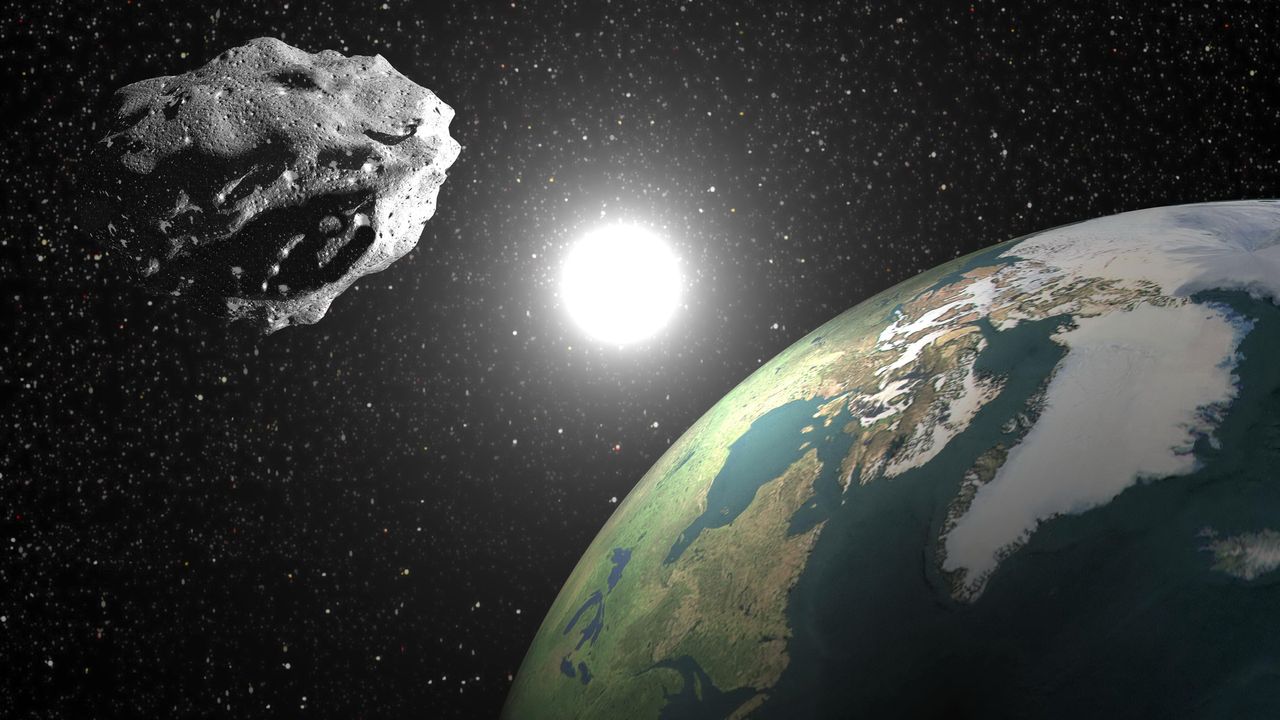
A new paper describes another possible “quasi-moon” of Earth, and the interloping asteroid may have been following our planet around for decades, undetected.

Quasi-moons, the Planetary Society states, are “like a gravitational sleight of hand.” They are asteroids, which — from our point of view on Earth — appear to be orbiting our planet like our permanent moon does. However, they actually orbit the sun, only temporarily moving through the solar system alongside our planet.

If the status of the newly detected asteroid, called 2025 PN7, is confirmed, it would not be the only object seemingly behaving as a moon of Earth; there are seven other known quasi-moons in Earth-like orbits, and they are “full of surprises,” said study co-author Carlos de la Fuente Marcos of the Complutense University of Madrid.


You may like

Of these quasi-moons, 2025 PN7 is the “smallest and the least stable known quasi-satellite of Earth,” de la Fuente Marcos told Live Science in an email.

The newly discovered asteroid is only 62 feet (19 meters) wide — slightly smaller than the meteor that exploded over Chelyabinsk, Russia, in 2013. The asteroid is officially classified as having a brightness of magnitude 26, meaning it is visible only through good telescopes. (The lower the magnitude, the brighter the object. For comparison, most naked-eye stars are magnitude 6 or lower, and the bright star Sirius is roughly magnitude -1.5.)

The potential quasi-moon finding was published Sept. 2 in the journal Research Notes of the American Astronomical Society (AAS). The journal, which is not peer-reviewed, aims to allow authors to “promptly” share items of interest with the astronomical community, with papers “moderated by an editor for appropriateness and format before publication” in lieu of peer review. That approach allowed study authors Carlos de la Fuente Marcos and Raúl de la Fuente Marcos, also of the Complutense University of Madrid, to publish their findings rapidly.

Related: First-ever image of China’s mysterious ‘quasi moon’ probe revealed weeks after it secretly launched into space

Get the world’s most fascinating discoveries delivered straight to your inbox.

An official Aug. 29 circular about 2025 PN7 from the International Astronomical Union shows data about the object dating back only to July 30, in observations by the Haleakalā Observatory’s Pan-STARRS1 telescope in Maui, Hawaii.

The quasi-moon designation was first proposed for 2025 PN7 by French journalist and amateur astronomer Adrien Coffinet, who posted Aug. 30 on the Minor Planet Mailing List about how his calculations appeared to show that was the case.

“2025 PN7 seems to be a quasi-satellite of the Earth for the next 60 years,” Coffinet wrote. Another in the group said it appears, from the object’s orbit, to have been flying nearby us already for about seven decades.

So, why didn’t astronomers notice 2025 PN7 before now? “It is small, faint, and its visibility windows from Earth are rather unfavorable, so it is not surprising that it went unnoticed for that long,” de la Fuente Marcos said.

More quasi-moons may be lurking out there. The Vera C. Rubin Observatory, which recently became operational and can scan for objects like this, “may uncover many more like 2025 PN7,” de la Fuente Marcos added.

Source link

Share. Facebook Twitter Pinterest LinkedIn Tumblr Email
Previous ArticleSeinfeld compares Free Palestine movement to KKK at Duke University event
Next Article Trump says Kirk suspect is in custody on Fox News
Editor
  • Website

Related Posts

Lifestyle

The ‘sweet spot’ of overconfidence — project a bit to be perceived as competent, but don’t be ‘too seduced,’ a cognitive neuroscientist explains in a Q&A

March 1, 2026
Lifestyle

NASA telescope spots first alien ‘astrosphere’ around a sun-like star: Space photo of the week

March 1, 2026
Lifestyle

Science history: Carbon-14 is discovered, opening a window into past civilizations — Feb. 27, 1940

March 1, 2026
Add A Comment

Comments are closed.

Categories
  • Entertainment
  • Lifestyle
  • News
  • Sports
  • Tech
  • Travel
Recent Posts
  • Actor Awards 2026: Nominations Full List
  • When Disability Rights Exist Only on Paper, A Tenant’s Fight With Corporate Housing in Orange County
  • The ‘sweet spot’ of overconfidence — project a bit to be perceived as competent, but don’t be ‘too seduced,’ a cognitive neuroscientist explains in a Q&A
  • Honor launches Magic V6 foldable phone, MagicPad 4, MagicBook Pro 14
  • Live Commentary – Fulham vs Spurs
calendar
March 2026
M T W T F S S
 1
2345678
9101112131415
16171819202122
23242526272829
3031  
« Feb    
Recent Posts
  • Actor Awards 2026: Nominations Full List
  • When Disability Rights Exist Only on Paper, A Tenant’s Fight With Corporate Housing in Orange County
  • The ‘sweet spot’ of overconfidence — project a bit to be perceived as competent, but don’t be ‘too seduced,’ a cognitive neuroscientist explains in a Q&A
About

Welcome to Baynard Media, your trusted source for a diverse range of news and insights. We are committed to delivering timely, reliable, and thought-provoking content that keeps you informed
and inspired

Categories
  • Entertainment
  • Lifestyle
  • News
  • Sports
  • Tech
  • Travel
Facebook X (Twitter) Pinterest WhatsApp
  • Contact Us
  • About Us
  • Privacy Policy
  • Disclaimer
  • UNSUBSCRIBE
© 2026 copyrights reserved

Type above and press Enter to search. Press Esc to cancel.