Close Menu
  • Home
  • UNSUBSCRIBE
  • News
  • Lifestyle
  • Tech
  • Entertainment
  • Sports
  • Travel
Facebook X (Twitter) WhatsApp
Trending
  • Luke Littler: Darts star makes copyright application to trademark his face and stop AI fakes | Darts News
  • Dave Grohl on Therapy After Affair, Baby Admission
  • Impersonating a police officer would be felony under proposed bill
  • Live Science Today: Monte Verde controversy and heatwave lashes the West
  • VCU stuns UNC with 19-point comeback win in overtime NCAA Tournament upset
  • BTS fans, youve got to see Googles trivia quest
  • Paul Merson: Liam Rosenior has to stop being so honest with Chelsea right up against it to qualify for Champions League | Football News
  • Josh Duggar on Joseph Duggar’s Arrest, Molestation Charges
Facebook X (Twitter) WhatsApp
Baynard Media
  • Home
  • UNSUBSCRIBE
  • News
  • Lifestyle
  • Tech
  • Entertainment
  • Sports
  • Travel
Baynard Media
Home»Lifestyle»Mysterious 160 million-year-old creature unearthed on Isle of Skye is part lizard, part snake
Lifestyle

Mysterious 160 million-year-old creature unearthed on Isle of Skye is part lizard, part snake

EditorBy EditorOctober 1, 2025No Comments4 Mins Read
Share Facebook Twitter Pinterest LinkedIn Tumblr Reddit Telegram Email
Share
Facebook Twitter LinkedIn Pinterest Email

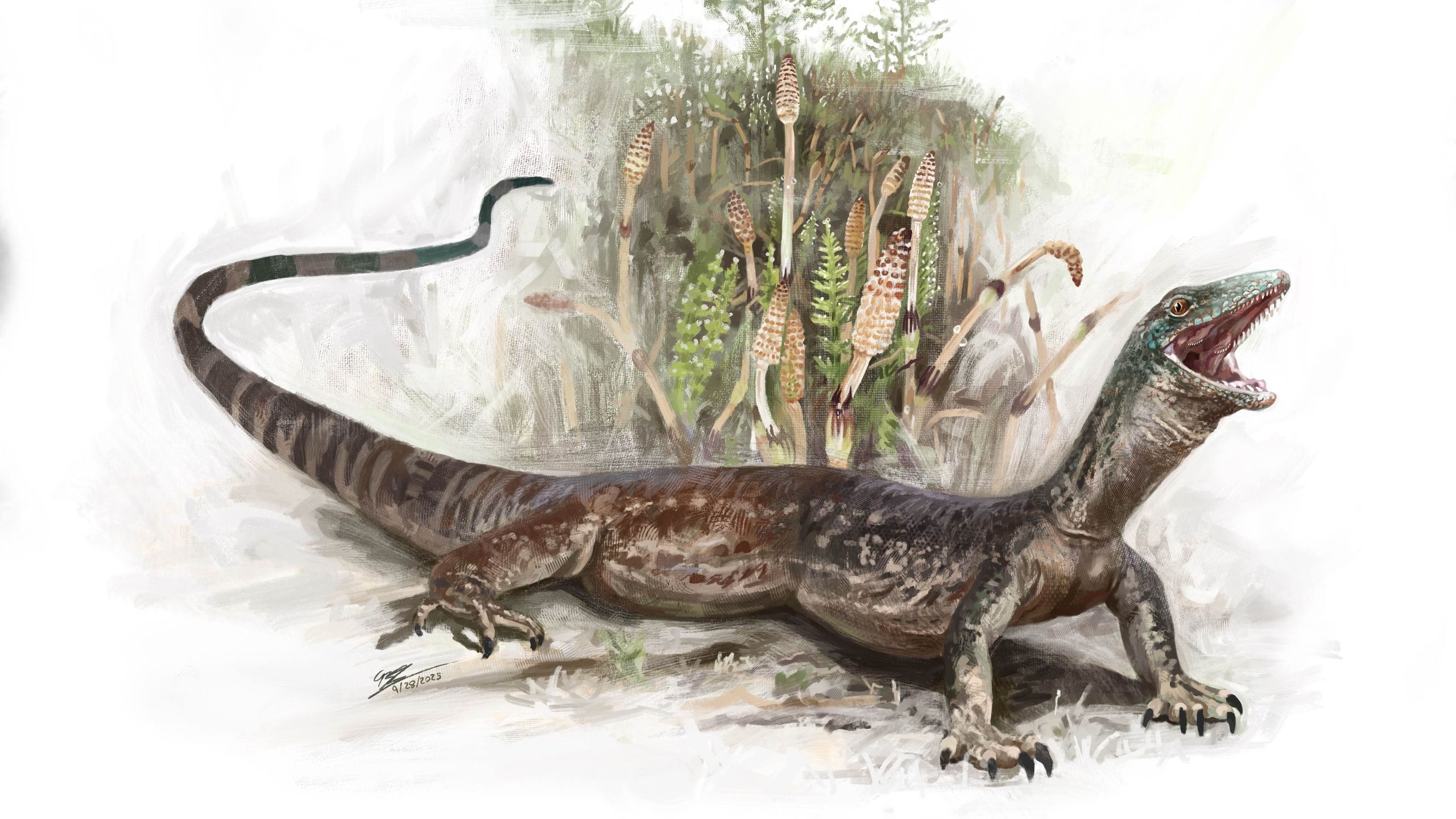
The fossilized skeleton of a Jurassic reptile that appears to be part lizard, part snake, has been unearthed on Scotland’s Isle of Skye.

This mysterious lizard had hooked, snake-like teeth for hunting down prey 167 million years ago, a new study has found.

The newly discovered species is named Breugnathair elgolensis, which means “false snake of Elgol,” honoring the creature’s confusing anatomy and the Elgol area of southern Skye, where the fossil was found, according to the study published Wednesday (Oct.1) in the journal Nature.


You may like

B. elgolensis was only about 16 inches (41 centimeters) long, but that still made it one of the largest lizards in its ecosystem, according to a statement released by the researchers. Scientists suspect that it hunted smaller lizards, early mammals and even young dinosaurs, such as small herbivorous heterodontosaurids and predatory bird-like paravians.

It had a snake-like jaw and curved teeth similar to a modern python, but its body was short, with fully formed limbs like a lizard. B. elgolensis also had gecko-like features on some of its bones, including the back of its skull. Researchers are still deciphering B. elgolensis‘ evolutionary history, but its discovery could change the way they look at early snake evolution.

Related: Night lizards survived dinosaur-killing asteroid strike, despite being close enough to see it happen

Scientists currently have a scattered understanding of early lizard and snake evolution. Both animals belong to a group called Squamata, which emerged about 190 million years ago. There’s some overlap between members of the group, but lizards came first and generally have four limbs, while snakes are limbless.

Get the world’s most fascinating discoveries delivered straight to your inbox.

“The Jurassic fossil deposits on the Isle of Skye are of world importance for our understanding of the early evolution of many living groups, including lizards, which were beginning their diversification at around this time,” study co-lead author Susan Evans, a professor of vertebrate morphology and paleontology at the University College London, said in the statement.

An illustration of Breugnathair elgolensis eating a small mammal whole like a snake.

Breugnathair elgolensis had teeth and teeth-bearing bones similar to a modern python. (Image credit: Mick Ellison/©AMNH)

Study co-author Stig Walsh, a senior curator of vertebrate paleobiology at the National Museums Scotland, first uncovered the B. elgolensis fossil in 2015. The team has since spent nearly a decade preparing and studying the specimen, which has included subjecting it to high-powered X-rays and detailed computed tomography (CT) imaging scans.

The researchers determined that B. elgolensis belonged to a Squamata sub-group called Parviraptoridae, which was previously only known from fragments of other fossils. While snake-like bones had been found in close proximity to gecko-like bones, some scientists had assumed they came from two separate animals. The new fossil confirms that one species did indeed have both features, according to the statement.

“I first described parviraptorids some 30 years ago based on more fragmentary material, so it’s a bit like finding the top of the jigsaw box many years after you puzzled out the original picture from a handful of pieces,” Evans said. “The mosaic of primitive and specialized features we find in parviraptorids, as demonstrated by this new specimen, is an important reminder that evolutionary paths can be unpredictable.”

The researchers still aren’t sure whether snakes evolved from species like B. elgolensis or whether snakes independently evolved similar mouth parts. It’s also possible that B. elgolensis is a stem lineage within Squamata, helping to give rise to all lizards and snakes.

“This fossil gets us quite far, but it doesn’t get us all of the way,” study lead author Roger Benson, the Macaulay Curator at the American Museum of Natural History’s Division of Paleontology, said in the statement. “However, it makes us even more excited about the possibility of figuring out where snakes come from.”

Source link

Share. Facebook Twitter Pinterest LinkedIn Tumblr Email
Previous ArticleJimmy Kimmel, Stephen Colbert call Trump ‘son of a b—h’ on ‘Late Show’
Next Article New York City apartment building partially collapses, ripping massive hole in Bronx high rise
Editor
  • Website

Related Posts

Lifestyle

Live Science Today: Monte Verde controversy and heatwave lashes the West

March 20, 2026
Lifestyle

Scientists witness birth of one of the universe’s strongest magnets for the first time, thanks to a general relativity ‘magic trick’

March 20, 2026
Lifestyle

‘Dark oxygen’ discovery on the seafloor is ‘fundamentally at odds with thermodynamics’ and should be retracted, experts say

March 20, 2026
Add A Comment

Comments are closed.

Categories
  • Entertainment
  • Lifestyle
  • News
  • Sports
  • Tech
  • Travel
Recent Posts
  • Luke Littler: Darts star makes copyright application to trademark his face and stop AI fakes | Darts News
  • Dave Grohl on Therapy After Affair, Baby Admission
  • Impersonating a police officer would be felony under proposed bill
  • Live Science Today: Monte Verde controversy and heatwave lashes the West
  • VCU stuns UNC with 19-point comeback win in overtime NCAA Tournament upset
calendar
March 2026
M T W T F S S
 1
2345678
9101112131415
16171819202122
23242526272829
3031  
« Feb    
Recent Posts
  • Luke Littler: Darts star makes copyright application to trademark his face and stop AI fakes | Darts News
  • Dave Grohl on Therapy After Affair, Baby Admission
  • Impersonating a police officer would be felony under proposed bill
About

Welcome to Baynard Media, your trusted source for a diverse range of news and insights. We are committed to delivering timely, reliable, and thought-provoking content that keeps you informed
and inspired

Categories
  • Entertainment
  • Lifestyle
  • News
  • Sports
  • Tech
  • Travel
Facebook X (Twitter) Pinterest WhatsApp
  • Contact Us
  • About Us
  • Privacy Policy
  • Disclaimer
  • UNSUBSCRIBE
© 2026 copyrights reserved

Type above and press Enter to search. Press Esc to cancel.