
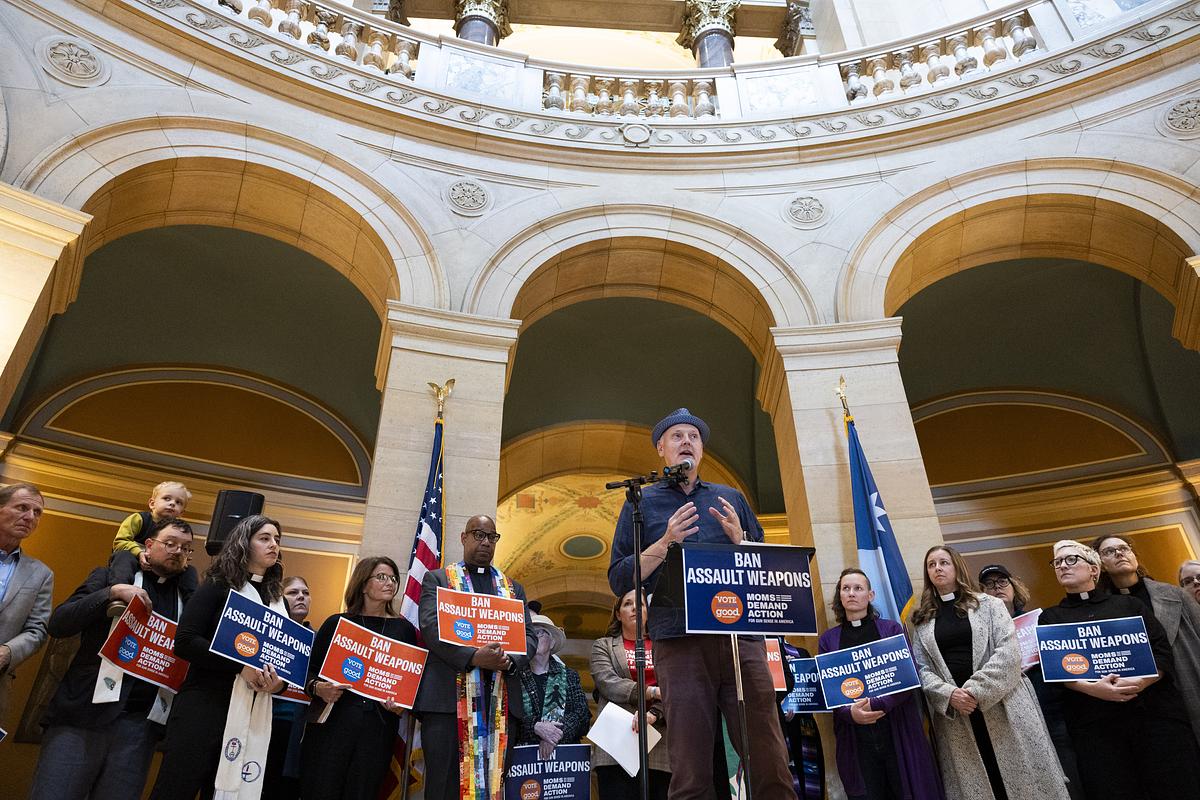
The Minnesota Legislature is not on track to ban semiautomatic assault weapons this legislative session.
However.
The Senate could take a floor vote on an assault weapons ban that has been the focus of a relentless public advocacy campaign since Robin Westman used an assault rifle (and two other guns) in August to kill two children and injure 28 more people at a Minneapolis Catholic school.
And that vote would come in an election year when, according to one recent poll, 69% of Minnesotans support a ban on the sale and possession of assault rifles.
The Senate Judiciary Committee on Friday passed 6-3 a bill written by Sen. Zaynab Mohamed, DFL-Minneapolis, to ban an array of gun types that are classified as assault weapons because they fire a large amount of bullets in a matter of seconds.
Mohamed’s measure also bans large-capacity magazines that allow someone to fire 10 or more bullets before reloading.
It was a party-line vote and the six DFLers included Sen. Judy Seeberger of Afton, one of three Democrats skeptical of an assault weapons ban when the party controlled the House and Senate in 2023.
Later in the hearing, Seeberger said that she had carried a weapon to the Capitol following the death of two Minneapolis residents at the hands of immigration agents, and that she would oppose banning guns at the Capitol.
“I do not feel safe against a tyrannical government,” Seeberger said.
(A measure to ban guns at the Capitol was “laid over,” which means you will never hear about it again unless it makes a 1,400-page omnibus bill two months from now.)
Also, Seeberger still had issues with barring high-capacity magazines and felt that the gun control debate is needlessly “politicized by both parties.”
Nonetheless, “I’ll be a ‘yes’ on the bill because we must do something,” Seeberger said, adding that she will keep working with Mohamed “in order to improve this bill.”
The measure moves to the Senate Finance Committee, which is chaired by John Marty, DFL-Roseville, a prolific proponent of stricter gun laws.
Then, the full Senate, which the DFL controls by one vote, is likely to take it up. Ron Latz, chair of the Judiciary Committee, said in an interview after the hearing that he expects Senate floor votes on the assault weapons and high-capacity magazine ban this session.
Mohamed’s bill was one of 17 (!) measures the Judiciary Committee considered at a hearing that sorted through nearly all the legislative proposals bandied since the Annunciation Catholic School shooting.
What to know about the daylong affair.
The assault weapons ban has legs as a campaign talking point, if not a 2026 statute
Early in the hearing, Mike Moyski called for two minutes of silence for the shooting victims at Annunciation, which included Moyski’s 10-year-old daughter, Harper Moyski.
Just about everyone in the Senate Building hearing room not only complied but stopped typing on their phones and computer, creating an extraordinary moment of meditative stillness.
Moyski then articulated arguments that Annunciation parents and allied groups like Moms Demand Action have made since August.
“Different weapons produce different outcomes,” Moyski said. “The weapon used at Annunciation allowed a single person to turn a church into a mass casualty scene in minutes.”
Moyski was one of over 100 members of the public that provided written testimony for the hearing. While Friday’s meeting was not nearly as packed as a similar House panel last month, it drew the familiar crowd of gun control advocates and a much smaller group of opponents to the assault weapons ban.
The Senate has a one-vote DFL majority. It is conceivable that an assault weapons ban could pass the upper chamber on a strict party line vote. Besides Seeberger, the potential DFL opponents are Grant Hauschild of Hermantown and Rob Kupec of Moorhead.
Hauschild texted Friday that he is “still looking” at the bill. Kupec did not respond to messages.
Another route would be a couple of suburban Republicans in support. According to a poll by research firm Lumaris, 79% of suburbanites surveyed support a ban on assault weapons.
But the lone suburban Judiciary Committee Republican up for election, Michael Kreun of Blaine, did not indicate he was wavering at the assault weapons ban.
These machinations, of course, come with the House split between Republicans and DFLers, which likely dooms an assault weapons ban.
House DFL Leader Zack Stephenson told reporters Thursday that no progress has been made in negotiations with Republicans on gun laws.
A few smaller measures could become law
The Judiciary Committee advanced Republican proposals, including a bill by retiring lawmaker Warren Limmer of Maple Grove to expand the state’s gun storage law.
Currently, the law makes it a crime for a person to store a firearm children could access. Limmer would expand the measure to criminalize placing a gun where someone who is prohibited from accessing firearms could access it.
And a measure by Rich Draheim, R-Madison Lake, would add $1 million for the state to hire eight school safety specialists.
Less clear is the fate of numerous measures that passed by voice vote, but had Republican opposition.
One such bill would let cities ban guns at city-owned facilities, a measure supported by the League of Minnesota Cities, which represents municipalities across the state.
Minneapolis Mayor Jacob Frey testified that “at almost any given moment there are perhaps multiple investigations about death threats against me,” yet the state does not give Minneapolis the power to ban guns at city hall.
The bill letting cities ban guns on municipal land was sent to the State and Local Government Committee.
