Close Menu
  • Home
  • UNSUBSCRIBE
  • News
  • Lifestyle
  • Tech
  • Entertainment
  • Sports
  • Travel
Facebook X (Twitter) WhatsApp
Trending
  • The life of a North Korean worker in Russia
  • Massive Iron Age hoards discovered in England may be from funeral of powerful Celtic queen
  • Democrats win Florida special election, flip GOP-held seat in Trump’s home turf
  • MN residents opposed to data centers take their fight to legislators
  • Drought could fuel the rise of antibiotic-resistant superbugs as climate change worsens, new research suggests
  • ICE sidesteps NY sanctuary law to nab illegal immigrant accused of raping girl
  • iPhone exploit DarkSword has been released in the wild
  • The U.S. router ban: Everything you need to know
Facebook X (Twitter) WhatsApp
Baynard Media
  • Home
  • UNSUBSCRIBE
  • News
  • Lifestyle
  • Tech
  • Entertainment
  • Sports
  • Travel
Baynard Media
Home»Lifestyle»Massive Iron Age hoards discovered in England may be from funeral of powerful Celtic queen
Lifestyle

Massive Iron Age hoards discovered in England may be from funeral of powerful Celtic queen

EditorBy EditorMarch 25, 2026No Comments5 Mins Read
Share Facebook Twitter Pinterest LinkedIn Tumblr Reddit Telegram Email
Share
Facebook Twitter LinkedIn Pinterest Email

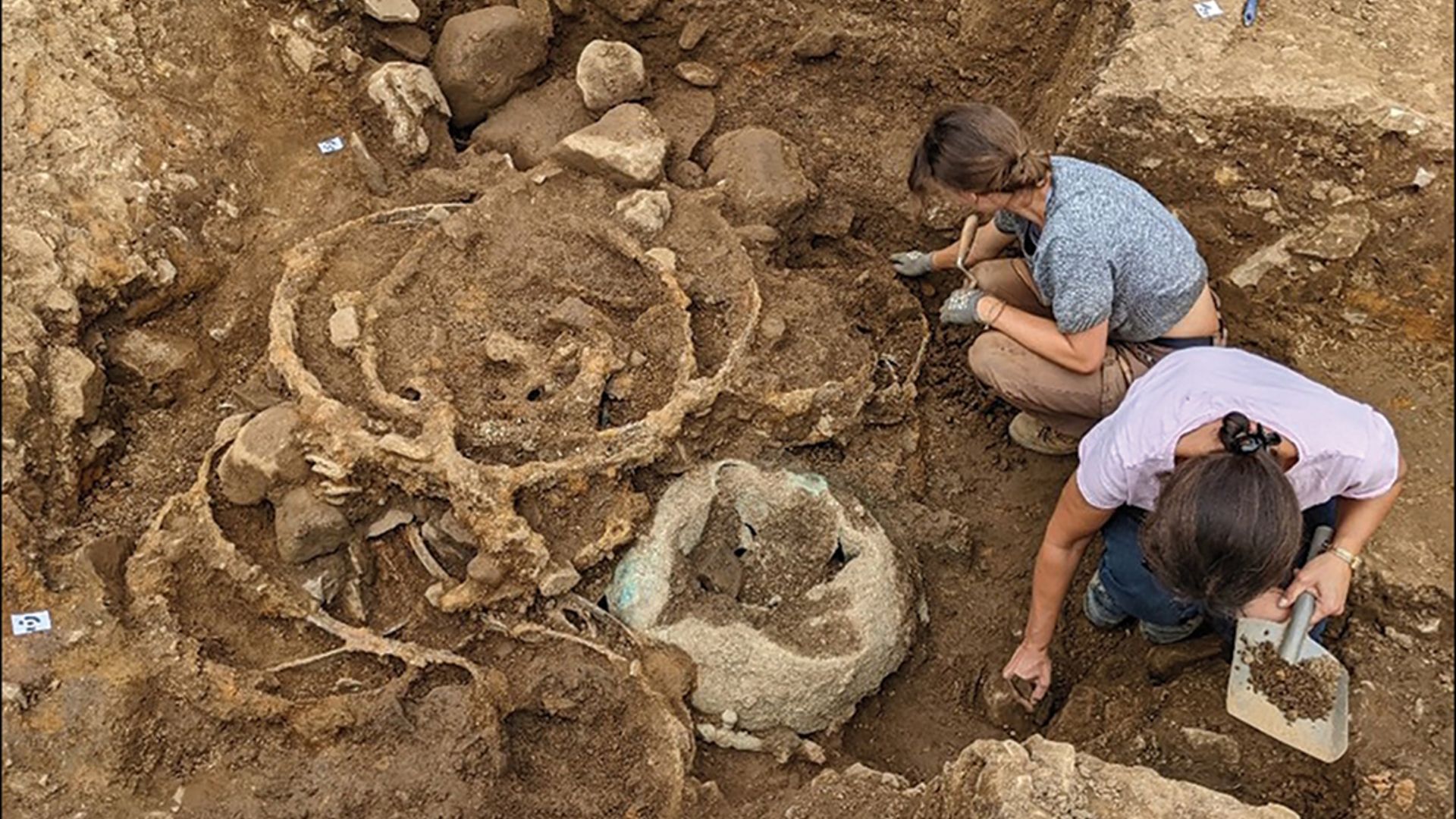
Two massive Iron Age hoards of burned metal weapons, vessels, and chariots or carts, found in the north of England, may have been part of a royal funeral, possibly for a queen, archaeologists say.

A metal detectorist found the hoards in 2021 near the village of Melsonby in Yorkshire and alerted archaeologists. Excavators discovered two separate deposits with a total of more than 950 artifacts, including iron “tires” for wooden wheels, a cauldron, an ornate wine-mixing bowl and ceremonial spearheads.

Together, the two deposits represent one of the largest Iron Age hoards ever found in Britain. Now, a new study, published March 17 in the journal Antiquity, suggests the hoards may have been used in the funeral of an Iron Age leader, before being deliberately burned, damaged and buried.

Article continues below


You may like

“It is clear that Melsonby was not a burial [because] we have no evidence of a body,” study co-author Tom Moore, an archaeologist at Durham University in the U.K., told Live Science in an email. “So our question is — why deposit this material?”

Moore and his colleagues think the size of the Melsonby hoards and the large number of expensive artifacts indicate they were part of an elite funeral held by the Brigantes, a powerful tribe of Iron Age Britons of mainly Celtic origin.

The Brigantes ruled the nearby Stanwick royal site, a few hundred feet away from the location where the hoards were found. At that time, Stanwick was a fortified village that the Romans called an “oppidum“; they were typically built by Celts on hilltops or other defensive areas.

Burnt artifacts

Moore said burning or destroying objects had been a key practice in many prehistoric funerals.

Get the world’s most fascinating discoveries delivered straight to your inbox.

“Much of the material … was burnt to high temperatures — enough to melt copper alloy and silver,” he said. “At this time, cremation was becoming a popular funerary rite for elites in parts of Britain.” No signs of a burial had been found nearby, but the remains could have been buried elsewhere.

The exact reason for the hoards’ burials, however, may never be known. “There are several possibilities for that event,” Moore said, “but a funeral of an important leader seems one of the most likely.”

The researchers used radiocarbon dating to determine that the artifacts originated in the first century B.C., while their style and decorations, including coral from the Mediterranean Sea, indicate that the elites at Stanwick had connections with the European mainland.


What to read next

Two images labeled a and b next to each other show teal-colored artifacts covered in dirt sitting in the middle of an excavation site

Other objects in the largest of the two hoards included this bronze vessel decorated with faces, which is thought to have been a bowl for mixing wine and water. (Image credit: Alexander Jansen/Durham University)

The Brigantes were allies of the Romans after their conquest of much of Britain after A.D. 43. Roman sources after A.D. 69 said the Brigantes were then ruled by a queen named Cartimandua, a “client ruler” and ally.

But the researchers think the hoards date to several generations before that and may have been used in a funeral for one of Cartimandua’s royal ancestors. (Royal power among the Brigantes seems to have passed from mother to daughter, so it is likely that some of Cartimandua’s ancestors were also ruling queens.)

Four-wheeled carts

A key discovery was that the Melsonby hoards contained several strange, U-shaped iron brackets, which have been found in continental Europe but not in Britain. The brackets have now been identified as parts of four-wheeled carts, which the Iron Age Britons used alongside their two-wheeled chariots, according to the study authors. This indicates the Britons had connections with other Celtic groups on the European continent.

A close up of two brown U-shaped brackets against a black surface with a mm ruler bar in the bottom right corner

The Melsonby hoards contained several U-shaped iron brackets, which the researchers think were parts for four-wheeled carts. (Image credit: Alexander Jansen/Durham University)

“The fact that we have elements which can only be ascribed to such vehicles … is a first for Britain,” Moore said. “Why we have never found them before is a mystery.”

Melanie Giles, an archaeologist at the University of Manchester who wasn’t involved in the Melsonby study but is excavating a chariot funeral from about the same time in Wales, said the chariot in Wales and the artifacts in the Melsonby hoards have several things in common. For one, “They’re sharing the same style of Celtic art,” Giles said.

In both cases, the Celtic motifs seemed to have been exaggerated, which may have been a sign of Celtic opposition to Roman expansion on the European continent, Giles proposed. “Some people think this is a kind of resistance to the Romans,” she said. “It’s people celebrating their Celtic art and being a bit more ‘in your face’ about it.”

Adams, S., Armstrong, J., Bayliss, A., Moore, T., & Williams, E. (2026). Vehicles of change: two exceptional deposits of destroyed chariots or wagons from Late Iron Age Britain. Antiquity, 1–21. https://doi.org/10.15184/aqy.2026.10311


Celtic quiz: Test your knowledge about these fierce tribes once described by Julius Caesar

Source link

Share. Facebook Twitter Pinterest LinkedIn Tumblr Email
Previous ArticleDemocrats win Florida special election, flip GOP-held seat in Trump’s home turf
Next Article The life of a North Korean worker in Russia
Editor
  • Website

Related Posts

Lifestyle

Drought could fuel the rise of antibiotic-resistant superbugs as climate change worsens, new research suggests

March 24, 2026
Lifestyle

Cannonball-size meteorite crashes through roof of Texas home as multiple ‘fireballs’ rain down on the US

March 24, 2026
Lifestyle

A rare active volcano on Mars may be causing the whole planet to spin faster

March 24, 2026
Add A Comment

Comments are closed.

Categories
  • Entertainment
  • Lifestyle
  • News
  • Sports
  • Tech
  • Travel
Recent Posts
  • The life of a North Korean worker in Russia
  • Massive Iron Age hoards discovered in England may be from funeral of powerful Celtic queen
  • Democrats win Florida special election, flip GOP-held seat in Trump’s home turf
  • MN residents opposed to data centers take their fight to legislators
  • Drought could fuel the rise of antibiotic-resistant superbugs as climate change worsens, new research suggests
calendar
March 2026
M T W T F S S
 1
2345678
9101112131415
16171819202122
23242526272829
3031  
« Feb    
Recent Posts
  • The life of a North Korean worker in Russia
  • Massive Iron Age hoards discovered in England may be from funeral of powerful Celtic queen
  • Democrats win Florida special election, flip GOP-held seat in Trump’s home turf
About

Welcome to Baynard Media, your trusted source for a diverse range of news and insights. We are committed to delivering timely, reliable, and thought-provoking content that keeps you informed
and inspired

Categories
  • Entertainment
  • Lifestyle
  • News
  • Sports
  • Tech
  • Travel
Facebook X (Twitter) Pinterest WhatsApp
  • Contact Us
  • About Us
  • Privacy Policy
  • Disclaimer
  • UNSUBSCRIBE
© 2026 copyrights reserved

Type above and press Enter to search. Press Esc to cancel.