
Refresh
That’s all, folks!
NASA sets date to share 3I/ATLAS images

Earthlings eager to see NASA’s newest images of the interstellar comet 3I/ATLAS will have to wait a few more days. The space agency just announced a live image viewing event scheduled for Wednesday (Nov. 19) at 3 p.m. EST.
During the event, NASA will share never-before-seen images of the interstellar comet taken during its close approach to Mars in early October. The U.S. government shutdown, which lasted from Oct. 1 to Nov. 12, prevented the agency from releasing these images until now.
Space and physics editor Brandon Specktor shared the details on how to watch, and why it matters, in his full story here.
Woman versus goose

A 12,000-year-old clay figurine unearthed in Israel may depict a goose attempting to mate with a squatting woman, archaeologists say.
Staff writer Kristina Killgrove reported on the unusual figurine, which may be the oldest representation of an animal and a human interacting.
But why did the sculptor depict this event, and what does it say about the Natufians, the ancient culture that crafted the object? You can read the full story here.
Dementia more deadly than heart disease?

Dementia is now more deadly than heart disease — at least in Australia. The new trend reflects dramatic improvements in health care which mean people live longer in general, Lauren Moran, the head of mortality statistics at the Australian Bureau of Statistics, told the Australian Broadcasting Corporation.
“People are now more likely to live to an age where they have a higher risk of developing dementia,” Moran said.
Whether Australia is a harbinger for the rest of the world remains to be seen. In the U.S., for instance, heart disease remains the top killer, closely followed by cancer. Alzheimer’s disease is the sixth-leading cause of death, per the Centers for Disease Control and Prevention.
Dueling climate change impacts
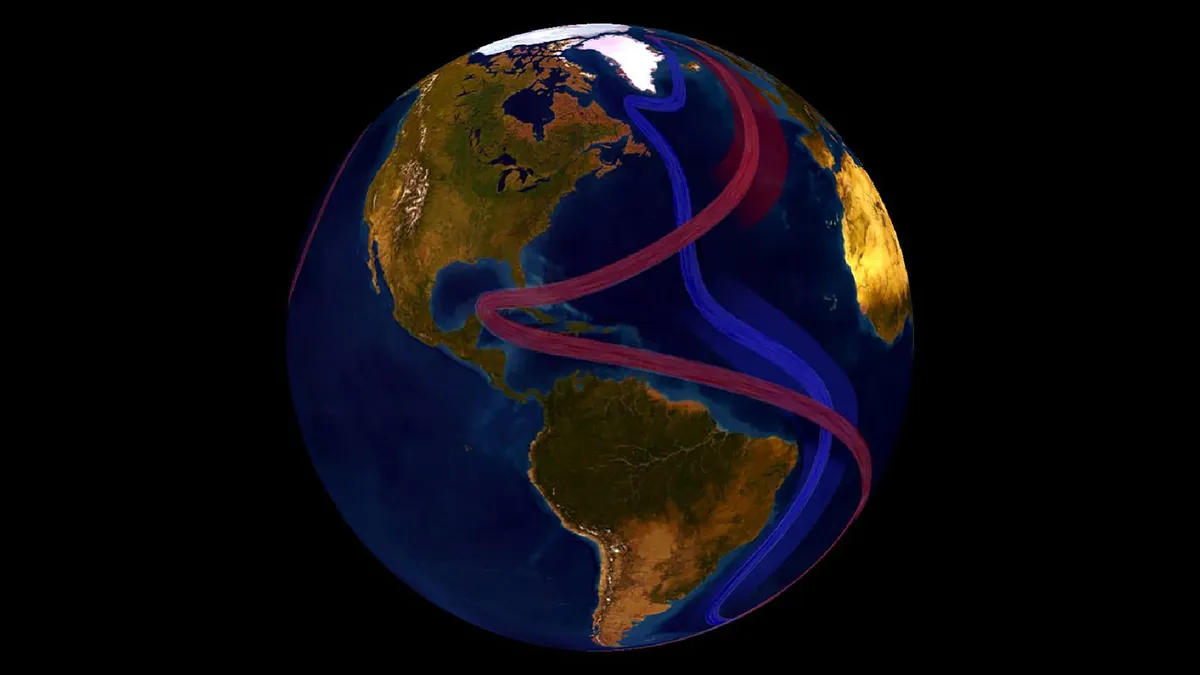
Meanwhile, climate change is also fueling the rapid melt of Antarctic ice.
Yet the melting of the West Antarctic ice sheet, which some climate scientists say is “all but inevitable” could have a surprising side effect — staving off the AMOC collapse, New Scientist reports.
Still, the ice sheet melting would be catastrophic for sea levels, and the AMOC would still decline by 60% and take 3,000 years to bounce back to its previous strength, according to new research.

Tia Ghose
Three more Chinese astronauts stranded

Three more astronauts are stranded in China’s Tiangong station following the return of their previously stuck colleagues, Senior Staff Writer Harry reports.
The latest trio — Zhang Lu, Wu Fei and Zhang Hongzhang — are the crew of the Shenzhou-21 mission, whose return capsule was taken home by the Shenzhou-20 crew following a potential space debris collision that rendered their original capsule inoperable.
The development could highlight a potential flaw in China’s space protocols that could put astronauts needlessly at risk.
You can read the full story here.
That’s all for today folks
We’re signing off from the U.K. side now. We’ll hand you over to our U.S. colleagues now for updates from Live Science, science across the web, and maybe even NASA if they choose to drop comet images while we’re off the clock. See you all tomorrow!
3I/ATLAS’s trajectory narrowed down ten-fold

Since its initial discovery in July, astronomers have answered many questions about what 3I/ATLAS is made of and where it could have come from in our galaxy. Yet, due to insufficient observations, where it’s heading hasn’t been entirely clear.
Now, thanks to data collected by the European Space Agency’s (ESA) ExoMars Trace Gas Orbiter during the comet’s flyby of the Red Planet, scientists have improved their estimates of 3I/ATLAS’s trajectory ten-fold.
The ESA is hoping to repeat the trick with its Jupiter Icy Moons Explorer (JUICE), which will get a good look at 3I/ATLAS later this month.
You can read Harry’s full story here.
Why are astronomers interested in 3I/ATLAS?
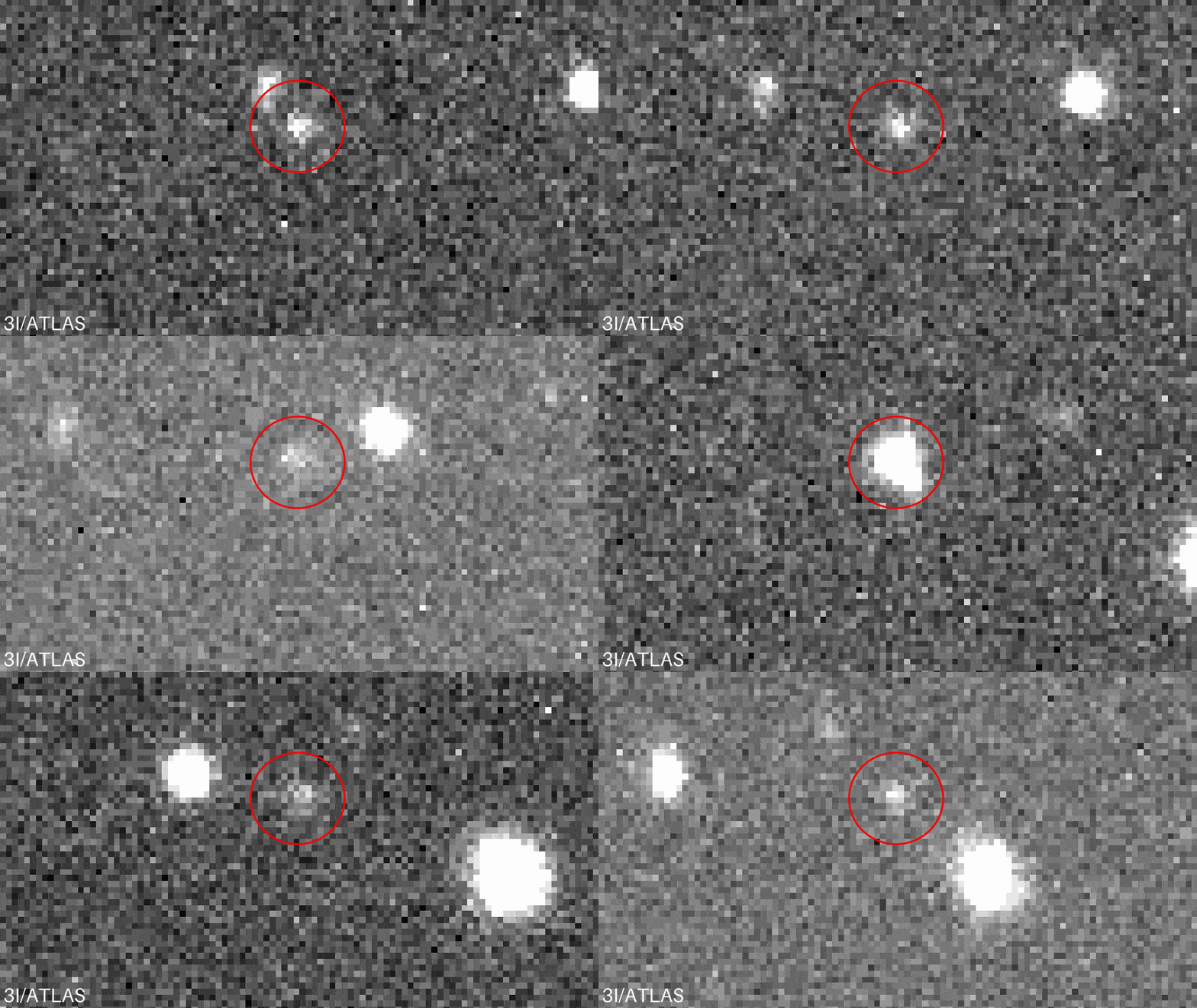
While it is indeed an interstellar visitor from beyond our solar system, most astronomers are confident that 3I/ATLAS is just a normal comet.
Well, normal in the sense that it’s natural. 3I/ATLAS is actually pretty amazing as comets go, being the oldest ever seen and the most massive of its kind, not to mention only the third interstellar object ever recorded.
This means that researchers will carefully study new images of the comet for clues to its makeup, origins, and a better understanding of the journey it took to arrive at our cosmic backyard.
Comets heat up as they fly closer to stars, causing ice on their surface to sublimate into gas, which researchers can then detect and study. Previous observations have already revealed that comet 3I/ATLAS appears to be unusually rich in carbon dioxide, with potentially a thick irradiated crust from billions of years of exposure to cosmic rays.
The comet’s irradiated nature could make it more difficult to decipher the properties of its material that would otherwise reveal more about the conditions of its home star system. Still, researchers still have a lot to learn about interstellar comets, and just having more data on this one is as good a start as any.
Other images taken by HiRISE

HiRise has imaged vast areas of the Martian landscape in unprecedented detail, according to NASA. Check out the HiRise website, hosted by The University of Arizona, to scroll through hundreds of previous HiRise images.
What is HiRISE?

The as-of-yet unreleased comet 3I/ATLAS images were taken by the High Resolution Imaging Science Experiment (HiRISE) aboard NASA’s Mars Reconnaissance Orbiter. The orbiter has been flying around Mars since 2006, searching for signs of water on the Red Planet. The HiRISE camera managed to get images of comet 3I/ATLAS as it zoomed past Mars in early October.
The images are expected to be the highest-resolution images of comet 3I/ATLAS yet, and even clearer than the Hubble Space Telescope’s comet snaps taken in July, the New York Post has reported.
Here’s a selection of some of our 3I/ATLAS stories so far

Patrick Pester
Everything you need to know about 3I/ATLAS

So what is 3I/ATLAS? And why do people care?
3I/ATLAS, which was first discovered in early July, is the third interstellar object ever found in our solar system. That means it doesn’t come from our cosmic neighbourhood, but from somewhere else in our Milky Way galaxy.
Where exactly in our galaxy the comet came from is unclear — scientists aren’t sure whether it came from the Milky Way’s ‘thin’ disk or its ‘thick’ disk — but depending on its origins it could be more than 7 billion years old, making it more than 3 billion years older than our sun. Tracing 3I/ATLAS’s origins is made even more challenging by its material, which has been transformed by billions of years of exposure to cosmic rays.
Telescope observations suggest the comet is roughly 7-mile-wide (11 kilometers) and zooming at more than 130,000 mph (210,000 km/h). Having passed perihelion, or the closest point to our sun, roughly two weeks ago, 3I/ATLAS is now zipping toward its closest point to Earth on Dec. 19.
The exotic comet has many peculiar properties, from its chemical composition to its large size. This, alongside radio signals coming from it that are typical of all comets, has fuelled a frenzy of speculation that the 3I/ATLAS is an alien probe.
That’s almost certainly not the case, but it doesn’t mean that astronomers aren’t excited to study it. Investigating the comet could yield fresh insights into the conditions around other stars, our early galaxy, and the vast frontier of interstellar space.
NASA set to share best images of comet 3I/ATLAS yet
Good morning, science fans. We’re back with more updates on the comet 3I/ATLAS. Following the end of the U.S. government shutdown, we’re seeing reports that NASA is set to release some of the best-quality images yet of the comet.
The images were taken by the HiRISE camera aboard NASA’s Mars Reconnaissance Orbiter, and could have significantly better resolution than those by the Hubble Space Telescope on July 21, 2025.
We’re getting to work on what all of this could mean for the rapidly-brightened comet, which is roughly 7-miles (11 kilometers) wide, more than 7 billion years old, and traveling at 130,000 mph (210,000 km/h) as it sheds its highly-irradiated coma across our solar system.
That’s more like it! Marvelous new image of interstellar Comet 3I/ATLAS, taken by photographer Satoru Murata before dawn this morning, captures intricate structure in its tail(s). On the right you can also see galaxy NGC 4691. https://t.co/7rP3S4ysa5 pic.twitter.com/KrjhOSCgLcNovember 16, 2025

Ben Turner