Close Menu
  • Home
  • UNSUBSCRIBE
  • News
  • Lifestyle
  • Tech
  • Entertainment
  • Sports
  • Travel
Facebook X (Twitter) WhatsApp
Trending
  • George Kittle’s wife shares live reaction to Achilles injury
  • ‘The scientific cost would be severe’: A Trump Greenland takeover would put climate research at risk
  • Headlines Across OC as Angel Stadium Sale Debate Intensifies
  • Anti-Islam activists clash with pro-Muslim counter-protesters in Dearborn, Michigan
  • Best monitor deal: Get the 45-inch LG Ultragear gaming monitor for its lowest price yet
  • Slovakia U21 0 – 4 England U21
  • 13 Top Sleep Products That Transform Your Bedtime Routine for Better Rest
  • Firefighters rescue puppies from burning house
Facebook X (Twitter) WhatsApp
Baynard Media
  • Home
  • UNSUBSCRIBE
  • News
  • Lifestyle
  • Tech
  • Entertainment
  • Sports
  • Travel
Baynard Media
Home»Lifestyle»James Webb telescope spies stunning ‘Firefly Sparkle’ galaxy — a baby clone of the Milky Way being ‘assembled brick by brick’ in the early universe
Lifestyle

James Webb telescope spies stunning ‘Firefly Sparkle’ galaxy — a baby clone of the Milky Way being ‘assembled brick by brick’ in the early universe

EditorBy EditorDecember 19, 2024No Comments4 Mins Read
Share Facebook Twitter Pinterest LinkedIn Tumblr Reddit Telegram Email
Share
Facebook Twitter LinkedIn Pinterest Email

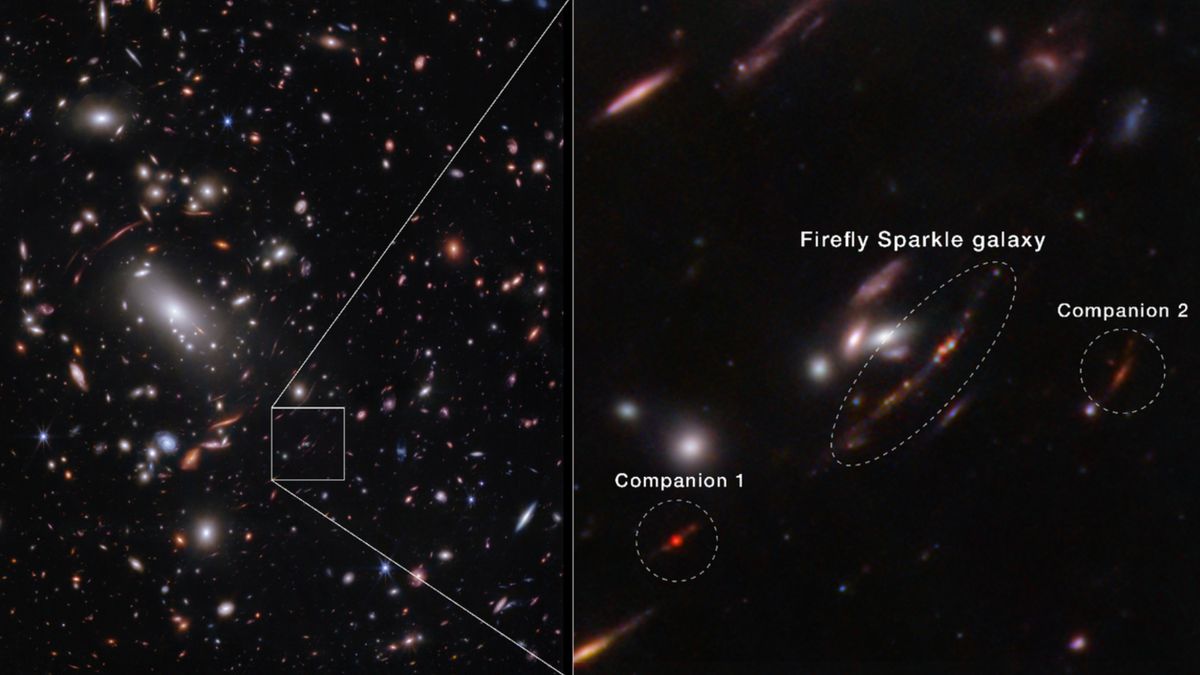
For the first time, astronomers have spotted and “weighed” a baby Milky Way-like galaxy lurking in the early universe, using incredibly detailed images from the James Webb Space Telescope (JWST). The researchers discovered the galaxy, named “Firefly Sparkle” because the dots in it resemble the glowing insects, thanks to a quirky space-time phenomenon predicted by Albert Einstein.

The light coming from Firefly Sparkle dates to around 600 million years after the Big Bang, which occured around 13.8 billion years ago. The young galaxy was spotted thanks to JWST’s unmatched power to resolve fine details, coupled with “gravitational lensing.”

First predicted by Einstein’s theory of general relativity in 1915, gravitational lensing occurs because light is warped as it passes by massive objects. In this case, the phenomenon also magnified the light from the distant object, enabling JWST to detect the far-flung galaxy — although the image is warped.

This effect means the JWST sees the galaxy stretched out into a line with multiple firefly-like bright spots, which enabled the researchers to accurately measure the individual components of the galaxy and create a detailed picture of it.

In a new study, published Dec. 11 in the journal Nature, researchers revealed that unlike some of the other galaxies JWST has spotted in the early universe, which are so huge they threaten to break cosmology, Firefly Sparkle is much less massive and dense. It likely resembles what the Milky Way looked like at a similar age and could reveal how our own galaxy evolved, the study authors noted.

Related: 42 jaw-dropping James Webb Space Telescope images

A wide-field view of galaxies and stars that have been gravitationally lensed

The MACS J1423 cluster has been gravitationally lensed by a central massive galaxy, allowing researchers to spot the Firefly Sparkle (circled). (Image credit: NASA, ESA, CSA, STScI, Chris Willott (National Research Council Canada), Lamiya Mowla (Wellesley College), Kartheik Iyer (Columbia University))

“Most of the other galaxies Webb has shown us aren’t magnified or stretched, and we are not able to see their ‘building blocks’ separately,” study lead author Lamiya Mowla, an astronomer at Wellesley College in Massachusetts, said in a NASA statement. “With Firefly Sparkle, we are witnessing a galaxy being assembled brick by brick.”

Get the world’s most fascinating discoveries delivered straight to your inbox.

Galactic evolution

The research team identified at least 10 individual star clusters within Firefly Sparkle, each with unique properties, suggesting that they have not yet been mixed together, like the jumbled-up stars spread across the arms of the Milky Way.

“This galaxy has a diverse population of star clusters, and it is remarkable that we can see them separately at such an early age of the universe,” study co-author Chris Willott, a JWST mission scientist with the National Research Council Canada, said in the statement. “Each clump of stars is undergoing a different phase of formation or evolution.”

The stellar clusters are arranged asymmetrically, with two clusters likely looming above the rest. This is another hint that these clusters have not yet mixed. As a result, it could take billions of years before Firefly Sparkle starts to resemble the Milky Way, the researchers wrote.

An artist's interpretation of what the Firefly Sparkle galaxy may look like

Two of the Firefly Sparkle’s 10 stellar clusters are orientated far above the rest. This is an artist’s interpretation of what the young galaxy may look like closer up. (Image credit: NASA, ESA, CSA, Ralf Crawford (STScI). Science: Lamiya Mowla (Wellesley College), Guillaume Desprez (Saint Mary’s University))

Firefly Sparkle also has two companion galaxies, which are located 6,500 light-years and 42,000 light-years away, respectively. While these are vast distances to us, the trio are close enough together that they would all fit within the Milky Way, which spans up to 100,000 light-years across.

It is therefore possible that these mini-galaxies could collide and merge, similar to how the stellar clusters inside Firefly Sparkle are expected to eventually intermingle, which may have also happened to the early Milky Way.

“It has long been predicted that galaxies in the early universe form through successive interactions and mergers with other tinier galaxies,” study co-author Yoshihisa Asada, a doctoral student at Kyoto University in Japan, said in the statement. “We might be witnessing this process in action.”

Source link

Share. Facebook Twitter Pinterest LinkedIn Tumblr Email
Previous ArticleLewis Hamilton: Ferrari boss Fred Vasseur says convincing seven-time world champion to join was ‘not difficult’ | F1 News
Next Article Best Sony TV deal: Save $1,100 on 75-inch BRAVIA XR
Editor
  • Website

Related Posts

Lifestyle

‘The scientific cost would be severe’: A Trump Greenland takeover would put climate research at risk

January 17, 2026
Lifestyle

New ‘Transformer’ humanoid robot can launch a shapeshifting drone off its back — watch it in action

November 19, 2025
Lifestyle

Medieval spear pulled from Polish lake may have belonged to prince or nobleman

November 19, 2025
Add A Comment

Comments are closed.

Categories
  • Entertainment
  • Lifestyle
  • News
  • Sports
  • Tech
  • Travel
Recent Posts
  • George Kittle’s wife shares live reaction to Achilles injury
  • ‘The scientific cost would be severe’: A Trump Greenland takeover would put climate research at risk
  • Headlines Across OC as Angel Stadium Sale Debate Intensifies
  • Anti-Islam activists clash with pro-Muslim counter-protesters in Dearborn, Michigan
  • Best monitor deal: Get the 45-inch LG Ultragear gaming monitor for its lowest price yet
calendar
February 2026
M T W T F S S
 1
2345678
9101112131415
16171819202122
232425262728  
« Jan    
Recent Posts
  • George Kittle’s wife shares live reaction to Achilles injury
  • ‘The scientific cost would be severe’: A Trump Greenland takeover would put climate research at risk
  • Headlines Across OC as Angel Stadium Sale Debate Intensifies
About

Welcome to Baynard Media, your trusted source for a diverse range of news and insights. We are committed to delivering timely, reliable, and thought-provoking content that keeps you informed
and inspired

Categories
  • Entertainment
  • Lifestyle
  • News
  • Sports
  • Tech
  • Travel
Facebook X (Twitter) Pinterest WhatsApp
  • Contact Us
  • About Us
  • Privacy Policy
  • Disclaimer
  • UNSUBSCRIBE
© 2026 copyrights reserved

Type above and press Enter to search. Press Esc to cancel.