
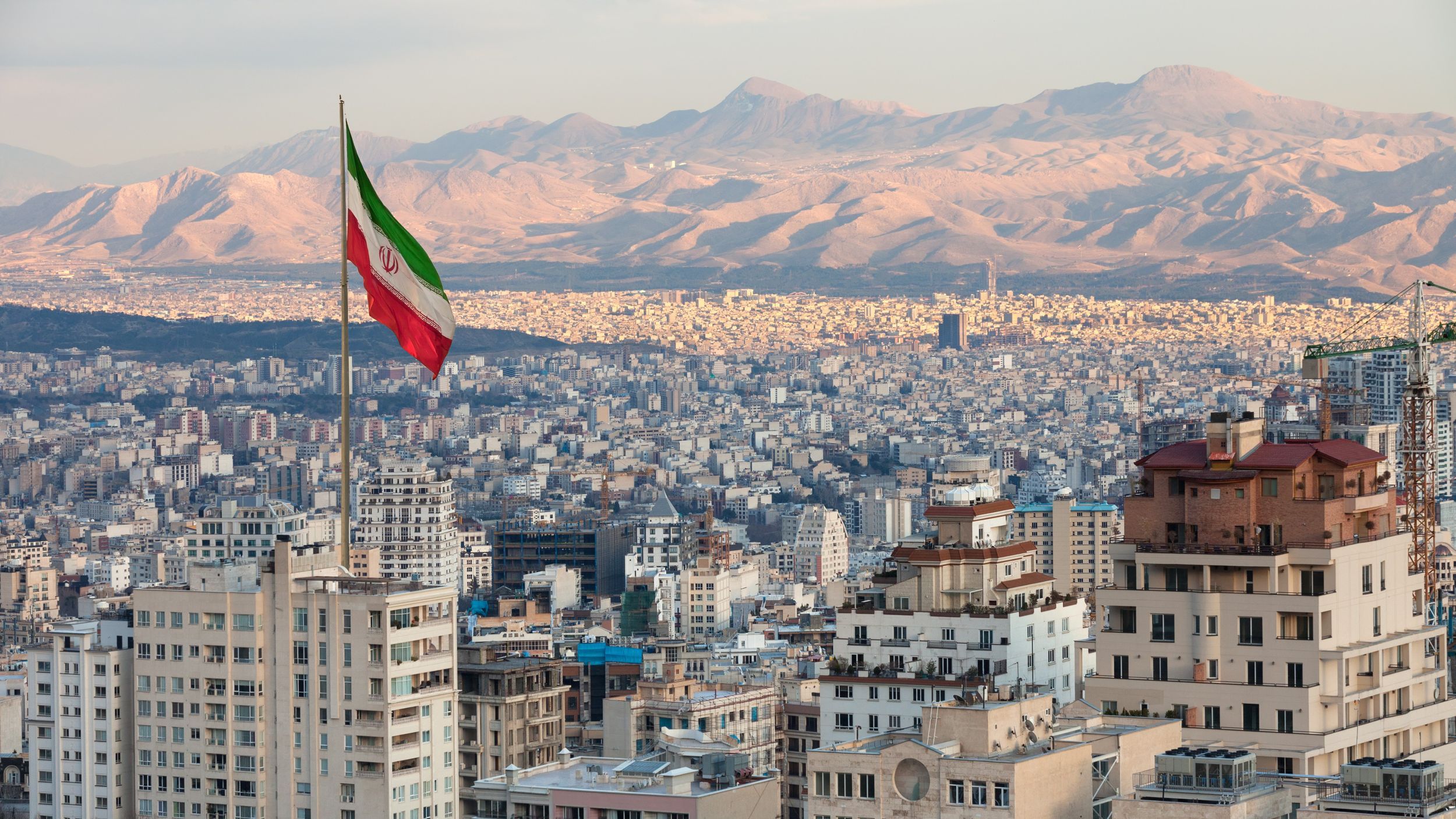
The depletion of Iran’s underwater aquifers is driving the ground to sink rapidly throughout the country, new research shows.
More than 12,120 square miles (31,400 square kilometers) of the country — an area roughly the size of Maryland — is now moving downward faster than 0.39 inches (10 millimeters) per year. In a more extreme example, the ground level has dropped by over a foot (34 cm) per year near the city of Rafsanjan, in central Iran.
Measuring the subsidence
In Iran, about 60% of the water supply comes from underground aquifers. To study what effects this is having on the surface, Jessica Payne, a doctoral candidate in the School of Earth and Environment at the University of Leeds in the U.K., and her colleagues used radar data from the European Space Agency’s Sentinel-1 satellite constellation to map how the ground level in Iran has changed over eight years between 2014 and 2022.
The researchers found 106 regions of subsidence covering a total of 12,120 square miles, or about 2% of the country.
“The rates of subsidence in Iran are some of the fastest in the world,” Payne told Live Science. “We found about 100 sites across Iran where subsidence is faster than about 10 millimeters [0.4 inches) a year. In Europe, case studies are considered extreme if they exceed 5 to 8 millimeters [0.2 to 0.3 inches] a year.”
The ground is sinking due to groundwater extraction, she said, with 77% of incidences of subsidence faster than 10 mm per year correlating with the presence of agriculture.
For example, near the city of Rafsanjan, the climate is really dry, there are pistachio plantations, and there is heavy use of the groundwater supply. Subsidence of 13 inches (34 cm) per year might not seem like a huge drop, Payne said, “but in 10 years, the ground’s going down about 3 to 4 meters [10 to 13 feet]; it’s really severe.”
In Bardaskan in northern Iran, the area found to be affected by subsidence was 429 square miles (1,110 square km) — 40% larger than the amount recorded in a 2008 study. Payne and her colleagues’ work was published Aug. 27 in the Journal of Geophysical Research: Solid Earth.
“Irreversible” sinking
Much of the subsidence at all 106 locations was irreversible, Payne said.
“The paper’s most striking conclusion is that most of Iran’s groundwater-related subsidence is irreversible, which underscores the severity of aquifer depletion,” Shirzaei said.
Aquifers don’t work like reservoirs, she noted. When you extract more water from a reservoir than enters it, the level goes down. But when it rains, it can fill up again.
In aquifers, where roughly the same amount of water is removed and replaced by precipitation annually, you get a falling and rising seasonal trend called elastic recovery, Payne said. But when far more water than that is extracted, the situation changes.
“Within aquifers, it’s like a bucket of sand. There are layers of mud and layers of sand, and the grains of mud and sand are being held apart by the water,” Payne explained. “But if that water is removed, and it hasn’t been removed before then, the sand and the mud don’t have enough strength themselves to hold up all that sediment above as well as buildings on top.”

As a result, the particles flatten, and the ground level drops in irreversible subsidence. Even if water returns to the system and it penetrates to the parts that are compacted, it wouldn’t lift the ground level back up to where it was, she said.
The implications of this are severe. “Steep gradients create fissures and structural instability, damaging buildings, roads, and railways,” Shirzaei said. “Cities like Tehran, Karaj, Mashhad, Isfahan, and Shiraz are directly affected. Karaj alone has over 23,000 people living in high-hazard zones.”
“It’s difficult to hear about the impacts from outside Iran, but anecdotally, I’ve heard from Iranian colleagues that buildings have had to be abandoned,” Payne said.
Subsidence is not unique to Iran.
“The scenario provided for Iran, unfortunately, echoes that characterizing many other countries and their metropolises,” Francesca Cigna, a researcher at the Institute of Atmospheric Sciences and Climate in Rome, Italy, who wasn’t involved in the study, told Live Science.
Other places seeing big drops are major cities in central Mexico, the U.S., China and Italy, she said.
“Iran’s peak rates rival Mexico City and Central Valley in California, placing it among the world’s most extreme subsidence hotspots,” Shirzaei said.
Disasters linked to subsidence are not unheard of. In Mexico, for example, land subsidence is thought to have contributed to a metro line collapse in 2021, resulting in 26 deaths and dozens of injuries.
The other main risk is loss of fresh water supplies. “Continued aquifer compaction means that much of the storage capacity is permanently lost,” Shirzaei said. “This worsens water scarcity during droughts, reduces resilience to climate variability, and makes recovery increasingly impossible.”
