Close Menu
  • Home
  • UNSUBSCRIBE
  • News
  • Lifestyle
  • Tech
  • Entertainment
  • Sports
  • Travel
Facebook X (Twitter) WhatsApp
Trending
  • George Kittle’s wife shares live reaction to Achilles injury
  • ‘The scientific cost would be severe’: A Trump Greenland takeover would put climate research at risk
  • Headlines Across OC as Angel Stadium Sale Debate Intensifies
  • Anti-Islam activists clash with pro-Muslim counter-protesters in Dearborn, Michigan
  • Best monitor deal: Get the 45-inch LG Ultragear gaming monitor for its lowest price yet
  • Slovakia U21 0 – 4 England U21
  • 13 Top Sleep Products That Transform Your Bedtime Routine for Better Rest
  • Firefighters rescue puppies from burning house
Facebook X (Twitter) WhatsApp
Baynard Media
  • Home
  • UNSUBSCRIBE
  • News
  • Lifestyle
  • Tech
  • Entertainment
  • Sports
  • Travel
Baynard Media
Home»Lifestyle»Gigantic 500,000-mile ‘hole’ in the sun’s atmosphere aims aurora-sparking solar wind at Earth (photo)
Lifestyle

Gigantic 500,000-mile ‘hole’ in the sun’s atmosphere aims aurora-sparking solar wind at Earth (photo)

EditorBy EditorFebruary 2, 2025No Comments3 Mins Read
Share Facebook Twitter Pinterest LinkedIn Tumblr Reddit Telegram Email
Share
Facebook Twitter LinkedIn Pinterest Email

Aurora forecast

circle with the northern lights inside and a pair of cartoon eyes looking to the top left.

(Image credit: Daisy Dobrijevic/Canva)

Keep up with current northern lights forecasts and geomagnetic storm warnings with our aurora forecast live blog.

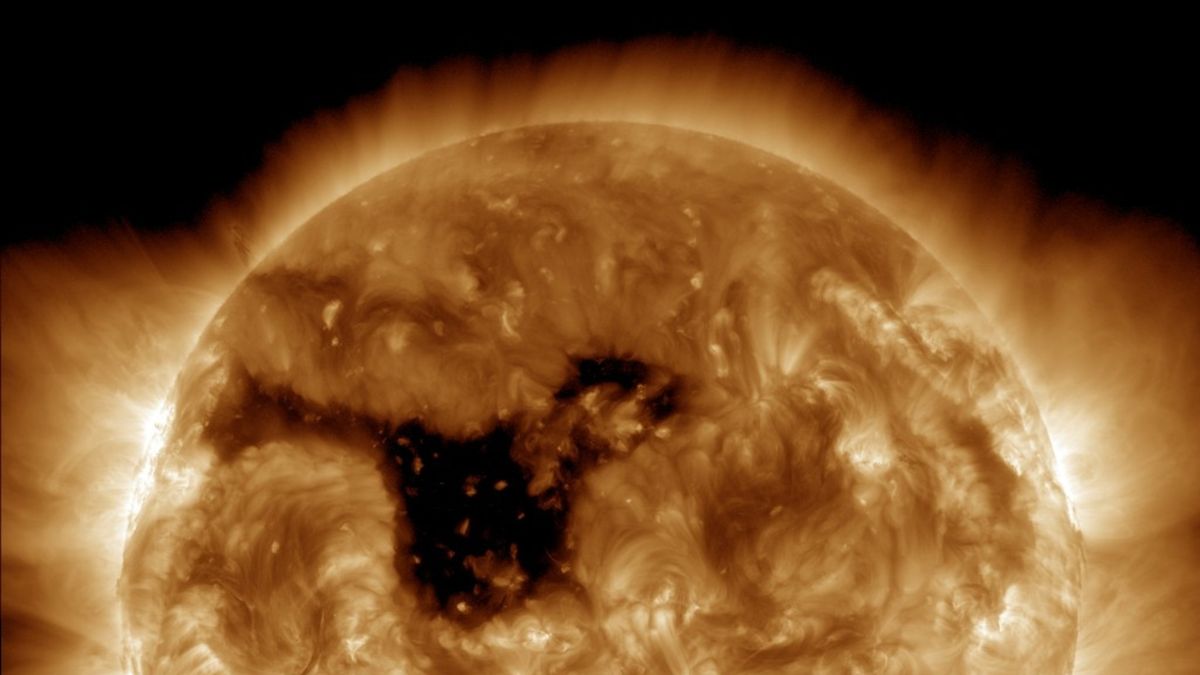
A colossal coronal hole, nearly 500,000 miles (800,000 kilometers) wide, has opened in the sun’s atmosphere, spewing fast-moving solar wind toward Earth.

Coronal holes are regions where the sun’s magnetic fields have opened up, allowing solar wind, to escape freely into space, according to spaceweather.com. These areas appear darker in ultraviolet images because the hot, glowing gases typically trapped within the magnetic fields are no longer contained, instead streaming outward into space.

The solar wind escaping from this coronal hole — the diameter of which measures over 62 times that of the diameter of Earth — is moving at speeds of more than 310 miles per second (500 kilometers per second). According to spaceweather.com, this flow is expected to reach Earth by Jan. 31, where it could spark minor (G1) geomagnetic storm conditions. While these storms are not severe, they can intensify auroral displays, creating vibrant northern and southern lights at higher latitudes. For an up-to-date breakdown of geomagnetic activity over the next 3 days, check out NOAA’s SWPC 3-day forecast. NOAA classifies geomagnetic storms using a G-scale, which ranks their intensity from G1 (minor) to G5 (extreme). The recent geomagnetic storm watch NOAA issued is rated as a G1.

Auroras occur when solar wind interacts with Earth’s magnetic field. The charged particles from the sun collide with gases in the upper atmosphere, such as oxygen and nitrogen, transferring energy to them. This energy is released as light, producing the colorful displays seen in the night sky. The stronger the solar wind, the more dynamic and widespread the auroras can become.

coronal hole on the surface of the sun on Jan. 28. close up view on the right shows a colossal dark region.

Coronal holes appear darker in ultraviolet images because the hot, glowing gases typically trapped within the magnetic fields are no longer contained. They are instead, readily spewing out into space. (Image credit: NASA/SDO)

Though G1 conditions are possible for Jan.31, remember that space weather is unpredictable and difficult to forecast, much like Earth’s weather. Even though geomagnetic storm warnings at this level are not uncommon, they can occasionally amount to nothing.

To stay updated on space weather and know the best times and places to catch auroras, consider using a space weather app tailored to your location. One app I recommend is “My Aurora Forecast & Alerts,” available on both and Android. Another great tool is the “Space Weather Live” app and Android which offers more in-depth insights into current space weather conditions and their potential for aurora activity.

Originally posted on Space.com.

Get the world’s most fascinating discoveries delivered straight to your inbox.

Source link

Share. Facebook Twitter Pinterest LinkedIn Tumblr Email
Previous ArticleAzim dominates Lipinets in BRUTAL bout
Next Article Van den Bergh hits incredible 9-DARTER at World Masters!
Editor
  • Website

Related Posts

Lifestyle

‘The scientific cost would be severe’: A Trump Greenland takeover would put climate research at risk

January 17, 2026
Lifestyle

New ‘Transformer’ humanoid robot can launch a shapeshifting drone off its back — watch it in action

November 19, 2025
Lifestyle

Medieval spear pulled from Polish lake may have belonged to prince or nobleman

November 19, 2025
Add A Comment

Comments are closed.

Categories
  • Entertainment
  • Lifestyle
  • News
  • Sports
  • Tech
  • Travel
Recent Posts
  • George Kittle’s wife shares live reaction to Achilles injury
  • ‘The scientific cost would be severe’: A Trump Greenland takeover would put climate research at risk
  • Headlines Across OC as Angel Stadium Sale Debate Intensifies
  • Anti-Islam activists clash with pro-Muslim counter-protesters in Dearborn, Michigan
  • Best monitor deal: Get the 45-inch LG Ultragear gaming monitor for its lowest price yet
calendar
February 2026
M T W T F S S
 1
2345678
9101112131415
16171819202122
232425262728  
« Jan    
Recent Posts
  • George Kittle’s wife shares live reaction to Achilles injury
  • ‘The scientific cost would be severe’: A Trump Greenland takeover would put climate research at risk
  • Headlines Across OC as Angel Stadium Sale Debate Intensifies
About

Welcome to Baynard Media, your trusted source for a diverse range of news and insights. We are committed to delivering timely, reliable, and thought-provoking content that keeps you informed
and inspired

Categories
  • Entertainment
  • Lifestyle
  • News
  • Sports
  • Tech
  • Travel
Facebook X (Twitter) Pinterest WhatsApp
  • Contact Us
  • About Us
  • Privacy Policy
  • Disclaimer
  • UNSUBSCRIBE
© 2026 copyrights reserved

Type above and press Enter to search. Press Esc to cancel.