
What happens when the government gets into the business of controlling the artwork allowed to be shown in a nation? A traveling exhibition on view at the Minneapolis Institute of Art offers an historical test case.
“Modern Art and Politics in Germany 1910–1945,” organized by the Neue Nationalgalerie modern art museum in Berlin, arrives in Minneapolis at a time when the U.S. government seems particularly interested in exerting cultural control, from overhauls of the Kennedy Center and the White House, to National Endowment for the Arts grants favoring classical styles.
Such tactics, the Mia’s exhibit seems to say, can go terribly wrong.
Before Neue Nationalgalerie existed, Germany’s state-run gallery had an annex called the “Gallery of Living Artists” focused on avant garde art. In 1933, when Adolf Hitler’s National Socialist German Workers’ Party came to power, it systematically took over museums, private galleries and art collections to align culture with the party’s ideology.
Related: Artists respond to censorship and surveillance in Walker’s exhibit about experimental German art in the Eastern Bloc
The Nazis purged the avant garde collection and put together an exhibition of what it called “Degenerate Art,” meant to denigrate modern artworks. The show toured multiple cities before the works were destroyed or sold to fund the regime. Other pieces were looted by insiders eager to profit off the chaos.

The show at the Mia, while tracing German political influence on art and culture, doesn’t shy from a critical look at modern art.
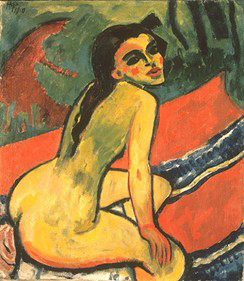
Take the Brücke collective, an influential group of German expressionists, several of whom are on display in the exhibition. One member, Max Pechstein, depicted a 9-year-old, Lina Franziska, as a coquettish nude in “Seated Girl” (1910). Gross, to viewers today.
Other Brücke artists gleaned imagery from African masks in ways that modern viewers recognize as cultural appropriation, not dissimilar to works by their European contemporaries Pablo Picasso and Henri Matisse.
Also part of the exhibition is Emil Nolde, another Brücke artist as well as a rabid anti-Semite and racist. He actually belonged to the Nazi party, but that didn’t stop his work from being labeled “degenerate.”
Irina Hiebert Grun, one of the curators of the exhibition, told me Nolde’s work was included in part because it presents an “opportunity to talk about history and how complicated it was for the artists.
“He was a great artist, but you have to tell the story behind it,” she said.
I found Nolde’s inclusion in the show, as well as others who belonged to the Nazi party like Franz Radziwill and Georg Kolbe, to be deeply unsettling, especially in a moment when diverse voices are being silenced. What made it even more unsettling was the show’s dearth of Jewish artists.
Related: Twin Cities artists grapple with censorship in a time of turmoil
“After the Second World War, the first director of our museum didn’t acquire Jewish artists,” Hiebert Grun told me. She noted, too, that many Jewish artists didn’t survive the Holocaust. “It’s really a problem, and it’s a gap in our collection.”
-
Christian Schad, Sonja, 1928. © Neue Nationalgalerie, Stiftung Preußischer Kulturbesitz, Berlin / Photo: Jörg P. Anders Credit: © Neue Nationalgalerie, Stiftun -
Josef Scharl, Ecce homo, 1931. © Neue Nationalgalerie, Stiftung Preußischer Kulturbesitz, Berlin / Photo: André van Linn Credit: © Neue Nationalgalerie, Stiftun -
Curt Querner, Self Portrait with Stinging Nettle, 1933. © Neue Nationalgalerie, Stiftung Preußischer Kulturbesitz, Berlin / Photo: André van Linn Credit: © Neue Nationalgalerie, Stiftun -
Otto Möller, City, 1921. © Neue Nationalgalerie, Stiftung Preußischer Kulturbesitz, Berlin / Photo: André van Linn Credit: © Neue Nationalgalerie, Stiftun


Still, the works depict many Jewish subjects, and together they help tell a story. The poster image for the show features Christian Schad’s portrait of “Sonja,” known to be Albertine Gimpel, a cosmopolitan young Jewish woman who fled to the U.S. in 1933 with the help of her eventual husband, American painter Franz Herda.
Other works portray prominent Jewish Germans – rabbis, art dealers, members of influential families, and others – who were soon to face the horrors of the Holocaust.

George Grosz’s satirical “Pillars of Society” (1926), named after a Henrik Ibsen play, shows grotesque depictions of a soldier, a journalist, a clergyman, a politician and a nationalist aristocrat donning a swastika.
It’s not surprising the Nazis deemed Grosz’s painting as “degenerate,” given its incisive politics. What’s more difficult to understand are works that don’t seem political at all, like Lyonel Feininger’s geometric “Teltow II” or the work of Georg Muche, who played with pastel colors and abstract patterns.
As I experienced the art, I reflected that “degenerate” was in part arbitrary and also used strategically to allow for plundering many of the works, much as the Jewish people were scapegoated, robbed and murdered.
Art is not and never has been separate from politics. The Mia’s exhibition shows just how high the stakes really are.
“Modern Art and Politics in Germany 1910–1945: Masterworks from the Neue Nationalgalerie, Berlin” is on view through July 16, 2026, at the Minneapolis Institute of Art, 2400 Third Ave. S., Minneapolis ($20). More information here.
