
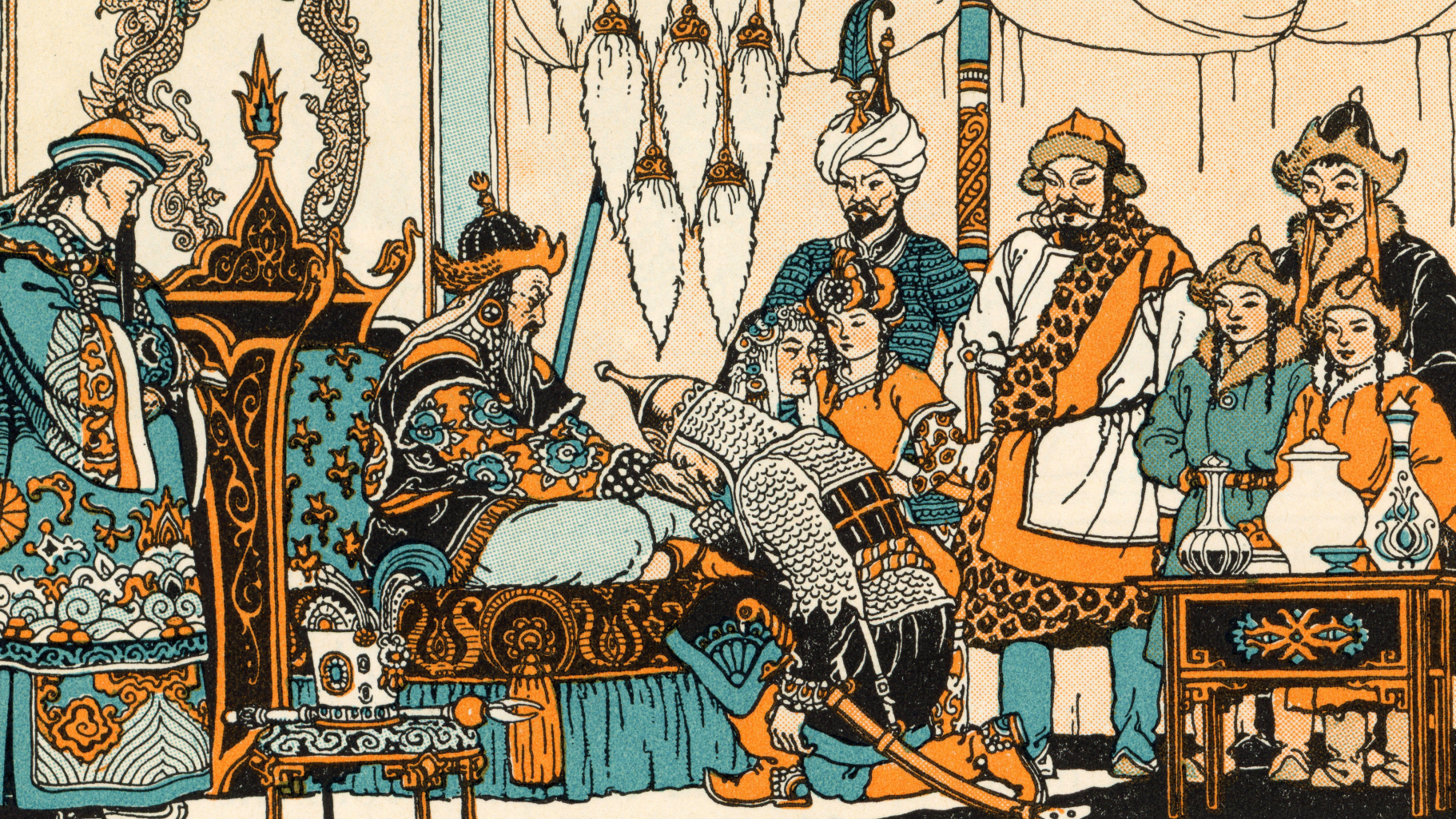
Kazakh folklore says that the body of Jochi, Genghis Khan’s eldest son, lies in a mausoleum in the Ulytau region, in the country’s central uplands. When archaeologists recently studied the body from the medieval mausoleum, though, they didn’t find Jochi — but they did find a novel genetic lineage that may have been passed on by Genghis himself.
Genghis Khan, born Temüjin in the Khentii mountains of northeast Mongolia, was a central Asian warrior who founded the sprawling Mongol Empire in 1206. The Mongols’ astounding horseback riding abilities and skill with bows and arrows enabled them to quickly conquer a territory stretching from the Pacific Ocean to Central Europe. Genghis Khan and his wife Börte had four sons and five daughters. Their eldest son, Jochi, was born around 1182 and died around 1227, shortly before Genghis’ own death. The northwestern part of the Mongol Empire that Jochi (also spelled Joshi, Zhoshi and Jüshi) ruled was later known as the Golden Horde.
To try and unearth DNA from Genghis’ close relations, Askapuli and colleagues investigated the folklore claims that Jochi, who died after falling from a horse in Ulytau, was buried in the eponymous mausoleum, which was built at least 70 years after his death. They published their findings Feb. 19 in the journal PNAS.
For the study, the researchers went to the Ulytau region and analyzed male skeletons from three medieval mausoleums reputedly belonging to Jochi and other men of the elite Golden Horde. The team examined these individuals’ DNA to look at their Y chromosome data, which is passed from father to son.

Two of the male skeletons were carbon-dated to between 1286 and 1398, making them unlikely to be the children of Genghis Khan. But the researchers’ DNA analysis did reveal that the two men shared a paternal lineage — also shared with a man who was carbon-dated to the 18th century — that is believed to be associated with Genghis Khan.
One issue with confirming this association, though, is that Genghis Khan’s skeleton has never been found and no one knows where he was buried. “Nobody knows exactly what his Y DNA would look like,” Askapuli said. “Not only from him, but his sons, his grandsons, immediate relatives — none of them are known. So this is an attempt to answer that question.”
A previous study published in the American Journal of Human Genetics in 2003 showed that an unusual Y chromosome lineage that originated in Mongolia a millennium ago, called C3*, is now common in people who are living throughout what was once the Mongol Empire. Those researchers concluded that the lineage was likely carried by male descendants of Genghis Khan and that 0.5% of the world’s male population today, or 1 in 200 men, may be descended from the famous warrior.
In the new analysis, Askapuli and colleagues found that the three men buried in the Golden Horde mausoleums were all paternally related and shared a recent ancestor in the C3* lineage.
“The Y chromosome haplotype they have belongs to the C3* cluster that was previously hypothesized to be Genghis Khan’s,” Askapuli said, “but this one is very rare in modern populations.”
The C3* cluster is a very large genetic family — a fact that was not known in 2003. “It has many different branches,” Askapuli explained, “and the Golden Horde elites have one of those branches.”
The specific branch that the researchers found in the mausoleum skeletons is actually much more rare than the one discovered in 2003, meaning far fewer men living today are related to Genghis Khan than previously assumed.
The scientists also found that the individuals in the Golden Horde mausoleums could trace their ancestry largely to Ancient Northeast Asian (ANA) populations, with genetic contributions from the Kipchaks, a group of eastern Scythian-related nomads that lived in the Eurasian Steppe and were integrated into the Golden Horde in medieval times.
Although the exact Y chromosome lineage that Genghis Khan shared with his male descendants is still unknown, Askapuli believes that in the near future, researchers may be able to answer this question.
“If we have a tomb which is historically recorded and also have a tombstone that says that this individual belonged to the descendants of Genghis Khan, and then if we perform genetic tests on these individuals, I think it is possible to make a final conclusion,” Askapuli said. “But it’s not a simple story — it’s complicated.”
Askapuli, A., Kanzawa-Kiriyama, H., Kakuda, T., Kassenali, A., Yessen, S., Schamiloglu, U., Schrodi, S. J., Hawks, J., & Saitou, N. (2026). Genomes of the Golden Horde elites and their implications for the rulers of the Mongol Empire. Proceedings of the National Academy of Sciences, 123(8). https://doi.org/10.1073/pnas.2531003123
