
QUICK FACTS
Where is it? Poás Volcano National Park, Costa Rica [10.19781287, -84.238304442]
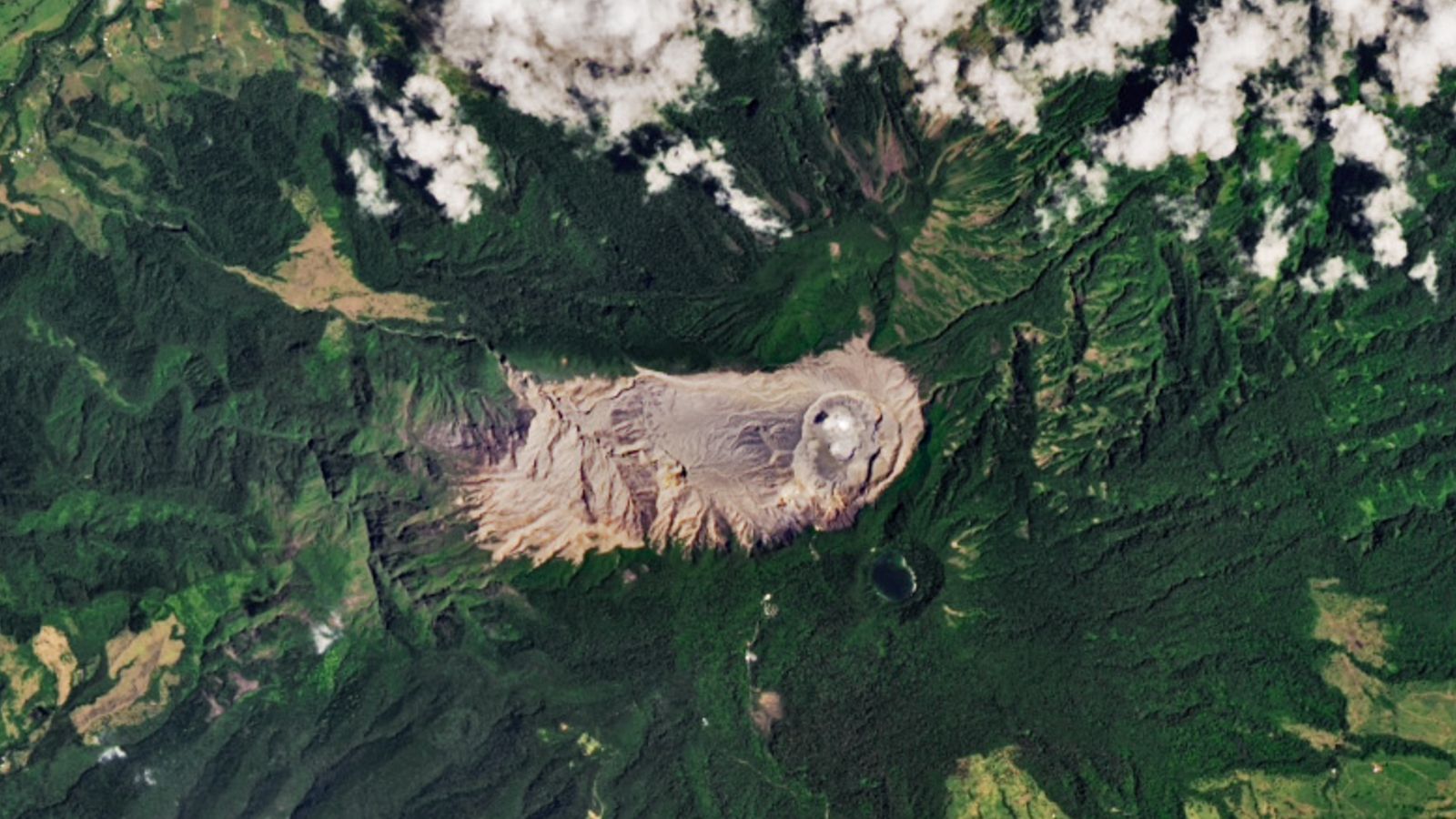
What’s in the photo? The barren slopes of the Poás volcano in the middle of a rainforest
Which satellite took the photo? Landsat 8
When was it taken? March 5, 2025
This striking satellite photo shows a barren Mars-like volcano lurking in the heart of the Costa Rican rainforest. The alien landscape contains a super-acidic lake that is a “paradise” for extreme microbes and provides researchers with an excellent analog for studying potential lifeforms on the Red Planet.
The unique volcano, named Poás, is the focal point of the Poás Volcano National Park in Costa Rica’s Alajuela province. It is a stratovolcano that formed between 1.5 million and 700,000 years ago, with a summit that reaches 8,848 feet (2,697 meters) above sea level.
Satellite images make it look like Poás is situated in the middle of nowhere. However, around 10 miles (16 kilometers) southeast of the volcano (just out of shot in this photo), lie the suburbs of Costa Rica’s capital San José, which is home to around 1.5 million people. As a result, the volcano is a popular tourist destination, despite being one of the most active volcanoes in Central America.
Poás has had dozens of major eruptions in the last 200 years, but also experiences many more smaller outbursts, where it puffs out a mix of steam, smoke and toxic gases, as well as the occasional ash cloud. Since 2005, the volcano has had 13 of these minor eruptive phases, according to the Smithsonian Institution’s Global Volcanism Program.
Its most recent eruption began on Jan. 5 and persisted for the majority of 2025, although it has likely now come to an end. This phase’s activity peaked in early May, when sulfur dioxide levels briefly impacted air quality in San José and ashfall damaged some nearby crops, according to NASA’s Earth Observatory.
Related: See all the best images of Earth from space

The main crater of Poás contains a highly acidic volcanic lake, named Laguna Caliente, which has an average pH value of just over 0, which is roughly equivalent to battery acid, according to the Earth Observatory. This crater, which is around 0.8 miles (1.3 km) wide, is also home to sporadic geysers.
While these extreme conditions mean no animals or plants live within the crater, the lake’s acidic waters are home to a thriving microbial community dominated by extremophile bacteria in the genus Acidiphilium, which feast on metal compounds dissolved in the water.
“We have a very human-centric bias for what a nice, happy, temperate environment is to grow in,” Rachel Harris, a microbial ecologist and geochemist at Harvard University who is currently involved in devising NASA’s Decadal Astrobiology Research and Exploration Strategy, told the Earth Observatory. “The Poás system may be hostile to most forms of life we are familiar with. But for a microbe adapted to acid, heat and toxic metals, it’s paradise,” Earth Observatory representatives added.
Researchers are interested in Poás’ extreme ecosystem because it is very similar to volcanic environments that likely existed on Mars more than 3 billion years ago, when the Red Planet was more similar to our own.

A 2022 study, for example, revealed that the low biodiversity and high resilience within Laguna Caliente’s microbial community is very close to what researchers expect could have developed within potential Martian ecosystems.
Poás is particularly similar to a region of Mars, known as Home Plate, which was surveyed by NASA’s Spirit rover in 2009. This 300-foot-wide (90 m) plateau likely had an acidic hydrothermal system that may have been almost identical to Laguna Caliente, according to the Earth Observatory.
Other types of extremophiles may also have once thrived on Mars, including lifeforms similar to lichens or photosynthetic algae. However, despite some promising recent findings from NASA’s Perseverance rover, there is no hard evidence that the Red Planet has ever supported alien life.
