Close Menu
  • Home
  • UNSUBSCRIBE
  • News
  • Lifestyle
  • Tech
  • Entertainment
  • Sports
  • Travel
Facebook X (Twitter) WhatsApp
Trending
  • Social media is polluting the Minnesota Capitol
  • Living in Europe vs. US: Why More Americans Choose Europe
  • Virginia Democratic Senate challenger says party is wrong on gun rights
  • Oil jumps, stocks slide ahead of U.S. stock market open as Iran war rounds one month
  • AI systems are enabling mass surveillance in the US, and there is no national law that ‘meaningfully limits’ the use of this data
  • Trump admin allows Russian oil tanker to reach Cuba amid ongoing energy crisis
  • Trump says his ‘preference’ would be to ‘take the oil in Iran’
  • Cost of Living in Portugal vs. USA: What to Expect
Facebook X (Twitter) WhatsApp
Baynard Media
  • Home
  • UNSUBSCRIBE
  • News
  • Lifestyle
  • Tech
  • Entertainment
  • Sports
  • Travel
Baynard Media
Home»Lifestyle»Earth from space: Italy’s ‘ticking time bomb’ plays peek-a-boo through a mysterious hole in the clouds
Lifestyle

Earth from space: Italy’s ‘ticking time bomb’ plays peek-a-boo through a mysterious hole in the clouds

EditorBy EditorJanuary 28, 2025No Comments3 Mins Read
Share Facebook Twitter Pinterest LinkedIn Tumblr Reddit Telegram Email
Share
Facebook Twitter LinkedIn Pinterest Email

QUICK FACTS

Where is it? Mount Vesuvius, Italy [40.82177024, 14.42760653]

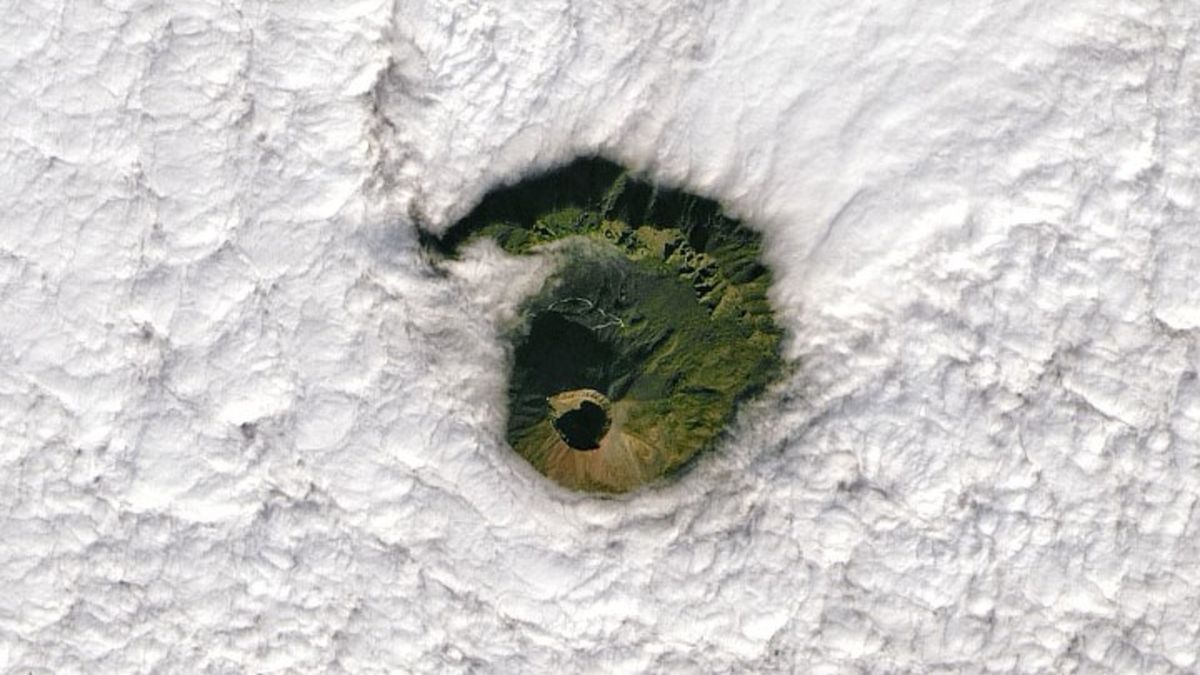
What’s in the photo? The peak of Vesuvius aligned with a gap in the clouds

Which satellite took the photo? Landsat 8

When was it taken? Jan. 2, 2022

This stunning satellite photo shows one of the world’s most famous and potentially dangerous volcanoes, Mount Vesuvius, playing a game of peek-a-boo with an orbiting spacecraft through a strangely shaped hole in the clouds.

Vesuvius is a 4,203-foot-tall (1,281 meters) stratovolcano located next to the city of Naples along the western Italian coastline. It is most famous for a massive eruption in A.D. 79, which destroyed the Roman cities of Pompeii and Herculaneum, and killed around 2,000 people, around half of which were perfectly preserved by the pyroclastic flows, along with their homes and possessions.

Today, around 800,000 people live on the volcano’s slopes and up to 3 million people reside within the potential danger zone of future eruptions, making Vesuvius “one of the world’s most dangerous volcanoes,” according to NASA’s Earth Observatory.

In the image, Vesuvius’ caldera — a large bowl-like depression caused by the collapse of the mountain’s summit during a previous eruption — appears to peer up through a gap in the clouds like a giant eye.

A large curved ridge can also be seen near the top of the cloud gap. This is the remnant of Mount Somma — an ancient volcano that once stood in the same spot as Vesuvius, before the newer volcano’s cone grew from its center.

Related: See all the best images of Earth from space

A satellite photo of thick clouds with a gap showing Mount Vesuvius below

It is not exactly clear why such a circular hole opened up in the thick cloud cover surrounding Vesuvius. (Image credit: NASA/Landsat/Joshua Stevens)

It is unclear exactly what caused the gap in the otherwise thick clouds covering Vesuvius and Naples.

Get the world’s most fascinating discoveries delivered straight to your inbox.

However, the circular shape of the hole is similar to circular holes punched in the clouds by airplanes, known as “fallstreak holes.” It is, therefore, plausible that a plane taking off or landing from Naples International Airport could have created the hole.

“Ticking time bomb”

Vesuvius is part of the Campanian volcanic arc — a string of volcanoes in Italy, including the currently active Mount Etna, that sits on a boundary between the African and Eurasian tectonic plates.

The volcano’s last major eruption concluded in 1944. Since then, the region surrounding Vesuvius has experienced several earthquake swarms, most recently in 1999, according to the Global Volcanism Program at the Smithsonian Museum of Natural History.

Scientists also believe that the next big eruption may not be too far around the corner.

In a 2011 paper published in Nature, researchers described Vesuvius as “Europe’s ticking time bomb” and warned that scientists and the civil authorities can’t agree on how to prepare for a future eruption.

Source link

Share. Facebook Twitter Pinterest LinkedIn Tumblr Email
Previous ArticleJustice Department fires federal prosecutors who worked on Trump prosecutions
Next Article Best Skincare Products for Dry and Sensitive Skin
Editor
  • Website

Related Posts

Lifestyle

Living in Europe vs. US: Why More Americans Choose Europe

March 30, 2026
Lifestyle

AI systems are enabling mass surveillance in the US, and there is no national law that ‘meaningfully limits’ the use of this data

March 30, 2026
Lifestyle

Cost of Living in Portugal vs. USA: What to Expect

March 30, 2026
Add A Comment

Comments are closed.

Categories
  • Entertainment
  • Lifestyle
  • News
  • Sports
  • Tech
  • Travel
Recent Posts
  • Social media is polluting the Minnesota Capitol
  • Living in Europe vs. US: Why More Americans Choose Europe
  • Virginia Democratic Senate challenger says party is wrong on gun rights
  • Oil jumps, stocks slide ahead of U.S. stock market open as Iran war rounds one month
  • AI systems are enabling mass surveillance in the US, and there is no national law that ‘meaningfully limits’ the use of this data
calendar
March 2026
M T W T F S S
 1
2345678
9101112131415
16171819202122
23242526272829
3031  
« Feb    
Recent Posts
  • Social media is polluting the Minnesota Capitol
  • Living in Europe vs. US: Why More Americans Choose Europe
  • Virginia Democratic Senate challenger says party is wrong on gun rights
About

Welcome to Baynard Media, your trusted source for a diverse range of news and insights. We are committed to delivering timely, reliable, and thought-provoking content that keeps you informed
and inspired

Categories
  • Entertainment
  • Lifestyle
  • News
  • Sports
  • Tech
  • Travel
Facebook X (Twitter) Pinterest WhatsApp
  • Contact Us
  • About Us
  • Privacy Policy
  • Disclaimer
  • UNSUBSCRIBE
© 2026 copyrights reserved

Type above and press Enter to search. Press Esc to cancel.