

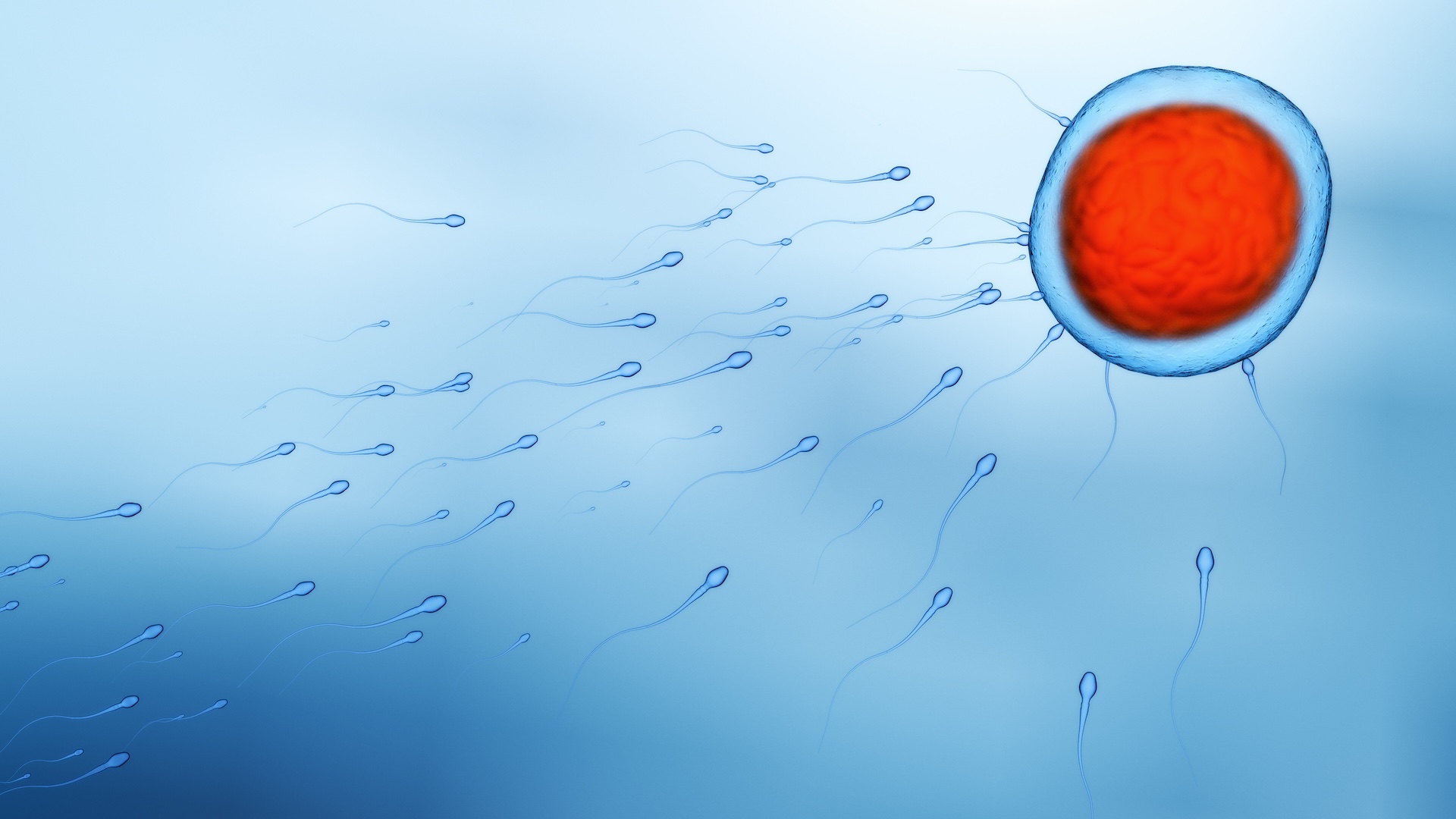
Egg fertilization is often described as an epic swim meet: Millions of sperm swim as fast as they can toward the egg until one — the fastest, strongest, healthiest sperm of them all — wins the race and wriggles into the egg, with the prize of passing its genes to future offspring.
But is this really how it happens? Do sperm really race to the egg?
Yes and no, David J. Miller, a professor in the animal sciences department at the University of Illinois Urbana-Champaign, told Live Science. “The important player in all of this is actually the female reproductive tract.”
Sperm do swim during this process, but “the major movement is actually provided by contractions of the female tract,” Miller explained. “There are contractions of the uterus, for example, that are much like contractions of the GI tract that can move fluid through the uterus.”
A 1996 study illustrated just how efficient these contractions are, Miller noted. Scientists deposited sperm-size beads into the uteruses of 64 women, and some of the beads traveled all the way to the fallopian tubes — where fertilization usually takes place — within minutes.
Related: Are you genetically more similar to your mom or your dad?
It makes sense that sperm would need some extra help, because while the sperm swim in one direction, the egg needs to travel in the opposite direction to meet them, Sabine Koelle, a full professor of anatomy and developmental biology at the University College Dublin School of Medicine and Medical Sciences, told Live Science. The egg can’t swim, so instead tiny hairs called cilia help it along .
“Cilia beat to transport the oocyte,” or egg, Koelle said. “Because the sperm are coming from the opposite direction, they have to struggle” against the current created by the cilia.
In fact, an individual sperm’s movement is less of an effort to move forward and more of an effort to move inward, toward the middle of the tract, Koelle said. If the sperm get too close to the sides, they stick and lose their forward momentum.
However, just because a sperm is the first to arrive doesn’t mean it gets to do the fertilizing. “Sperm require some final maturation that occurs in the female tract, and it’s time dependent,” Miller said. “So the sperm that ‘win the race,’ so to speak, need more time before they can actually fertilize the egg.”
“They may not be there when they’ve completed that maturation,” Miller added. “They might be replaced by some of the other more slowly transported sperm that have had time to complete that maturation.”
But even those less-mature sperm are more successful than the vast majority of sperm that get deposited. As the female reproductive tract pushes the sperm along, it also cuts unlucky individuals from the swim team.
“Less than 1% — maybe up to 2 or 3% of the sperm that are actually deposited — make it all the way to where the egg is,” Miller said. “A lot of them are flushed back out from the tract. Some are eaten up by immune cells in the uterus, because sperm are foreign.”
Up to 70% of sperm don’t even make it past the cervix, Koelle noted. “The sperm are stuck there and can’t free themselves,” she said.
For those few sperm that make it into the fallopian tube, the goal is to get as far as possible and then stick to the wall as they wait for the egg to arrive. This is another place where the female reproductive organs are choosing winners: Scientists have noticed that normal-looking sperm are more likely to bind to the wall, Miller said, and binding to the wall provides some metabolic benefits that increase their lifespan.
Then, once the egg arrives, the fallopian tube — also known as the oviduct — allows only healthy-looking sperm to unstick from the wall. “As soon as a sperm is not OK, the oviduct doesn’t release it,” Koelle said. “It’s the main selector of good sperm.”
This isn’t a perfect system, of course. “ Obviously, we have genetic diseases that come through sperm. So it’s not always true that the fittest are the best ones genetically,” Miller said.
Every step of the way, the female reproductive tract is doing its best to weed out the less-fit sperm so that only healthy sperm reach the egg. In that way, fertilization is less like a race and more like a job interview.
“There’s certain qualifications that you need to be able to apply for the job,” Miller said. “But also, the sperm that have those qualifications would have to have them at the time the job is open — the time when the egg is ovulated.” But in the end, it’s the female reproductive tract that chooses the best candidate.
