
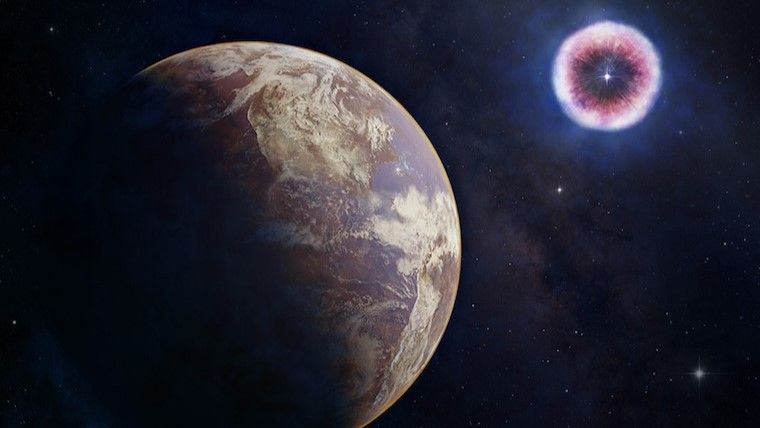
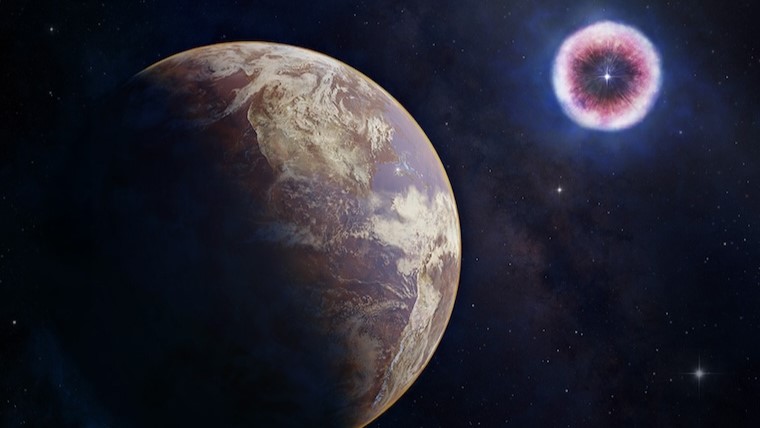
Radiation from an exploding star may have had a profound effect on the evolution of life on Earth, a new study suggests.
About 2.5 million years ago, the viruses infecting fish in Africa”s Lake Tanganyika underwent a mysterious and rapid explosion in diversity. Yet the exact cause of this change has remained a mystery.
Now, a new study has found that the upswing in the types of viruses found in the lake happened at the same time that our planet was being pummeled by cosmic rays from an ancient supernova — suggesting a possible link between the two events. The researchers published their findings Jan. 17 in The Astrophysical Journal Letters
“It’s really cool to find ways in which these super distant things could impact our lives or the planet”s habitability,” lead author Caitlyn Nojiri, an astrophysicist at the University of California, Santa Cruz, said in a statement. “We saw from other papers that radiation can damage DNA. That could be an accelerant for evolutionary changes or mutations in cells.”
Lake Tanganyika, in East Africa”s Great Rift Valley, is one of the largest freshwater lakes on the planet; it spans about 12,700 square miles and divides four nations — Burundi, the Democratic Republic of the Congo (DRC), Tanzania and Zambia. The lake is home to more than 2,000 species, more than half of which aren’t found elsewhere. This means that, according to the World Conservation Union, “no place on earth holds such a variety of life.”
Related: Scientists detect the most powerful cosmic rays ever — and their unknown source could be close to Earth
One factor that may have driven this diversification is radiation, the study authors propose. Scientists already know that energetic particles in space, known as cosmic rays, can damage the cells of astronauts to cause accelerated aging and that bombardments from these particles could be responsible for the structural preference of biological molecules known as chirality. Yet just how much of a role these space rays played in the history of evolution is relatively unexplored.
To investigate this question, the researchers behind the new study dug up and examined core samples retrieved from the seafloor. They found that it was rich in an isotope of iron called iron-60, which is commonly produced by stellar explosions. By radioactively dating this isotope, they found that the iron-60 within their sample split into two separate ages: one that formed 6.5 million years ago and another that was 2.5 million years old.
To trace the origins of this isotope, the researchers simulated the sun’s movement through the Milky Way. They discovered that roughly 6.5 million years ago, our solar system and star passed through the Local Bubble — a lower-density region of the Milky Way’s Orion Arm that is littered with debris from exploded stars.
The analysis then revealed that the later spike likely came from a supernova, either from a group of young stars in the Scorpius-Centaurus group 460 light-years away, or the Tucana-Horologium group 230 light-years away. By conducting a simulation of a near-Earth stellar explosion, the scientists found that such an event would have rained cosmic rays upon Earth for 100,000 years after the initial blast, creating a pattern matching that of the spike found in the sediment.
If their assumptions are correct and this event actually happened, it would have been powerful enough to penetrate Earth’s atmosphere and snap DNA strands in half — explaining the coinciding explosion of diversity in viruses discovered in Lake Tanganyika.
Although the scientists cautioned that this connection is far from certain, it does raise the possibility that powerful cosmic events may have sculpted life on our planet more significantly than scientists first thought.
“We can’t say that they are connected, but they have a similar timeframe,” Nojiri said. “We thought it was interesting that there was an increased diversification in the viruses.”
