Close Menu
  • Home
  • UNSUBSCRIBE
  • News
  • Lifestyle
  • Tech
  • Entertainment
  • Sports
  • Travel
Facebook X (Twitter) WhatsApp
Trending
  • George Kittle’s wife shares live reaction to Achilles injury
  • ‘The scientific cost would be severe’: A Trump Greenland takeover would put climate research at risk
  • Headlines Across OC as Angel Stadium Sale Debate Intensifies
  • Anti-Islam activists clash with pro-Muslim counter-protesters in Dearborn, Michigan
  • Best monitor deal: Get the 45-inch LG Ultragear gaming monitor for its lowest price yet
  • Slovakia U21 0 – 4 England U21
  • 13 Top Sleep Products That Transform Your Bedtime Routine for Better Rest
  • Firefighters rescue puppies from burning house
Facebook X (Twitter) WhatsApp
Baynard Media
  • Home
  • UNSUBSCRIBE
  • News
  • Lifestyle
  • Tech
  • Entertainment
  • Sports
  • Travel
Baynard Media
Home»Lifestyle»Continent-size blobs in Earth’s mantle are a billion years old, ancient crystals reveal
Lifestyle

Continent-size blobs in Earth’s mantle are a billion years old, ancient crystals reveal

EditorBy EditorJanuary 23, 2025No Comments4 Mins Read
Share Facebook Twitter Pinterest LinkedIn Tumblr Reddit Telegram Email
Share
Facebook Twitter LinkedIn Pinterest Email

Continent-size islands deep inside Earth’s mantle could be more than a billion years old, a new study finds.

Known as large low-seismic-velocity provinces (LLSVPs), these blobs are both hotter and older than nearby areas of the mantle. The findings, published Jan. 22 in the journal Nature, shed light on Earth’s deep interior and could help explain how the mantle moves over time.

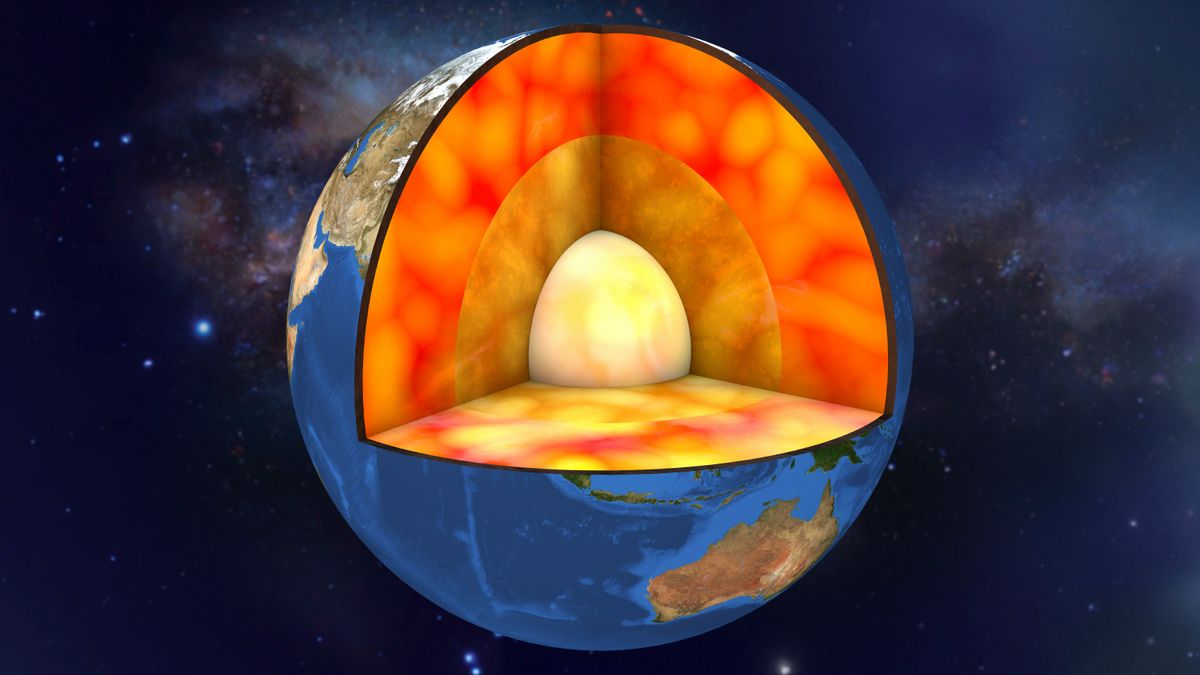
Scientists have known about these LLSVPs for a few decades. The two giant blobs — one beneath the Pacific Ocean and one beneath Africa — lie at the boundary between Earth’s mantle and its outer core, some 1,900 miles (3,000 kilometers) beneath the surface.

“People have been wondering for all this time what they are,” study co-author Arwen Deuss, a seismologist at Utrecht University in the Netherlands, told Live Science. “The only thing that we know of these is that when seismic waves travel through these places, they slow down.”

To better understand the nature of the LLSVPs, Deuss and her colleagues pored through seismic data from more than 100 earthquakes strong enough to reverberate through the whole planet, including the LLSVPs and the surrounding mantle.

From these data, the researchers calculated both the speed of the seismic waves and how quickly they lost energy as they traveled through different parts of the mantle. In agreement with previous work, the team found that the seismic waves moved more slowly through the LLSVPs than through other parts of the mantle, suggesting that the blobs run hotter than their surroundings. But the waves lost much less energy than expected when traveling through the LLSVPs. Another feature, such as a change in composition, must be responsible for the unexpected result, the team suspected.

Computer model of low-seismic velocity provinces (LLSVPs).

A cross-section of Earth showing seismic wave speed and deceleration through low-seismic velocity provinces (LLSVPs) (top left and right). The bottom donut shapes show that, although the waves travel more slowly through these continent-size blobs because they are warm (bottom left), they are not slowing within the provinces as much as they do in surrounding areas (bottom right). (Image credit: Utrecht University)

Computer models suggested that the size of crystalline minerals in the LLSVPs might play a role. Every time a wave crosses a boundary between two crystals, known as a grain boundary, it loses energy. If the crystals are smaller, there are more of these grain boundaries in a given volume.

Get the world’s most fascinating discoveries delivered straight to your inbox.

Deuss likened the seismic waves to running. “If you run in dune sand, when you have a lot of small grains, then you get really tired because you kind of sink into the sand,” she said. The same thing happens to seismic waves when they pass through regions of the mantle around the LLSVPs. That part of the mantle is made of old tectonic plates that break into tiny pieces when they sink deep enough into the planet.

The LLSVPs, by contrast, contain larger crystals than their surroundings. Because the waves don’t run into grain boundaries as often when passing through the LLSVPs, they don’t lose as much energy as they do in surrounding rock. Crystals in the mantle take a long time to grow, Deuss said, so the larger crystals in the LLSVPs have likely been undisturbed for quite some time.

Representation of the process of subduction of tectonic plates and of a mantle plume rising from an LLSVP.

This schematic shows how tectonic plates dive into the mantle, while mantle plumes fed by LLSVPs bring deep mantle material to Earth’s surface at volcanic hotspots. In the latter, the mineral grains are larger than those from subducted plates. This process may help explain the geological composition of volcanic rocks around the world. (Image credit: Utrecht University)

“They must have been there for at least a billion years,” Deuss said. “And then everything suddenly fell into place, because many people have been suspecting that they might well be old, but nobody had any way to prove it.”

These older sections of the mantle could provide insight into how the mantle moves and mixes over time. The stable LLSVPs might help explain why volcanic rocks in different parts of the world have different compositions or how tectonic plates are organized at the surface, Deuss told Live Science. But figuring out exactly how these impacts show up in the geological record will require further field research.

With the new findings, “now people can do lots of other investigations to figure out, what is the origin of these places? Why have they been sitting there? And that might lead to a lot of other outstanding questions in science that still need answers,” Deuss said.

Source link

Share. Facebook Twitter Pinterest LinkedIn Tumblr Email
Previous ArticleTrump administration reportedly axed Social Security pages on updating gender
Next Article Wood signs new Forest deal
Editor
  • Website

Related Posts

Lifestyle

‘The scientific cost would be severe’: A Trump Greenland takeover would put climate research at risk

January 17, 2026
Lifestyle

New ‘Transformer’ humanoid robot can launch a shapeshifting drone off its back — watch it in action

November 19, 2025
Lifestyle

Medieval spear pulled from Polish lake may have belonged to prince or nobleman

November 19, 2025
Add A Comment

Comments are closed.

Categories
  • Entertainment
  • Lifestyle
  • News
  • Sports
  • Tech
  • Travel
Recent Posts
  • George Kittle’s wife shares live reaction to Achilles injury
  • ‘The scientific cost would be severe’: A Trump Greenland takeover would put climate research at risk
  • Headlines Across OC as Angel Stadium Sale Debate Intensifies
  • Anti-Islam activists clash with pro-Muslim counter-protesters in Dearborn, Michigan
  • Best monitor deal: Get the 45-inch LG Ultragear gaming monitor for its lowest price yet
calendar
February 2026
M T W T F S S
 1
2345678
9101112131415
16171819202122
232425262728  
« Jan    
Recent Posts
  • George Kittle’s wife shares live reaction to Achilles injury
  • ‘The scientific cost would be severe’: A Trump Greenland takeover would put climate research at risk
  • Headlines Across OC as Angel Stadium Sale Debate Intensifies
About

Welcome to Baynard Media, your trusted source for a diverse range of news and insights. We are committed to delivering timely, reliable, and thought-provoking content that keeps you informed
and inspired

Categories
  • Entertainment
  • Lifestyle
  • News
  • Sports
  • Tech
  • Travel
Facebook X (Twitter) Pinterest WhatsApp
  • Contact Us
  • About Us
  • Privacy Policy
  • Disclaimer
  • UNSUBSCRIBE
© 2026 copyrights reserved

Type above and press Enter to search. Press Esc to cancel.