
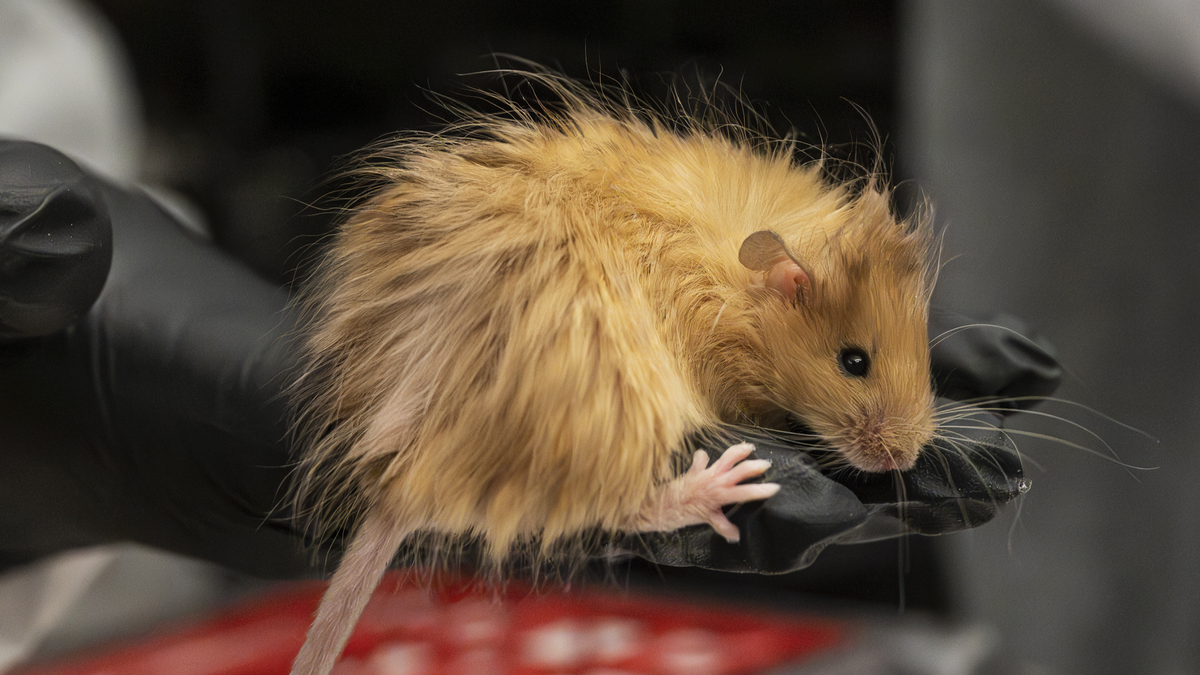
Scientists have created genetically engineered “woolly mice” with fur similar to the thick hair that kept woolly mammoths warm during the last ice age.
The biotechnology company Colossal Biosciences unveiled images and footage of the woolly mice on Tuesday (March 4). The adorable rodents mark a milestone in Colossal’s project to bring back woolly mammoths by 2028, the company said in a statement shared with Live Science.
“We actually just started this work in mice in September [2024],” Ben Lamm, Colossal’s co-founder and CEO, told Live Science. “We didn’t know they were going to be this cute.”
Colossal scientists plan to eventually “resurrect” woolly mammoths (Mammuthus primigenius) by first editing cells from the mammoths’ closest living relatives, Asian elephants (Elephas maximus), to create elephant-mammoth hybrid embryos with shaggy hair and other woolly mammoth traits. But before the researchers can start working with elephants, they must test the relevant gene edits and engineering tools in mice, which are easier to keep and quicker to breed.
Related: Woolly mammoth de-extinction inches closer after elephant stem cell breakthrough
“A mouse model is super useful in this case, because unlike elephants [whose gestation lasts about 22 months], mice have a 20-day gestation,” Beth Shapiro, an evolutionary biologist and chief science officer at Colossal, told Live Science.
The short gestation period enabled researchers to design, clone and grow the woolly mice in just six months, Lamm and Shapiro said. Colossal scientists described the results in a study that will be uploaded to the preprint database BioRxiv. The study has not been peer reviewed.
Fluffy rodents
To create the woolly mice, the researchers modified seven of the rodents’ genes, six of which were related to fur texture, length and color. The scientists selected these genes by screening for DNA sequences that control hair growth in mice and have evolutionary links to sequences that gave woolly mammoths shaggy hair.
“We haven’t taken mammoth genes and put them into a mouse,” Shapiro said. “We’ve looked for the mouse variants of the genes that we think are useful in mammoths and then created mice that have many of these edits simultaneously.”
Most of the edits “switched off” genes that are usually active in mice. For example, the scientists blocked a gene called FGF-5 that regulates hair length, resulting in mice with fur that is three times longer than standard laboratory mice.

The team also gave the mice mutations that existed in woolly mammoths, resulting in wavier fur than normal mice. Woolly mammoths had a truncated version of a gene called TGF alpha, as well as a mutation in the keratin gene KRT27, which the scientists incorporated into woolly mouse DNA.
The researchers used three genetic engineering techniques to add the edits into a single organism, including a technology called multiplex precision genome editing, which enables researchers to edit several DNA sites at once with high precision.
“It’s definitely a proof of concept that you can incorporate multiple mutations into a single mouse and make its hair look like mammoth hair,” Vincent Lynch, an evolutionary biologist and associate professor at the University at Buffalo who is not involved in the Colossal research, told Live Science.
Colossal scientists also focused on a gene that regulates fat metabolism and fatty acid absorption in mice. Woolly mammoths thrived in frigid temperatures in part thanks to fat deposits beneath their skin, so the team attempted to confer the same deposits onto mice by editing the associated DNA sequence.

But the effects of this insertion are unclear, Lynch said. “I guess they expected the mouse to have more or less body fat,” he said, adding that the physical outcomes are likely too small to observe.
It’s still unclear whether the genetically modified mice can tolerate colder conditions than standard mice, but Colossal scientists say they will test this in the coming months. “We know that the edits are in there, so now we just need to test what level of cold tolerance it confers,” Lamm said.
While woolly mice are a step closer to the goal of bringing woolly mammoths back, there are still significant hurdles to overcome. For example, the technology involved in engineering the woolly mice is very advanced, but it’s a far cry from what will be needed to get similar results in elephants, Lynch said. Mice have naturally dense hair, but that is not the case in elephants, meaning the technical challenge will be much greater, he said.
“Elephants have fur, but the density of the hair is much less than other mammals, so even if they could make those mutations in an Asian elephant […] it’s just going to be really sparse,” Lynch said. “So what you need to do, actually, is a bunch of additional genome editing to somehow find a way to increase the density of the hair.”
