

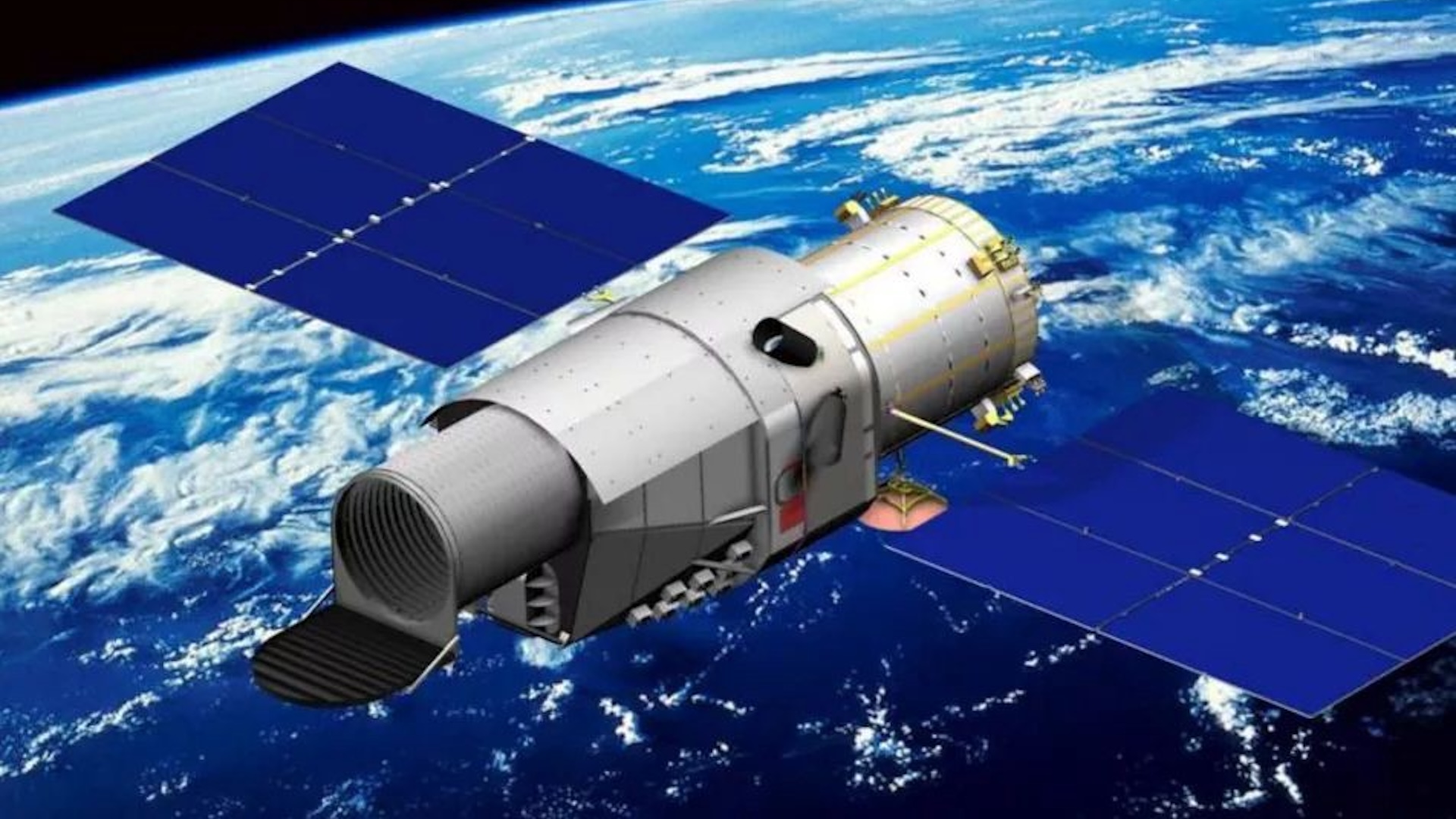
China’s space agency is building a new space telescope that will rival current top-tier observatories. Known as the China Space Station Telescope (CSST), it will not only be as powerful as the cutting-edge James Webb Space Telescope (JWST), but will also be fully repairable and upgradable from space.
The CSST will join the next generation of game-changing telescopes. These include the Euclid space telescope, which was launched by the European Space Agency in July 2023; NASA’s Nancy Grace Roman Space Telescope, which is in its final launch preparation; and the Vera C. Rubin Observatory, a massive ground-based installation with first light expected this summer.
These massive observatories have a wide range of observational targets. But one of their primary missions is to conduct surveys of the deep universe to attempt to solve a number of cosmological mysteries.
Now joining this trio is another world-class cosmology observatory. In Mandarin, the telescope is known as Xuntian, which means “surveying the sky,” which is highly appropriate given its intended mission. Project scientists shared new details of the mission in a paper posted to the preprint database arXiv on Jan. 25.
Related: Can the James Webb Space Telescope really see the past?
Set to launch no earlier than 2026, the telescope will feature a primary mirror with a diameter of 6.6 feet (2 meters). Even though that’s slightly smaller than the width of the Hubble Space Telescope’s mirror, the CSST’s advanced optics will give it a field of view at least 300 times greater than Hubble’s. Its observations will span the light spectrum from near-ultraviolet to near-infrared.
Chasing cosmic mysteries
With those capabilities, the CSST will perform a number of critical tests and measurements.
One of its primary missions will be to measure something called weak gravitational lensing. The light from distant galaxies gets slightly bent on its way to us due to the relatively small curvatures of space from all the intervening galaxies. By mapping hundreds of thousands of galaxies and searching for subtle distortions in their shapes, astronomers hope to build exquisite maps of the distribution of matter in the universe. These maps could give scientists clues about the mysterious nature of dark matter, which makes up most of the universe’s matter but does not interact with light and thus can’t be seen directly.
At larger scales, the CSST will study the statistics of voids and clusters. Voids are the vast, empty regions between galaxies, and clusters are dense groupings of galaxies. The properties of both voids and clusters — how big they are, how far apart they are from each other, and so on — depend on the nature of dark energy, the mysterious substance that appears to be accelerating the expansion of the universe.
To top it all off, the CSST will search for supernovas and measure something called baryon acoustic oscillations. The supernovas provide a fixed measure to distant galaxies, and the baryon acoustic oscillations are remnants from when the universe was still a plasma, billions of years ago. Both are vital tools for understanding the evolution of the cosmos.
The CSST will complement the other top-tier instruments, thus providing access to different regions of the universe and to different distances. The hope is that all four world-class telescopes will coordinate their efforts.
But the CSST has one more trick up its sleeve. There’s a reason it has “station” in its name: After launch, it will share an orbit with the Chinese Tiangong space station. They won’t always fly right next to each other, but their orbits will bring them close on a regular basis.
This arrangement makes it a snap for the Chinese space agency to service the telescope, trade out instrument modules, and even perform upgrades — an ability the other space-based telescopes will lack. So although those other instruments will have finite lifetimes, the CSST may continue to provide reliable, useful cosmological data for many decades into the future.
