
The breakup of the ancient supercontinent Nuna during Earth’s “Boring Billion” years drastically shook up the planet, and the reshuffle may have created the conditions that gave rise to complex life, new research shows in unprecedented detail.
The Boring Billion refers to the period between 1.8 billion and 800 million years ago. Even though this interval encompassed the breakup and assembly of two ancient supercontinents, Nuna and Rodinia, scientists gave the period this name due to a perceived lack of upheaval.
“The term was coined to describe what appeared to be a long interval of geochemical, climatic, and biological stability in Earth’s history,” Dietmar Müller, a professor of geophysics at the University of Sydney who led the new research, told Live Science in an email. “However, we now know that this interval was less boring in terms of plate tectonics and evolutionary changes than previously thought.”
Nuna’s breakup set off a chain of events that made Earth more hospitable to life, according to a study published Oct. 27 in the journal Earth and Planetary Science Letters. As pieces of Nuna drifted away from the supercontinent’s core, shallow seas mushroomed in the gaps between them that were more temperate and oxygen-rich than previous oceans had been, first-of-their-kind simulations revealed.
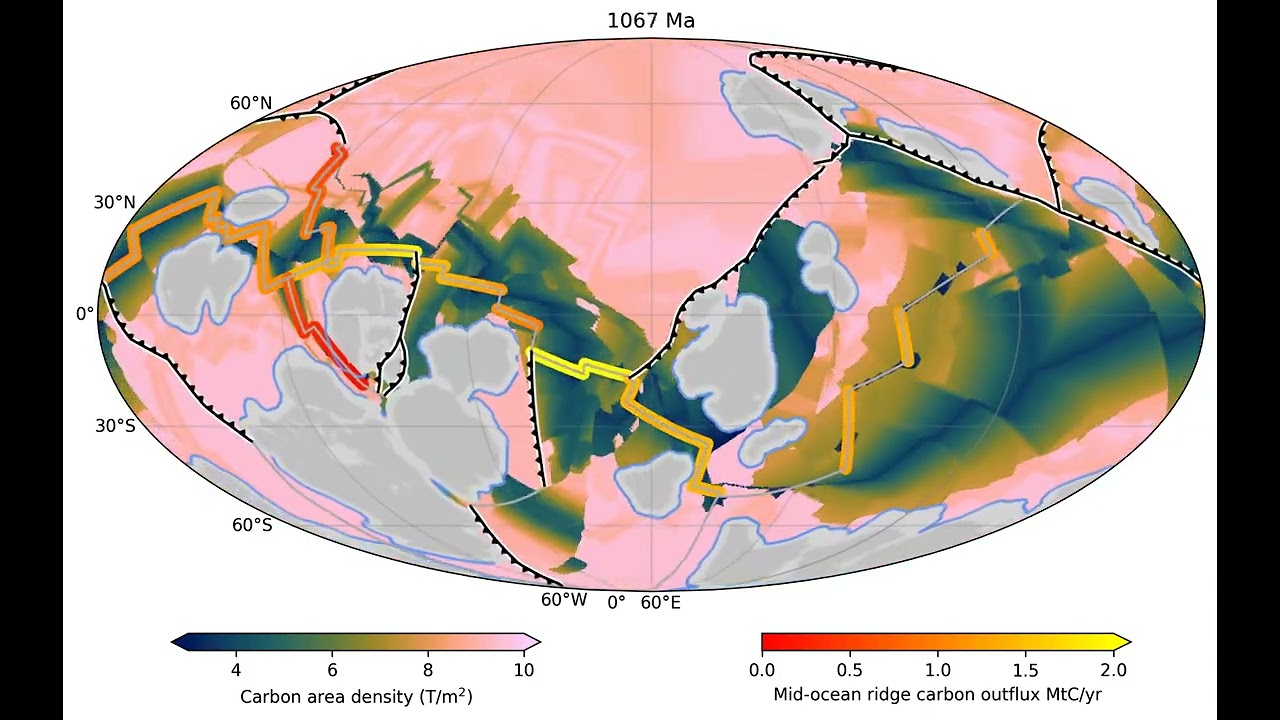
The researchers reconstructed tectonic-plate movements and related changes in carbon storage and emissions over the past 1.8 billion years, using a cutting-edge model they recently released. The novelty of the method lies in its ability to reconstruct carbon fluxes in greater detail than has been possible so far, the team wrote in the study.
Over the course of 350 million years during the Boring Billion, the total length of shallow seas around landmasses doubled to about 81,000 miles (130,000 kilometers), equivalent to more than three times Earth’s circumference at the equator, the team found. At the same time, subduction zones — where one tectonic plate dives beneath another — shortened overall due to how the plates were shifting, according to the study.
Subduction zones trigger volcanic activity at the surface because they inject seawater that lowers the melting temperature of rocks into Earth’s mantle, the layer that sits beneath the crust. This facilitates the formation of magma, which then rises into the crust and erupts from volcanoes along with debris and gases such as carbon dioxide (CO2).
As subduction zones shortened, the amount of CO2 escaping from Earth’s interior into the atmosphere decreased. This cooled the planet and helped establish the oxygen-rich conditions in the newly formed shallow seas, and these relatively stable ecosystems gave rise to more complex life than had existed so far, the researchers suggested.
“We think these vast continental shelves and shallow seas were crucial ecological incubators,” study co-author Juraj Farkaš, an associate professor in the School of Physics, Chemistry and Earth Sciences at the University of Adelaide in Australia, said in a statement. “They provided tectonically and geochemically stable marine environments with presumably elevated levels of nutrients and oxygen, which in turn were critical for more complex lifeforms to evolve and diversify on our planet.”
Specifically, shallow seas may have sped up the diversification of eukaryotes — organisms whose cells have specialized structures called organelles and a membrane-bound nucleus that houses the DNA. All animals, plants and fungi are eukaryotes, so the emergence of eukaryotic cells during the Boring Billion was a key step in the evolution of complex life, the study authors proposed.
Researchers already knew that eukaryotes evolved during the Boring Billion thanks to fossil evidence dating to 1.05 billion years ago. But the conditions under which these organisms emerged remained unclear.
“The breakup of Nuna created a lot of new ocean floor in young ocean basins that previously did not exist,” Müller explained. And this ocean floor contributed to the decline of atmospheric CO2 already triggered by the shortening of subduction zones, he said. That’s because when seawater seeps into cracks in the seabed, carbon gets stripped out to make limestone.
“This ocean floor was altered by hydrothermal fluid circulation and stored carbon in the form of carbonate cements in voids and fractures, drawing down atmospheric CO2,” Müller said.
In short, ancient supercontinent Nuna’s breakup sparked three major changes that benefited complex life: It created shallow seas, diminished outgassing from volcanoes, and locked carbon away in ocean sediments, leading to a more oxygen-rich atmosphere and temperate conditions.
“The next steps will be to discover more well preserved eukaryote fossils to document their earliest evolution,” Müller concluded.
