
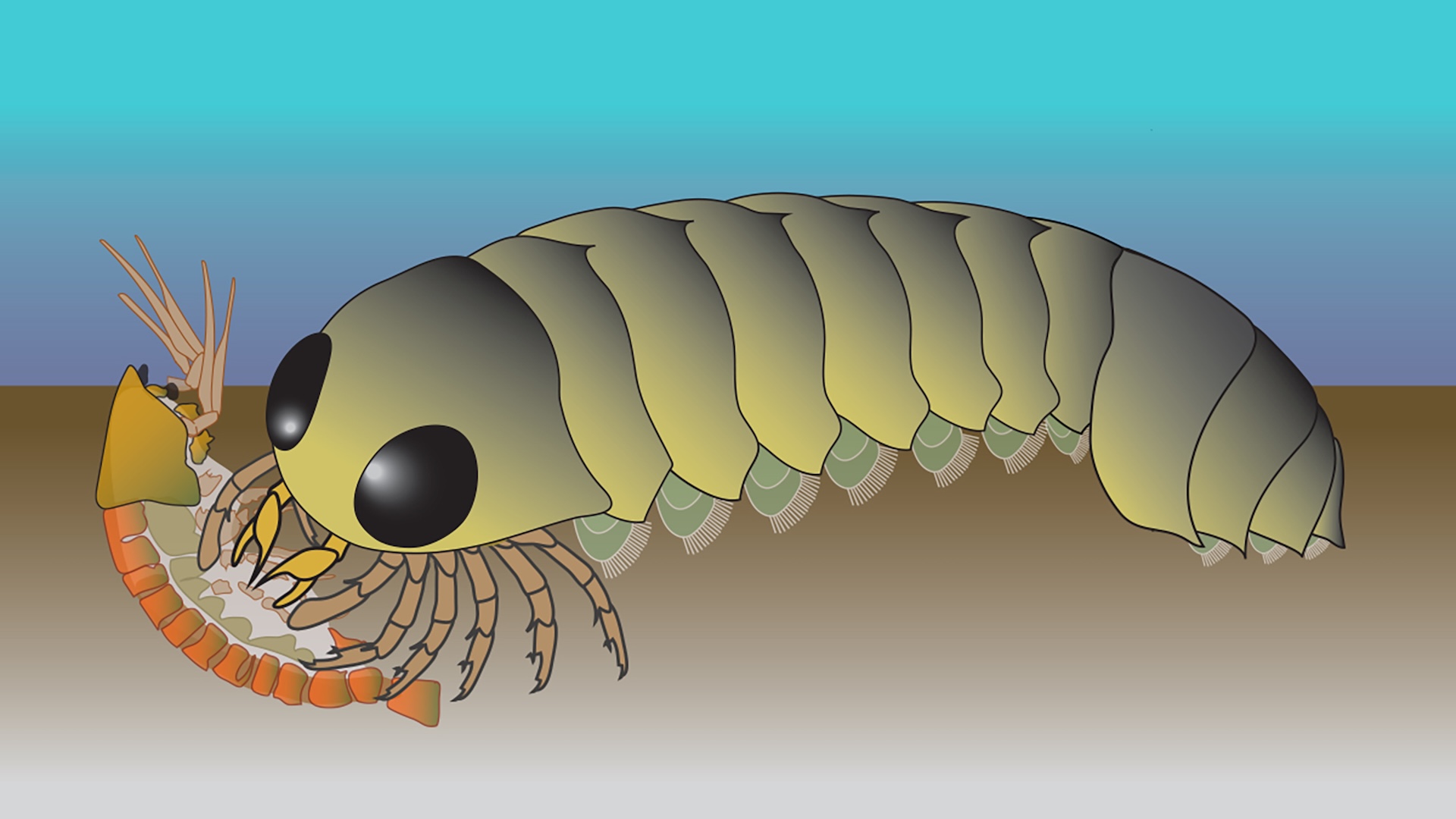
An unusual fossil brain suggests that the ancestors of spiders and other arachnids may have once scuttled around the sea, rather than on land as was long thought, a new study finds.
The fossil shows that certain features of the brain of a now-extinct animal known as Mollisonia symmetrica are arranged backward compared with those of most modern arthropods, a large group of invertebrates that includes animals like insects, crustaceans and millipedes. However, M. symmetrica‘s brain is similar to those in one arthropod group: arachnids, a class that includes spiders, scorpions and ticks. This difference suggests that the marine-dwelling M. symmetrica is an early ancestor of modern arachnids, researchers reported Tuesday (June 22) in the journal Current Biology.
“It is still vigorously debated where and when arachnids first appeared, and what kind of chelicerates were their ancestors, and whether these were marine or semi-aquatic like horseshoe crabs,” study co-author Nicholas Strausfeld, a professor who specializes in arthropod neuroscience at the University of Arizona, said in a statement. Chelicerates make up a major group of arthropods that includes arachnids and horseshoe crabs.
Chelicerates like M. symmetrica branched off from other arthropods by the mid-Cambrian period. The Mollisonia genus, which has four known species, lived between approximately 515 million and 480 million years ago. The species M. symmetrica had a segmented body like that of a scorpion, a round carapace and six pairs of appendages for moving and hunting.
Although scientists aren’t sure exactly when arachnids branched off further from other chelicerates, arachnids have been around for some 400 million years. Until now, their fossil record suggested they lived exclusively on land.
In the new study, the researchers investigated the fossilized brain and central nervous system of a M. symmetrica specimen from the Burgess Shale formation of the Canadian Rockies. They found that the animal’s brain was not organized like that of a horseshoe crab of the genus Limulus. Instead, certain regions of its brain appear to be arranged in the opposite direction compared with those of other arthropods, similar to how modern spiders’ brains are laid out. This suggests that arachnids evolved and diverged from horseshoe crabs earlier than scientists had thought.

“It’s as if the Limulus-type brain seen in Cambrian fossils, or the brains of ancestral and present [day] crustaceans and insects, have been flipped backwards, which is what we see in modern spiders,” Strausfeld said.
Related: Why do spiders have 8 legs?
This opposite arrangement is exclusive to arachnid brains in modern animals, suggesting that M. symmetrica was an early arachnid and that this unique arrangement evolved in the ocean rather than later on land. Studies of existing spider brains suggest that the inverted setup allows spiders to coordinate many aspects of predatory movement, including their stealth, speed and dexterity.
“The arachnid brain is unlike any other brain on this planet, and it suggests that its organization has something to do with computational speed and the control of motor actions,” Strausfeld said.

Spiders’ stealth and speed as hunters on land may have contributed to the evolution of insect wings, which would have allowed prey to escape, Strausfeld added.
“Being able to fly gives you a serious advantage when you’re being pursued by a spider,” Strausfeld said. “Yet, despite their aerial mobility, insects are still caught in their millions in exquisite silken webs spun by spiders.”
To figure out whether the similarities between M. symmetrica‘s brain and those of modern spiders came from a common lineage or mere coincidence, the researchers used a computer program to estimate the likelihood that the two were related. To do this, they compared brain and body traits of several living and extinct arthropods. The analysis suggested that the Mollisonia lineage eventually evolved into the arachnid group, meaning that it may have led to “the planet’s most successful arthropodan predators,” the researchers wrote in the study.
Spider quiz: Test your web of knowledge
