
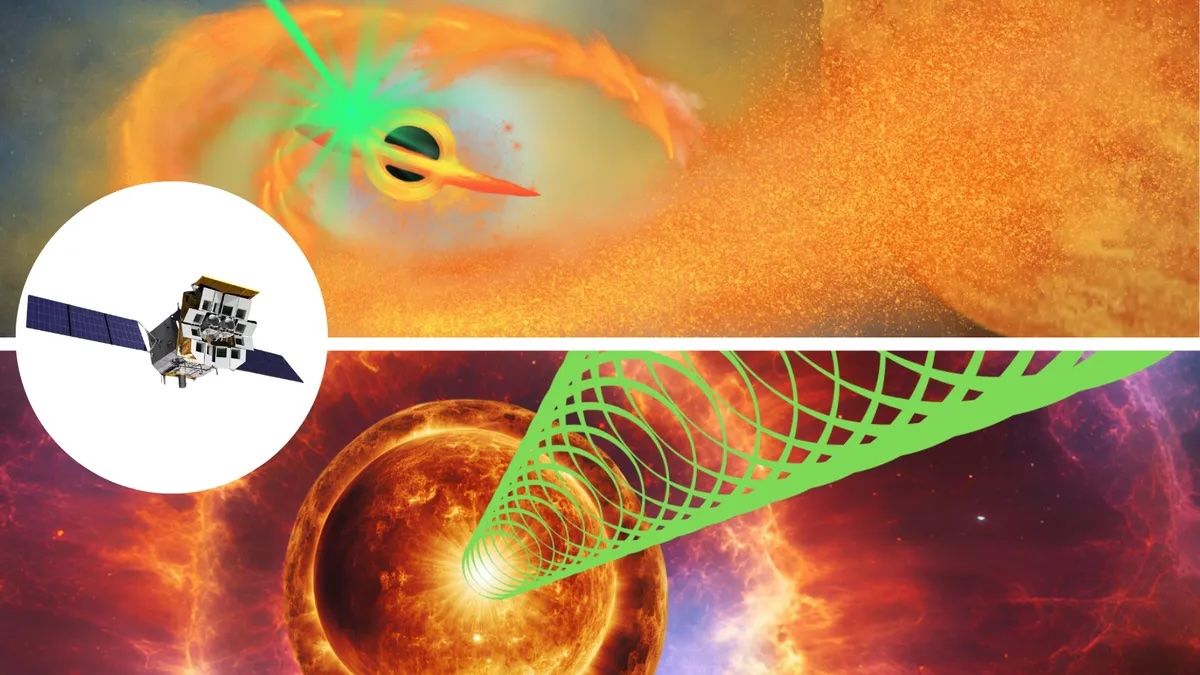
Astronomers are trying to understand a mysterious cosmic explosion that the Einstein Probe spacecraft spotted in April last year.
The highly energetic explosion was initially attributed to a burst of gamma rays emitted either by the collision of two neutron stars or from the death of a massive star. Soon, however, the possibility emerged that the unusual explosion, designated EP240408A, could have been the result of a supermassive black hole ripping apart and consuming a star in what is known as a tidal disruption event (TDE).
However, EP240408A refused to conform to what is expected of either of these powerful cosmic events, opening up the possibility that what the Einstein Probe actually saw with its X-ray eye was something entirely new!
The lingering nature of this mystery prompted an international team of astronomers to follow up on EP240408A with observations from a wealth of ground and space-based telescopes.
This included NASA’s Nuclear Spectroscopic Telescope Array (NuSTAR) and Neutron star Interior Composition Explorer (NICER) instruments.
“EP240408A ticks some of the boxes for several different kinds of phenomena, but it doesn’t tick all the boxes for anything. In particular, the short duration and high luminosity are hard to explain in other scenarios,” team member and Carnegie Mellon University researcher Brendan O’Connor said in a statement. “The alternative is that we are seeing something entirely new!”
This introduced the possibility that EP240408A could be the result of a new and rare cosmic event called a “jetted TDE.”
Related: ‘Impossible’ black holes detected by James Webb telescope may finally have an explanation — if this ultra-rare form of matter exists
The tale of jetted tidal disruption events
TDEs occur when unfortunate stars wander too close to supermassive black holes at the heart of galaxies.
With masses equivalent to that of millions or even billions of suns, supermassive black holes exert a tremendous and terrifying gravitational influence. This generates powerful tidal forces in stars that get too close, squashing them horizontally and stretching them vertically.
This rips up those stars, turning them into a noodle-like strand of plasma in a process called “spaghettification.” This stellar pasta can’t fall directly to the black hole because it has angular momentum. Instead, this matter wraps around the supermassive black hole like spaghetti wrapping around a fork, forming a flattened cloud called an accretion disk. From the accretion disk, this stellar material is gradually fed to the central supermassive black hole.

Jetted TDEs are thought to account for just around 1% of all TDEs. Quite what causes them isn’t yet certain.
In separate research, also published in The Astrophysical Journal Letters, back in Oct. 2023, researchers suggested that jetted TDEs occur when there is a significant misalignment between the rotation axis of the supermassive black hole and the orbital plane of the star it is devouring.
As the magnetic properties of the black hole bring the stellar material into alignment over the course of weeks to years, jets erupt from these TDEs, distinguishing them from the other 99% of similar star-destroying events.

First detected in 1967, gamma-ray bursts may be much more familiar to astronomers than jetted TDEs, but that doesn’t make them any less fascinating.
Gamma-ray bursts are the most energetic explosions in the universe, releasing as much as a quintillion (10 followed by 18 zeroes) times the energy that is radiated by the sun. This is suspected to announce the birth of a stellar-mass black hole either when a massive star dies or when two neutron stars collide and merge.
The key to determining what caused EP240408A may lie with one of the aforementioned NASA projects.
“NICER’s ability to steer to pretty much any part of the sky and monitor for weeks has been instrumental in our understanding of these unusual cosmic explosions,” explained Massachusetts Institute of Technology (MIT) researcher and team member Dheeraj Pasham.
As astronomers continue to attempt to solve this mystery, the Einstein Probe promises to set up even more. But at least one researcher on this team is thrilled by that prospect.
“I’m excited to chase the next weird explosion from the Einstein Probe,” said Pasham.
The team’s research was published on Jan. 27 in The Astrophysical Journal Letters.
Originally posted on Space.com.
