Close Menu
  • Home
  • UNSUBSCRIBE
  • News
  • Lifestyle
  • Tech
  • Entertainment
  • Sports
  • Travel
Facebook X (Twitter) WhatsApp
Trending
  • Cooking Demonstrations and Movie Screenings
  • Brain aging results from a loss of control over how genes are regulated, mouse study suggests
  • Trump says Iran’s sinister hidden leaders are making a peace deal difficult
  • Stocks fall, oil prices rise amid doubts over U.S.-Iran talks
  • Live Science Today: Meta and Google fined for causing social media addiction and how dogs were our friends for millennia
  • Paige Spiranac gives important golf tips to women
  • Group homes and state spending on them boom in Brooklyn Park
  • Explore the natural world from the comfort of your own home with this Paramount+ streaming deal
Facebook X (Twitter) WhatsApp
Baynard Media
  • Home
  • UNSUBSCRIBE
  • News
  • Lifestyle
  • Tech
  • Entertainment
  • Sports
  • Travel
Baynard Media
Home»Lifestyle»Astronomers discover surprisingly lopsided disk around a nearby star using groundbreaking telescope upgrade
Lifestyle

Astronomers discover surprisingly lopsided disk around a nearby star using groundbreaking telescope upgrade

EditorBy EditorOctober 31, 2025No Comments4 Mins Read
Share Facebook Twitter Pinterest LinkedIn Tumblr Reddit Telegram Email
Share
Facebook Twitter LinkedIn Pinterest Email

Astronomers have discovered a surprisingly lopsided disk surrounding the mysterious nearby star Beta Canis Minoris, thanks to a brand new “photonic lantern” device that could vastly improve the observing power of ground-based telescopes.

Beta Canis Minoris, also known as Gomeisa, is around 3.5 times more massive than the sun and is located approximately 162 light-years from Earth in the Canis Minor constellation, where it is visible to the naked eye at night. Despite its relative proximity to Earth, researchers still don’t know much about it. For example, past research suggested it is a close binary system made up of two smaller stars orbiting one another in extreme proximity, but this has not yet been confirmed.

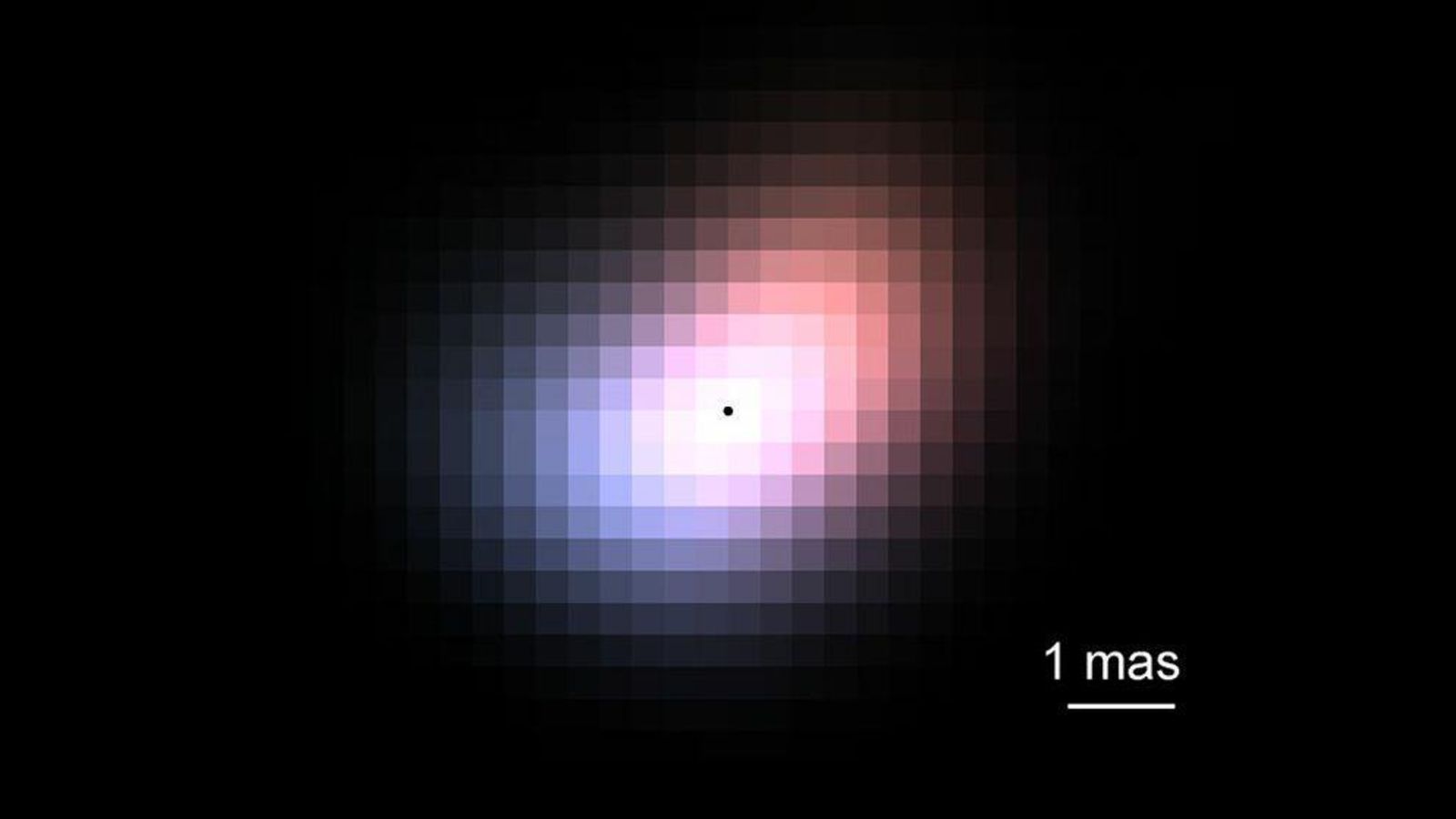
In a new study, published Oct. 22 in The Astrophysical Journal Letters, researchers used their new photonic lantern device, attached to the Subaru Telescope on the summit of Mauna Kea in Hawaii, to photograph the puzzling star. This revealed that the swirling disk of hydrogen gas circling the star is not as symmetrical as expected, which could be further evidence that it’s a binary system.


You may like

“We were not expecting to detect an asymmetry like this, and it will be a task for the astrophysicists modeling these systems to explain its presence,” study lead-author Yoo Jung Kim, a doctoral student at the University of California, Los Angeles, said in a statement.

But what really excites the study team is that their new device achieved such a high level of detail on its very first use. They believe that the small device captured the “sharpest-ever measurement of a star’s surrounding disk” acquired by a single ground-based telescope.

A photo of three telescopes on top of a mountain

The photonic lantern was attached to the Subaru telescope (left) on the summit of Hawaii’s Mauna Kea. (Image credit: Julie Thurston Photography via Getty Images)

The photonic lantern can be attached to almost any optical observatory-grade telescope. It works by taking light from an object and splitting it up into individual strands — “like separating a chord into its individual musical notes,” researchers wrote in the statement. Each strand is then separated further by wavelength, like the colours in a rainbow, before all the individual bits of information are recombined using specialized computer software.

This process enables astronomers to partially bypass a major limitation of visual astronomy, known as the “diffraction limit,” which is caused by subtle fluctuations that occur across multiple wavelengths of light as it passes through Earth’s atmosphere. With the new device, the researchers can see “subtle details that are otherwise lost,” Kim said.

Get the world’s most fascinating discoveries delivered straight to your inbox.

In this case, the lantern enabled the team to more accurately measure subtle color variations in the star’s gas disk, which are caused by the Doppler effect — the change in the frequency of a wave due to the relative motion of its source and the observer. Half of the disk is tinted blue because it is spinning towards us, while the other half has a redder hue because it is spinning away from us. However, the color variation on each side of the star does not perfectly match, meaning the gas was not spinning in a perfect disk.

Side-by-side photos of a research next to some equipment and a close-up of the photonic lantern device

The photonic lantern is a small device that can be added to instruments on larger telescopes. The yellow line on the right-hand image represents light entering the device. (Image credit: Sébastien Vievard/University of Hawaiʻi at Manoa)

Normally, this type of insight is only available to space-based assets — like the James Webb Space Telescope — which don’t have to contend with atmospheric disturbance, or by stacking together multiple images from different ground-based telescopes. However, the photonic lantern can boost the power of single ground-based telescopes so they can achieve comparable results, the researchers said.

“In astronomy, the sharpest image details are usually obtained by linking telescopes together,” Kim said. “But we did it with a single telescope.”

The team will now study other objects with their new device and attach it to other telescopes to see if the same level of observing power can be replicated.

“We are just getting started,” study co-author Nemanja Jovanovic, an astronomer and photonics expert at Caltech, said in the statement. “The possibilities are truly exciting.”

Source link

Share. Facebook Twitter Pinterest LinkedIn Tumblr Email
Previous ArticleSteve Smith Sr questions whether Keon Coleman’s elite receiver ability
Next Article Powerful storm hits mid-Atlantic and Northeast
Editor
  • Website

Related Posts

Lifestyle

Brain aging results from a loss of control over how genes are regulated, mouse study suggests

March 26, 2026
Lifestyle

Live Science Today: Meta and Google fined for causing social media addiction and how dogs were our friends for millennia

March 26, 2026
Lifestyle

Explore the natural world from the comfort of your own home with this Paramount+ streaming deal

March 26, 2026
Add A Comment

Comments are closed.

Categories
  • Entertainment
  • Lifestyle
  • News
  • Sports
  • Tech
  • Travel
Recent Posts
  • Cooking Demonstrations and Movie Screenings
  • Brain aging results from a loss of control over how genes are regulated, mouse study suggests
  • Trump says Iran’s sinister hidden leaders are making a peace deal difficult
  • Stocks fall, oil prices rise amid doubts over U.S.-Iran talks
  • Live Science Today: Meta and Google fined for causing social media addiction and how dogs were our friends for millennia
calendar
March 2026
M T W T F S S
 1
2345678
9101112131415
16171819202122
23242526272829
3031  
« Feb    
Recent Posts
  • Cooking Demonstrations and Movie Screenings
  • Brain aging results from a loss of control over how genes are regulated, mouse study suggests
  • Trump says Iran’s sinister hidden leaders are making a peace deal difficult
About

Welcome to Baynard Media, your trusted source for a diverse range of news and insights. We are committed to delivering timely, reliable, and thought-provoking content that keeps you informed
and inspired

Categories
  • Entertainment
  • Lifestyle
  • News
  • Sports
  • Tech
  • Travel
Facebook X (Twitter) Pinterest WhatsApp
  • Contact Us
  • About Us
  • Privacy Policy
  • Disclaimer
  • UNSUBSCRIBE
© 2026 copyrights reserved

Type above and press Enter to search. Press Esc to cancel.