
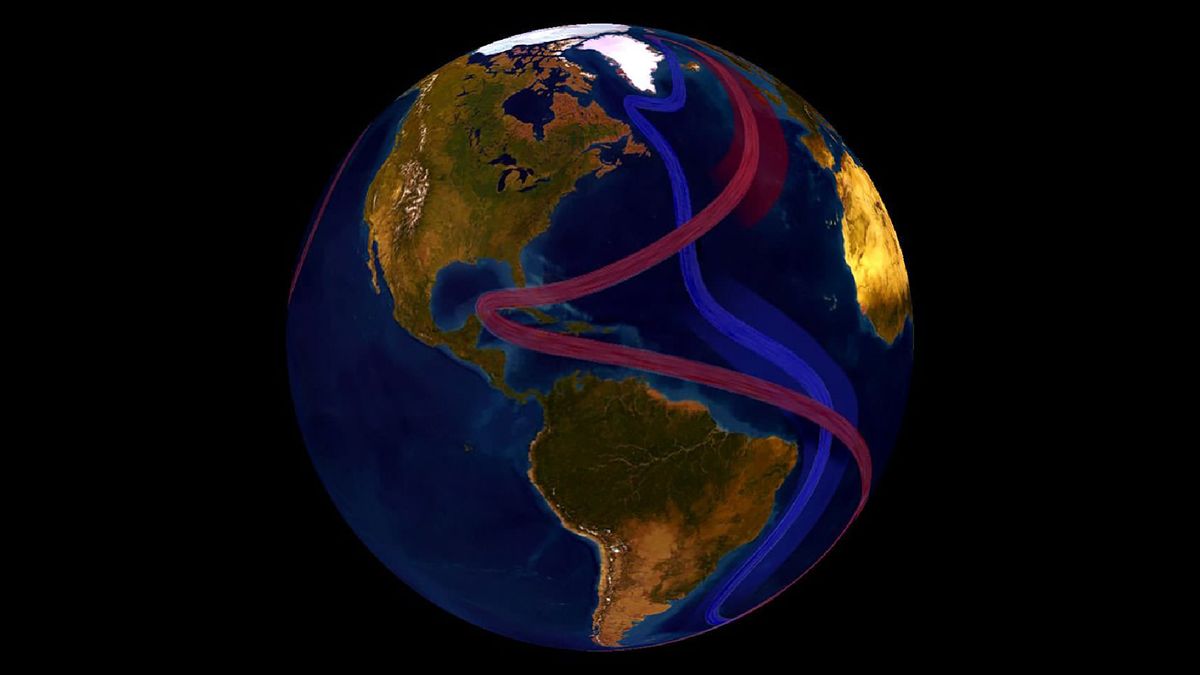
Scientists say there is a high chance that key Atlantic Ocean currents will weaken over the coming decades due to climate change — but whether they have already slowed is hotly debated. Now, a new study finds that Atlantic circulation has remained stable since the 1960s, suggesting the system may be more resilient to warming than scientists thought.
But the results are controversial. Previous studies show mixed results, with some papers concluding that the Atlantic Meridional Overturning Circulation (AMOC) is weaker now than at any point in the past millennium, and others finding little to no evidence for a decline in current strength.
“I would say that whether or not the AMOC has weakened is still an open question,” Maya Ben-Yami, a climate researcher at the Technical University of Munich in Germany who was not involved in the new study, told Live Science in an email.
The AMOC is a system of Atlantic Ocean currents, including the Gulf Stream, that circulate in a giant loop from Antarctica to Greenland. It transports heat to the Northern Hemisphere. Should it weaken, it could trigger significant cooling in Northern Europe and dramatic disruptions to weather patterns worldwide.
Related: ‘We are approaching the tipping point’: Marker for the collapse of key Atlantic current discovered
Direct observations of AMOC’s strength only go back to 2004. So to measure longer-term trends in Atlantic circulation, researchers rely on climate parameters, or “fingerprints,” they think are linked to the AMOC. These include sea surface temperature, salinity, sea surface height, water density and data from marine sediments, Ben-Yami said.
“The reason we’re not sure about the AMOC weakening is that all these different fingerprints can give us different results,” she said.
The results of the new study, published Jan. 15 in the journal Nature Communications, suggest the AMOC has not weakened over the past 60 years.
‘Rather inaccurate’ data
The scientists estimated AMOC strength using the newest generation of climate models, which are more sensitive to rising greenhouse gas concentrations in the atmosphere than previous models. The researchers tested 24 models in total and found that the most commonly used fingerprint, sea surface temperature, had a weaker relationship to the AMOC than previously thought.
So the team instead focused on an indicator called the “sea-air heat flux,” which simulates the exchange of heat between the ocean and the atmosphere. Should the AMOC weaken, less heat would pass from the ocean to the atmosphere in the North Atlantic. But the models showed no decline in heat transfer over the past 60 years, suggesting the AMOC has remained stable during this time.
“Our paper says that the Atlantic overturning has not declined yet,” study co-author Nicholas Foukal, an assistant scientist at the Woods Hole Oceanographic Institution, said in a statement. “That doesn’t say anything about its future, but it doesn’t appear the anticipated changes have occurred yet.”
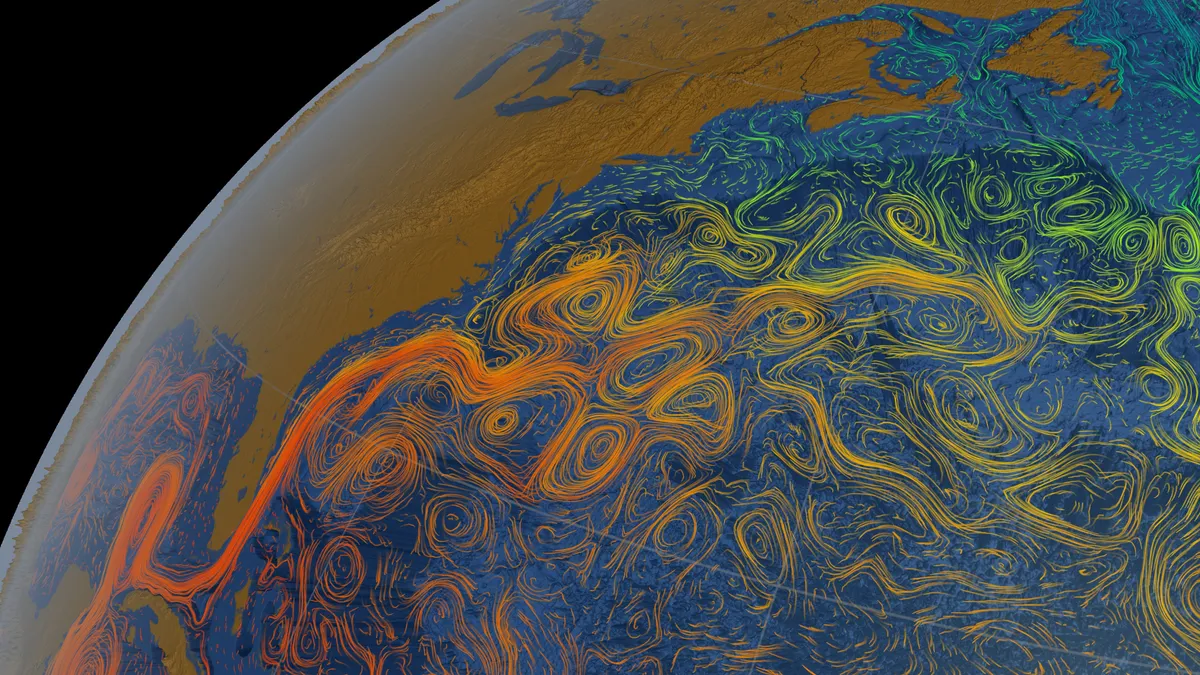
However, several researchers have criticized the study. Climate models simulate sea-air heat fluxes by assimilating observational data like temperature and salinity, meaning any assumptions and gaps in the observations can lead to erroneous flux estimates, Ben-Yami said.
Foukal and colleagues acknowledge these uncertainties in the paper, but they argue that their results are robust nevertheless.
Countless factors can influence transfers of heat from the ocean to the atmosphere, said Stefan Rahmstorf, a professor and oceanographer who co-leads the Earth system analysis research department at the Potsdam Institute for Climate Impact Research in Germany.
“Surface heat loss depends also on air temperature, wind speed, humidity, radiation and cloud cover in complex ways, all of which are not accurately known,” Rahmstorf told Live Science in an email. “Therefore, these surface heat loss data are rather inaccurate and in my view not so well suited to reconstruct the AMOC time evolution.”
The newest climate models may also not be best suited to this type of analysis, because of their sensitivity and failure to reproduce some past ocean events, Rahmstorf said. “I do not believe that the new attempt to reconstruct the AMOC is more reliable than earlier methods,” he said.
Useful new insight
Other experts were less critical of the new research. “The new steer towards focusing on air-sea heat fluxes makes intuitive sense and is useful new insight,” David Thornalley, a professor of climate and ocean science at University College London who was not involved in the study, told Live Science in an email.
Thornalley’s previous work suggests the AMOC has weakened significantly, but that it did so during the 1800s, with a period of relative stability following in the 1900s. “The idea that there may have been little change over the past 60 years is not too new,” he said.
Regardless of the study’s uncertainties, the new research contributes to a better understanding of the AMOC, Ben-Yami said. Ultimately, the question of whether the AMOC weakened in the past does not impact what scientists think will happen going forward. “The AMOC will definitely weaken in the future,” Ben-Yami said.
Other researchers agreed. Even with deep cuts to greenhouse gas emissions, “it’s almost unanimous at this point that the Atlantic overturning will slow in the future,” Foukal concluded.
