
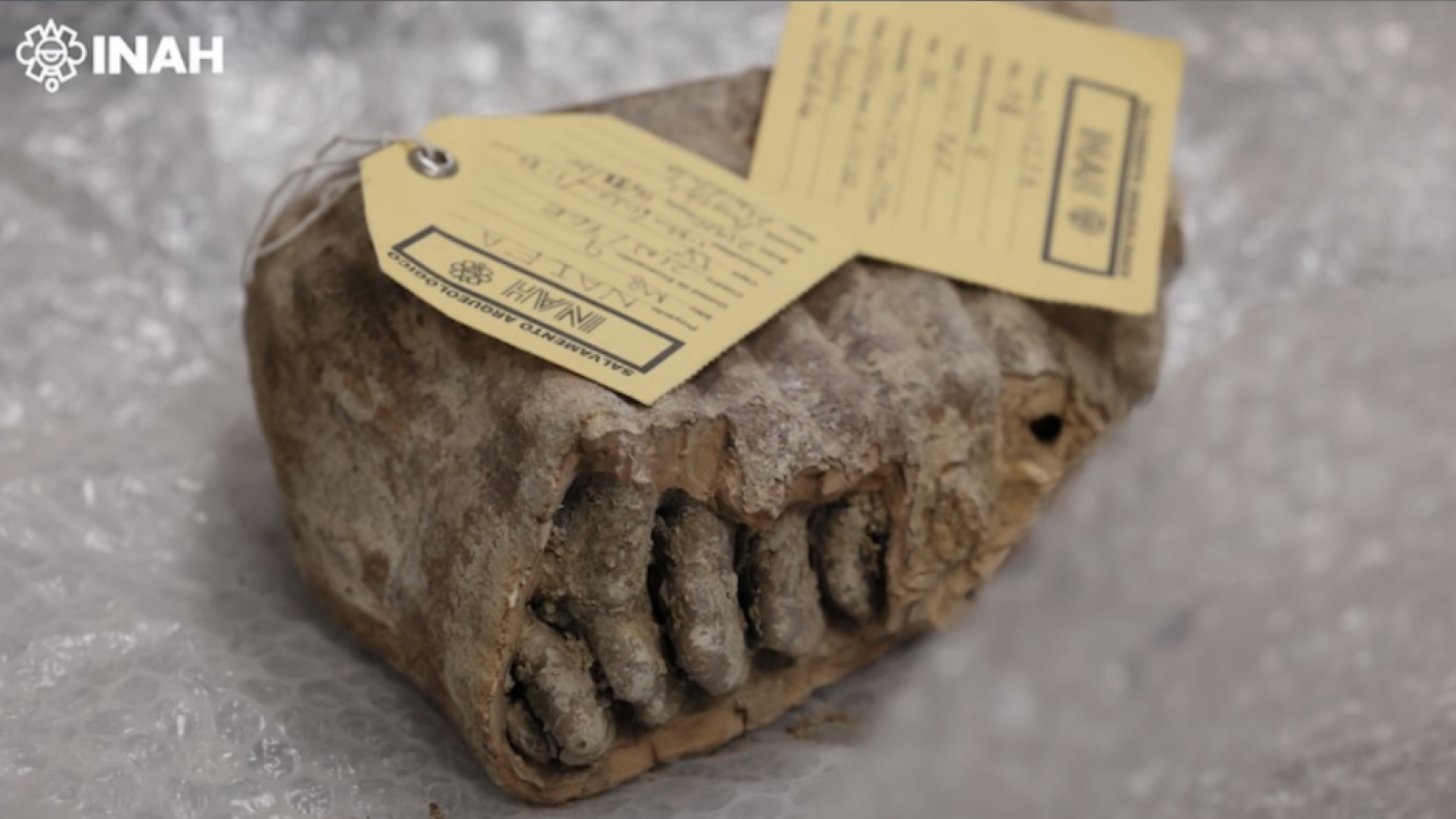
For the first time in tropical latitudes, scientists have sequenced ancient DNA from the only mammoth endemic to North and Central America: the Columbian mammoth. The research revealed unexpected — and as yet unexplained — genetic differences that made these animals distinct from their northern counterparts.
Columbian mammoths (Mammuthus columbi) were approximately 13feet (4 meters) tall and towered over their woolly mammoth (Mammuthus primigenius) relatives, with whom they co-existed and even interbred. Their fossils have been discovered in Canada, the U.S., Mexico and Central America. But information regarding how they evolved in the Americas remains unclear.
Construction beginning in 2019 of the Felipe Ángeles International Airport in Santa Lucía, Mexico, uncovered a vast wealth of Pleistocene (2.6 million to 11,700 years ago) fossils, including more than 100 Columbian mammoths.
The sheer amount of fossils, said Federico Sánchez-Quinto, a paleogenomicist at the National Autonomous University of Mexico’s (UNAM) International Laboratory for Human Genome Research, prompted him to reach out to those involved with the excavation. This is what ultimately led to the team’s DNA work.
When an animal dies, its DNA rapidly degrades, something that is compounded further by heat. In that respect, “DNA is like ice cream,” Sánchez-Quinto told Live Science, as it preserves better in the cold. Nonetheless, Ángeles Tavares-Guzmán, co-author and biotechnology engineer, was “hopeful” about their chances, especially as another team recently extracted ancient DNA from a similarly warm climate.
Related: ‘Closer than people think’: Woolly mammoth ‘de-extinction’ is nearing reality — and we have no idea what happens next
In total, the scientists sequenced 61 mitochondrial genomes from 83 mammoth molars. Five radiocarbon-dated samples indicate they were between 11,000 to 16,000 years old. The research was published Aug. 28 in the journal Science.
By piecing together ancient DNA, scientists can better trace the path mammoths took across the Americas. But in this case, the sequencing revealed some puzzling findings.
Research from 2021 indicates that a previously unknown lineage of the Eurasian steppe mammoth (Mammuthus trogontherii) mated with woolly mammoths (Mammuthus primigenius) before crossing Beringia — an icy land bridge — into North America 800,000 to 400,000 years ago, which ultimately resulted in the Columbian mammoth species.

One theory is that Columbian mammoths continued to migrate southward until eventually reaching what is now Mexico — a theory that would be substantiated by finding animals with similar DNA in both Mexico and farther north.
But instead, the team uncovered evidence that the Columbian mammoths in Mexico are genetically different from those in the U.S. and Canada. In other words, although the Mexican Columbian mammoths are the same species as U.S. and Canadian Columbian mammoths, their specific genetic make-up is different.
The team also found that the common ancestor of the Mexican Columbian mammoths diverged much earlier than those that migrated to and remained within the U.S. and Canada.
Study co-author Eduardo Arrieta-Donato, a researcher at UNAM’s International Laboratory for Human Genome Research, suggested thinking of that common ancestor as the Mexican mammoths’ great, great, great grandmother. “[She] was already a hybrid of the steppe mammoths and the woolly mammoths from Beringia,” he said. As her descendants bred and migrated southward, they may have been isolated from other North American mammoths, which could explain that genetic uniqueness, Arrieta-Donato added.
That uniqueness suggests that Columbian mammoth evolution “was way more complicated than we thought,” Sánchez-Quinto said, “and that Mexico bears important genetic variation that is not present in other places.”
Interestingly, other Pleistocene species excavated in Mexico also display divergent genetic lineages compared with their northern relatives. For example, genetic variation has also been seen in Pleistocene black bears (Ursus americanus) and in at least one mastodon )— an extinct type of elephant-like mammoth relative. One species with genetic variation separating them from their northern counterparts is surprising; three species showing similar genetic distinctions indicates something extraordinary happened as species migrated southward.
The new research “raises several new and very interesting questions,” said Love Dalén, a professor of evolutionary genetics at the Centre for Palaeogenetics at Stockholm University who was not involved in the study.
“I am very impressed that Federico and colleagues have managed to get DNA from such heavily degraded samples!” he told Live Science in an email. “It is a mammoth feat to get DNA from tropical Late Pleistocene samples!”
Tavares-Guzmán, Arrieta-Donato and Sánchez-Quinto noted two significant aspects of their paper. First, that successfully extracting ancient DNA in Mexico challenges the expectation that DNA is less likely to be extracted in warm climates. And second, that their work shows that DNA analysis doesn’t need to be exported to other countries. “Labs in the Global South have all the capacity to carry out these projects,” Sánchez-Quinto said. “Sometimes what we are missing is the money.”
The new research hints that species from Mexico seem to be unique. Discovering exactly why that is, however, requires obtaining more DNA samples from a wider geographic distribution. “This is more than justification to further screen the biodiversity happening at the tropics through time,” Sánchez-Quinto said, “which, ideally, should be carried out by local scientists.”
