Close Menu
  • Home
  • UNSUBSCRIBE
  • News
  • Lifestyle
  • Tech
  • Entertainment
  • Sports
  • Travel
Facebook X (Twitter) WhatsApp
Trending
  • 2 rivers merged to form the Euphrates 3.6 million years ago, eventually leading to the Fertile Crescent
  • NASA confirms fireball meteor exploded over northeastern US with force of 230 tons of TNT
  • Astronauts could use lightning-like plasma jets to kill germs on the moon and Mars, demo hints
  • First whole-genome sequence of a Greenland shark holds clues to their extreme longevity
  • Heading a soccer ball just once is enough to raise levels of proteins associated with brain damage
  • OpenAI’s internal AI model just solved an 80-year-old math problem ‪—‬ and mathematicians verified it
  • Skeletal remains of Queen Elisenda, one of the most powerful rulers in medieval Europe, unearthed in Barcelona — along with several others who bore unexplained stab wounds
  • Tests that measure ‘biological age’ aren’t helpful for tracking your health, scientists say
Facebook X (Twitter) WhatsApp
Baynard Media
  • Home
  • UNSUBSCRIBE
  • News
  • Lifestyle
  • Tech
  • Entertainment
  • Sports
  • Travel
Baynard Media
Home»Lifestyle»James Webb telescope uncovers massive ‘grand design’ spiral galaxy in the early universe — and scientists can’t explain how it got so big, so fast
Lifestyle

James Webb telescope uncovers massive ‘grand design’ spiral galaxy in the early universe — and scientists can’t explain how it got so big, so fast

EditorBy EditorDecember 19, 2024No Comments3 Mins Read
Share Facebook Twitter Pinterest LinkedIn Tumblr Reddit Telegram Email
Share
Facebook Twitter LinkedIn Pinterest Email

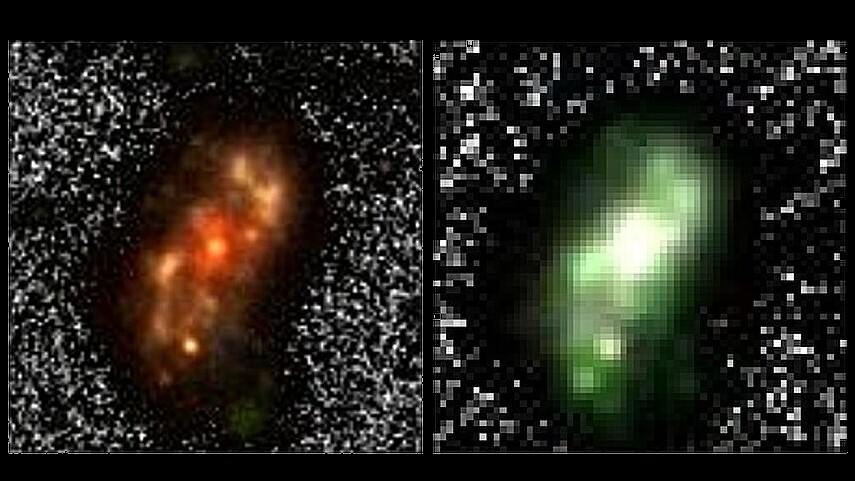
Researchers just found an unexpected galaxy using the James Webb Space Telescope (JWST). The large swirl of stars is known as a grand-design spiral galaxy, and its exceptionally advanced age could change what we know about galaxy formation.

Generally, the older a galaxy is, the farther away it is from us. Scientists can gauge the age and distance of galaxies through something called redshift — a phenomenon that occurs when light shifts to lower-frequency, redder wavelengths as it crosses large stretches of space. This happens for a couple of reasons; first, because the universe is expanding, older stars naturally end up further away. And second, because red is the longest wavelength in the visible spectrum of light, stars that are very far away tend to appear redder, having a higher redshift. JWST is designed to peer deeply into the red and infrared spectrum, allowing it to see old, distant galaxies more clearly than any previous telescope.

But spiral galaxies tend to be on the younger side, making the newly-discovered galaxy, designated A2744-GDSp-z4, an outlier. Grand-design galaxies like A2744-GDSp-z4 are characterized by their two well-defined spiral arms. Very few have ever been found with a redshift above 3.0 — meaning their light has been traveling for nearly 11.5 billion years, according to the Las Cumbres Observatory.

The newfound galaxy, meanwhile, has a redshift of 4.03, meaning the light JWST detected was emitted more than 12 billion years ago. According to the researchers who discovered it, that means A2744-GDSp-z4 came together when the universe was only about 1.5 billion years old — and it appears to have formed very rapidly. Given its estimated star formation rate, it accrued a mass of about 10 billion solar masses in just a few hundred million years.

Related: James Webb telescope confirms we have no idea why the universe is growing the way it is

This flies in the face of how scientists think spiral galaxies usually form.

“The rarity of high redshift spirals might be a consequence of galaxies being dynamically hot at those early epochs,” the researchers, led by Rashi Jain at the National Center for Radio Astrophysics in India, wrote in the new study. “Dynamically hot systems tend to form clumpy structures,” rather than highly ordered spirals, the researchers added.

Get the world’s most fascinating discoveries delivered straight to your inbox.

The team theorizes that A2744-GDSp-z4’s formation may have been driven by the presence of a stellar bar — gassy structures found in a majority of galaxies, which fuel starbirth and channel gas between the inner and outer regions of a galaxy, contributing to the galaxy’s size and shape. The ancient spiral could also have formed through the merger of two smaller galaxies, though this seems less likely given its orderly structure, the researchers wrote.

The findings were published Dec. 9 on the preprint database arXiv. The study has not yet been peer-reviewed.

Source link

Share. Facebook Twitter Pinterest LinkedIn Tumblr Email
Previous ArticleMystery illness in Congo could be severe malaria
Next Article John Lennon’s Son Julian Details Undergoing Surgery for Cancerous Mole
Editor
  • Website

Related Posts

Lifestyle

2 rivers merged to form the Euphrates 3.6 million years ago, eventually leading to the Fertile Crescent

June 2, 2026
Lifestyle

NASA confirms fireball meteor exploded over northeastern US with force of 230 tons of TNT

June 2, 2026
Lifestyle

Astronauts could use lightning-like plasma jets to kill germs on the moon and Mars, demo hints

June 1, 2026
Add A Comment

Comments are closed.

Categories
  • Entertainment
  • Lifestyle
  • News
  • Sports
  • Tech
  • Travel
Recent Posts
  • 2 rivers merged to form the Euphrates 3.6 million years ago, eventually leading to the Fertile Crescent
  • NASA confirms fireball meteor exploded over northeastern US with force of 230 tons of TNT
  • Astronauts could use lightning-like plasma jets to kill germs on the moon and Mars, demo hints
  • First whole-genome sequence of a Greenland shark holds clues to their extreme longevity
  • Heading a soccer ball just once is enough to raise levels of proteins associated with brain damage
calendar
June 2026
M T W T F S S
1234567
891011121314
15161718192021
22232425262728
2930  
« May    
Recent Posts
  • 2 rivers merged to form the Euphrates 3.6 million years ago, eventually leading to the Fertile Crescent
  • NASA confirms fireball meteor exploded over northeastern US with force of 230 tons of TNT
  • Astronauts could use lightning-like plasma jets to kill germs on the moon and Mars, demo hints
About

Welcome to Baynard Media, your trusted source for a diverse range of news and insights. We are committed to delivering timely, reliable, and thought-provoking content that keeps you informed
and inspired

Categories
  • Entertainment
  • Lifestyle
  • News
  • Sports
  • Tech
  • Travel
Facebook X (Twitter) Pinterest WhatsApp
  • Contact Us
  • About Us
  • Privacy Policy
  • Disclaimer
  • UNSUBSCRIBE
© 2026 copyrights reserved

Type above and press Enter to search. Press Esc to cancel.