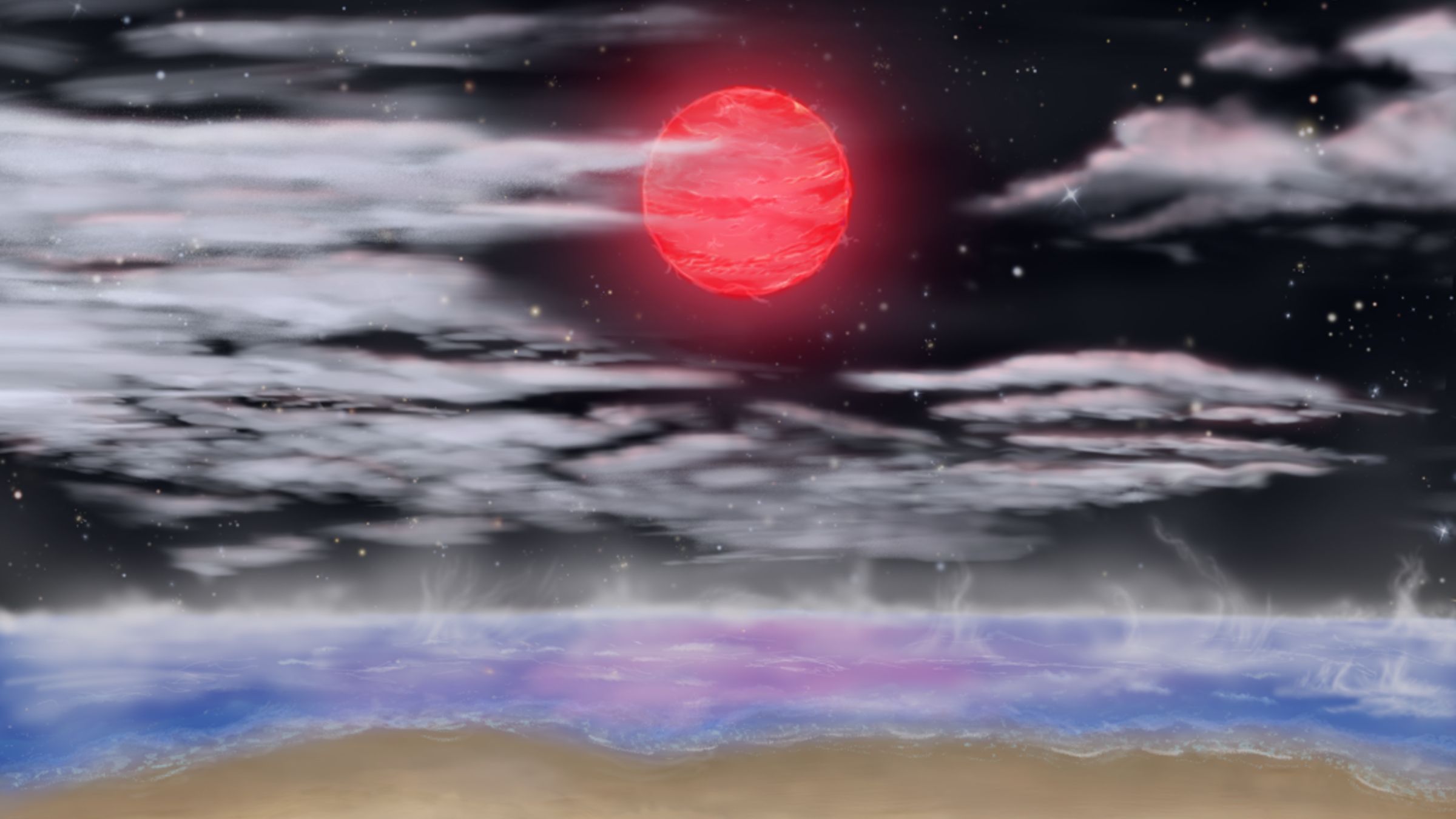
A hefty “super Earth” lurking in one of the closest star systems to our planet may be much better suited to supporting extraterrestrial life than scientists initially thought, a new study suggests. The alien world’s relative proximity to Earth, and the nature of its home star, make it a prime candidate for follow-up observations, researchers say.
The exoplanet, dubbed GJ 3378b, was discovered in 2024 and orbits a red dwarf star around 25 light-years from our planet. The alien world circles its star every 21.5 days at a distance around 10 times closer than Earth orbits the sun, which would make it completely inhospitable in our solar system. But because the red dwarf emits around 90% less radiation than the sun does, GJ 3378b is slap bang in the middle of this star system’s “habitable zone,” where liquid water could exist on the exoplanet’s surface.
But in a new study, published June 30 in The Astrophysical Journal, researchers recalculated the exoplanet’s size, using the Habitable-zone Planet Finder instrument attached to the Hobby-Eberly Telescope at the McDonald Observatory in Texas. This device measures subtle wobbles in the host star, caused by the gravitational tug of orbiting planets, and can be used to calculate the planet’s mass and trajectory.
This revealed that GJ 3378b is actually only 2.3 times more massive than Earth, which almost guarantees it is a rocky world and means it could have an atmosphere with a similar pressure to our own, raising the chances that extraterrestrial lifeforms could thrive there.
The newly constrained size of GJ 3378b makes it much more likely that the exoplanet has an atmosphere similar to Earth’s. But more research is needed to confirm if it even has an atmosphere.
(Image credit: NASA/Eyes on Exoplanets viewer)
While researchers have found several other exoplanets that could harbor life, the fact that GJ 3378b is so close to us makes it particularly intriguing, as it will be easier to confirm whether it is truly habitable.
“This one’s exciting,” study first author Paul Robertson, an astronomer at the University of California, Irvine, said in a statement. “25 light-years sounds like a long way, but the Milky Way is about 100,000 light-years across, so in that respect it’s our next-door neighbor.”
Get the world’s most fascinating discoveries delivered straight to your inbox.
Before we get too carried away, there is still no evidence that GJ 3378b has an atmosphere or liquid water. Its proximity to its home star may mean that any atmosphere it once had was stripped away by stellar winds, similar to how solar radiation likely stripped Mars of its atmosphere and ancient oceans.
Therefore, more observations are needed. But if an atmosphere is detected, GJ 3378b would likely jump to near the front of the queue of exoplanets that researchers want to study further.
“If a planet in the habitable zone has a proper atmosphere, we can justify further research looking for biosignatures, liquid water or other signs of life,” study co-author Gogod James, an undergraduate student at UC Irvine, said in the statement.
The fact that GJ 3378b orbits a red dwarf also makes it more appealing for future study because this is the most common star type in the Milky Way, so experts are keen to learn more about these stars’ planetary systems and potential to nurture life.
“About 70% of stars in our galaxy are red dwarfs, so they represent the standard,” study co-author Michael Endl, an astronomer at the McDonald Observatory and the University of Texas at Austin, said in another statement. “It’s really important that we understand the planet population around these stars.”
Robertson, P., Endl, M., Cochran, W. D., Stefansson, G., Mahadevan, S., Cañas, C. I., James, G., Arendtsz, R., Terrien, R. C., Bender, C. F., Diddams, S. A., Giovinazzi, M. R., Gupta, A. F., Halverson, S., Kanodia, S., Krolikowski, D. M., Logsdon, S. E., Ninan, J. P., Rogers, C. J., . . . Schwab, C. (2026). A Revised Mass and Period for the Habitable Zone super-Earth GJ 3378 b: A Planet Straddling the Cosmic Shoreline. The Astrophysical Journal, 1005(1), 32. https://doi.org/10.3847/1538-4357/ae732b