
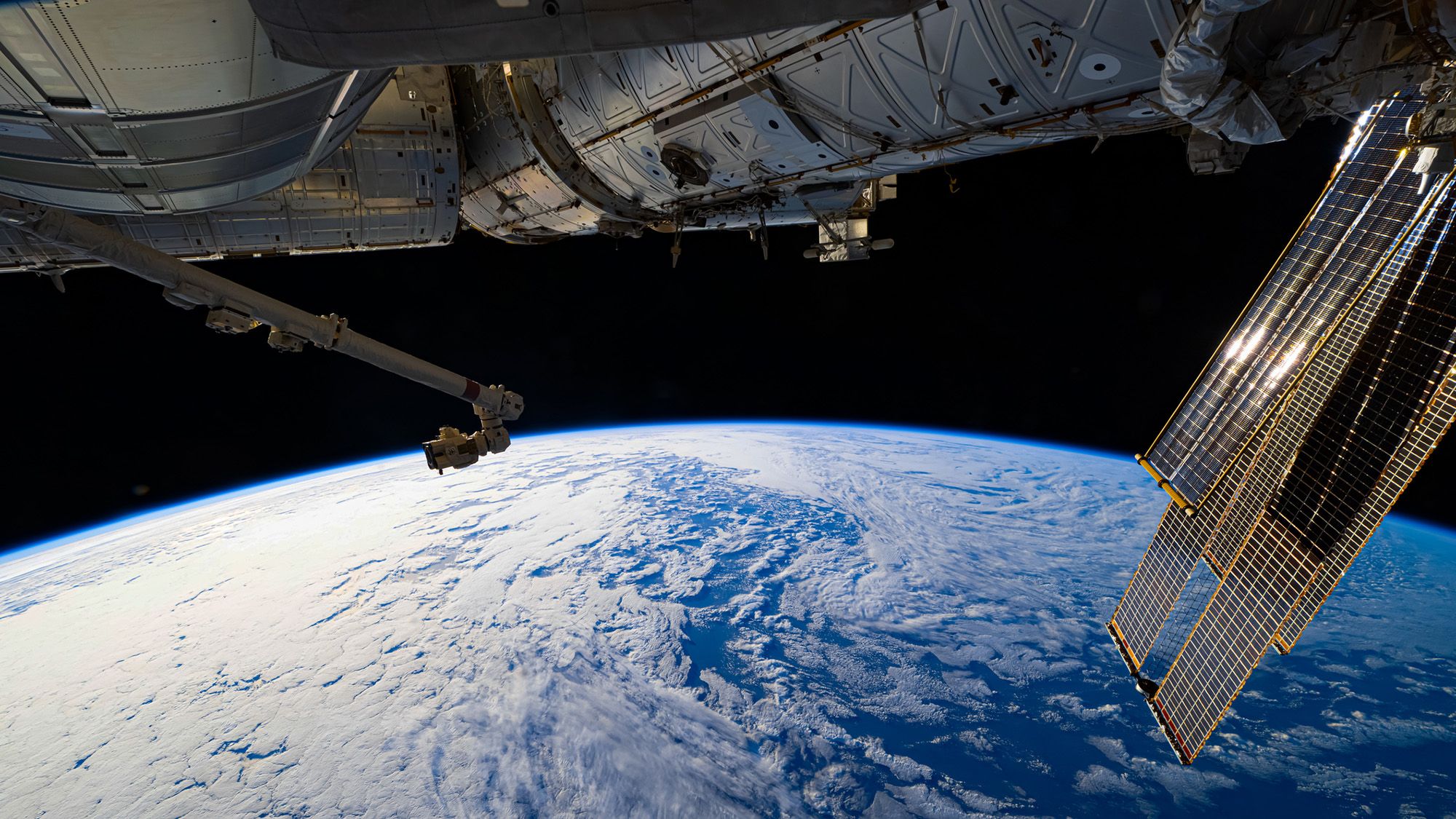
If you push two metal plates together on Earth, nothing happens. But if you take those same plates into the vacuum of space, they can fuse into a single piece of metal.
This phenomenon, called cold welding, has been a known hazard for spacecraft engineers for a long time. So what’s actually happening at the atomic level, and why does space make it so much easier?
The answer comes down to a lack of oxygen in space, experts told Live Science.
Sign up for our newsletter

(Image credit: Marilyn Perkins / Future)
Sign up for our weekly Life’s Little Mysteries newsletter to get the latest mysteries before they appear online.
Metals are made of lattices — structures where atoms are bonded to one another. But atoms near the surface of a metal aren’t bonded to anything on the outward-facing side. If given the chance, they’ll “reach out” and share electrons with the surface of another piece of metal.
But on Earth, nearly every metal surface is coated in an oxide layer. The layer is just a few atoms thick and forms when metal meets oxygen. “Once the oxide is formed, it’s over,” Julia Greer, a materials scientist at Caltech, told Live Science. “Then it can’t cold weld anymore, because the oxygen basically passivates these bonds.”
That thin oxide acts like an insulating wrapper. Without it, the free electrons at the surface of one metal piece stop recognizing which atom they belong to. “Those electrons don’t know if it’s in this piece or if it’s in that piece, so they begin sharing the electrons, and essentially that cold welds things together,” Sven Bilén, a professor of engineering design and aerospace engineering at Penn State, told Live Science.
In space, there’s no oxygen to rebuild that layer once it’s gone. The cold and the radiation make things worse. Bombardment from solar and ionic radiation in orbit can scour metal surfaces clean, Greer said, leaving freshly exposed atoms primed to bond. “Everything in space is conducive to cold welding,” she said.
Metal surfaces are never perfectly smooth, either. At a microscopic level, they’re jagged — more like tiny mountain ranges than flat plains, said Zachary Cordero, an aerospace engineer at MIT.
Pressing two surfaces together, especially with any sliding or vibration, can shear off the oxide layer that formed while the metal was on Earth and flatten those peaks into metal-to-metal contact. “You’re breaking up the surface oxide, and you’re forming metallurgical bonds,” Cordero said.
Why cold welding worried early spacecraft engineers
Cold welding in space has long been a problem. “If there is cold welding, things can become stuck in place,” Cordero told Live Science. “If you have a deployable structure and there’s cold welding, you might freeze the mechanism, or a door might become locked, or something might become immobilized, which you don’t want.”
For example, say you were to add a metal screw to a metal door. After a while, you would not be able to unscrew it because it would have become part of the door.
Bilén pointed to NASA’s Galileo probe, which launched in 1989: lubricant loss and launch vibrations during launch are thought to have stripped the oxide layer from parts of its furled high-gain antenna. When engineers attempted to deploy the antenna in 1991, it never fully opened.

An illustration of NASA’s Galileo spacecraft, whose high-gain antenna never fully deployed during its journey to Jupiter. The failure is widely attributed to cold welding.
(Image credit: MARK GARLICK/SCIENCE PHOTO LIBRARY via Getty Images)
Some metals are more troublesome than others. Gold and platinum don’t form an oxide layer at all, even on Earth, which makes them notoriously prone to cold welding. “Gold definitely is a very notorious metal for cold welding,” Greer said, adding that gold’s softness lets it conform easily to whatever surface it touches and it bonds even more easily.
How to prevent cold welding in space
To prevent components from accidentally fusing in orbit, engineers rely on a few strategies. One is anodizing, a process that locks an artificial oxide layer onto a metal surface. Another method is to coat moving parts with dry lubricants, such as molybdenum disulfide, to physically keep surfaces from touching.
A third strategy is to pair dissimilar metals — for instance, gold next to a “body-centered” metal, like molybdenum — so their atomic structures don’t mesh as neatly. “Their packing order is not quite perfectly aligned, and so there’ll be a lot more energetic kind of barrier to overcome,” Greer said.
Before launch, hardware also gets shaken on vibration tables and cycled through extreme hot-and-cold swings inside vacuum chambers, simulating the stresses of liftoff and orbit to catch problems on the ground.
Even with all of those precautions, cold welding can still happen. Bilén recalled bolts in his own lab’s vacuum chamber fusing shut after a move across campus. They eventually had to be drilled out. “It happens even on Earth,” he said.
See how much you know about human exploration into space with our spaceflight quiz!
TOPICS
