
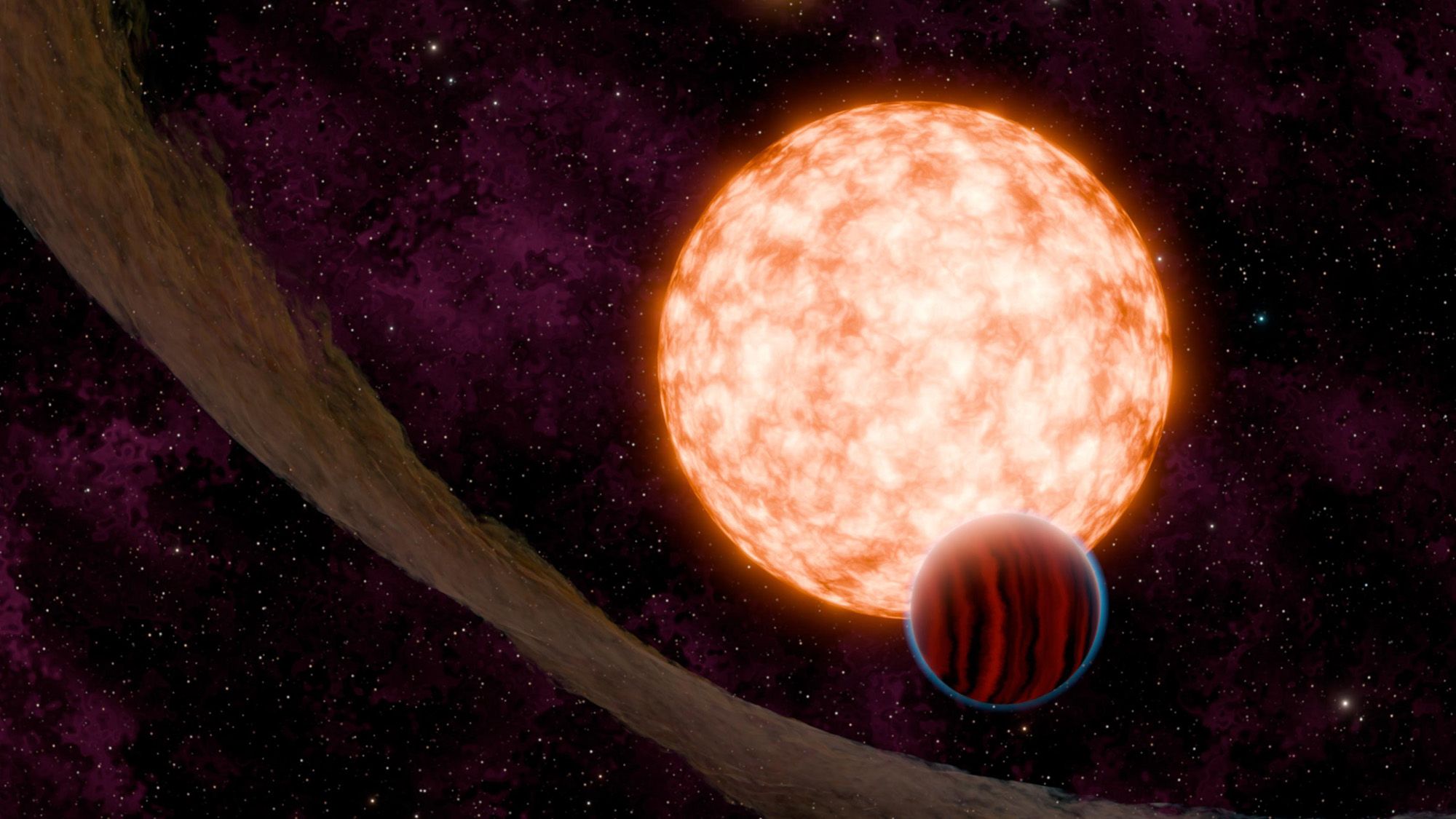
Humans have been searching the stars for alien radio signals for decades — and so far, E.T. has not phoned home. But that doesn’t mean intelligent life isn’t out there, a new study hints. Rather, something else could be interfering: according to the research, space weather surrounding alien planets could be preventing us from detecting technological signals from extraterrestrial civilizations.
The findings, published March 5 in The Astrophysical Journal, offer a potential answer to the Fermi paradox: Given the size of the universe, there are many potentially habitable planets that could support life, and yet we have not detected technosignatures from any of them — so, “Where is everyone?” physicist Enrico Fermi famously posited in 1950.
In the new study, researchers found that space weather caused by a planet’s star could broaden hypothetical technosignals, dissipating their power over a larger range of frequencies and making them more difficult to detect.
“If a signal gets broadened by its own star’s environment, it can slip below our detection thresholds, even if it’s there, potentially helping explain some of the radio silence we’ve seen in technosignature searches,” Vishal Gajjar, an astronomer at the SETI Institute and first author of the paper, said in a statement.
One way astronomers search for alien life is by looking for very narrowband signals, which are sharp spikes in the power of a radio emission. This spike usually only covers a few hertz.
“These don’t occur naturally,” Evan Keane, an astronomer at Trinity College Dublin who was not involved in the research, told Live Science. “So, if you see something very narrowband, you know that it is from something of interest.” Astronomers would, for example, be able to easily detect some narrowband technosignatures on Mars, coming from the Mars rovers. But they have not observed any such signals from a clearly non-human origin.
Distorting signals
The new research argues that astronomers may have been looking for the wrong signal shape. In the new study, the researchers found that alien signals could be distorted by stellar space weather surrounding their home stars, which could explain why they have not been detected.
Get the world’s most fascinating discoveries delivered straight to your inbox.
Space weather refers to changes in the space environment caused by charged particles, radiation and giant lumps of plasma called coronal mass ejections emitted by the sun. Other stars also generate space weather in their vicinity.
Gajjar and SETI colleague Grayce Brown investigated how space weather has historically impacted communications between Earth and spacecraft such as Mariner IV, which flew by Mars in the 1960s, and the Viking probes, which launched in 1977 for a voyage through the solar system and beyond. They created one of the largest collections of signal broadening examples and used that information to determine how other sunlike stars would affect the environment around their exoplanets. From this, the team calculated what would happen to a hypothetical alien narrowband signal that originated on one of them.

A planet’s radio signal may begin as a sharp tone (left, white) but can be spread out by the star’s plasma winds into a wider, fainter signal (right, green). The new study suggests radio astronomers may be missing signals by mostly looking for the sharp white shape instead of the broader green one.
(Image credit: Vishal Gajjar)
Then, they turned their attention to M dwarf stars, the most common type in the Milky Way. These stars account for three out of four stars in our galaxy, and some have been around since the early universe. That gives them a lot of time to have developed technologically advanced life, according to the paper.
There are no actual measurements of space weather around these stars, so Gajjar and Brown modeled what might happen to a narrowband technosignal that emerged from exoplanets and had to travel through interplanetary plasma. They found that hypothetical narrowband signals from these exoplanets were more likely to be smeared by space weather, making them even harder to detect.
In the paper, the authors propose a framework to estimate how much broadening would happen to a signal, given its frequency and the type of star its exoplanet was orbiting.
This new framework doesn’t totally answer Fermi’s infamous question, but it does give us a potential reason for the silence. The Fermi paradox “is not solely evidence for the absence of transmitters, but also a reflection of our detection limitations arising from a mismatch between the assumed signal morphology” and shape, the researchers wrote.
A step forward for SETI
Michael Garrett, an astrophysicist at the University of Manchester in the U.K. who was not involved in the study, welcomed the research.
“It is a solid contribution that SETI researchers and signal-processing teams should pay attention to,” he told Live Science. “One of the strengths of the paper is that it’s grounded in real measurements too, drawing on decades of spacecraft observations.”
However, he emphasized that the paper focused on narrowband radio signals, which was only one way of potentially detecting an alien civilization. By contrast, Garrett’s work explores the possible combined radio leakage from a technological civilization across a large range of frequencies.
Andrew Siemion, director of Breakthrough Listen Oxford Hub in the U.K. who was not involved in the research but collaborates with the SETI Institute, said this is the first paper to explore the space around exoplanets and its impact on detectability.
“The work offers a very concrete mechanism through which a candidate signal might ultimately be validated as having a likely origin with a distant planetary system,” he told Live Science.
The authors recommended that future searches, especially with sensitive next-generation telescopes such as SKA-Low, take note of signal broadening when searching for civilizations beyond Earth.
Are you a UFO fanatic? Find out with our extraterrestrials quiz!
