Close Menu
  • Home
  • UNSUBSCRIBE
  • News
  • Lifestyle
  • Tech
  • Entertainment
  • Sports
  • Travel
Facebook X (Twitter) WhatsApp
Trending
  • Lemur used in ‘lemur yoga’ session dies of human herpesvirus, study finds
  • ‘A fine line between reducing stigma and trivialising conditions’: Social media, self-diagnosis and the glamorization of ADHD
  • New 2D memory device stores data on just a single electron
  • Before we ban kids from social media completely, here’s what we should try first | Jonathan Bellack and Mariana Olaizola Rosenblat
  • Scientists uncover a better way to beat ‘the bends’ — using deep-diving pigs
  • Mars may have been losing its water more than 4 billion years ago, oldest-known Martian meteorite suggests
  • ‘The lance head was still inside the pelvis’: Mass grave found in Austria may hold casualties of unknown ancient Roman battle
  • ‘Full-on berserker mode’: Archaeologists solve mystery of medieval soldiers with gruesome square holes in their skull
Facebook X (Twitter) WhatsApp
Baynard Media
  • Home
  • UNSUBSCRIBE
  • News
  • Lifestyle
  • Tech
  • Entertainment
  • Sports
  • Travel
Baynard Media
Home»Lifestyle»NASA satellite captures wave of warm water hundreds of miles long that signals a devastatingly strong El Niño
Lifestyle

NASA satellite captures wave of warm water hundreds of miles long that signals a devastatingly strong El Niño

EditorBy EditorJune 23, 2026No Comments3 Mins Read
Share Facebook Twitter Pinterest LinkedIn Tumblr Reddit Telegram Email
Share
Facebook Twitter LinkedIn Pinterest Email

A massive wave of warm water is making its way across the Pacific Ocean as the newly declared El Niño gets into full swing, satellite images show.

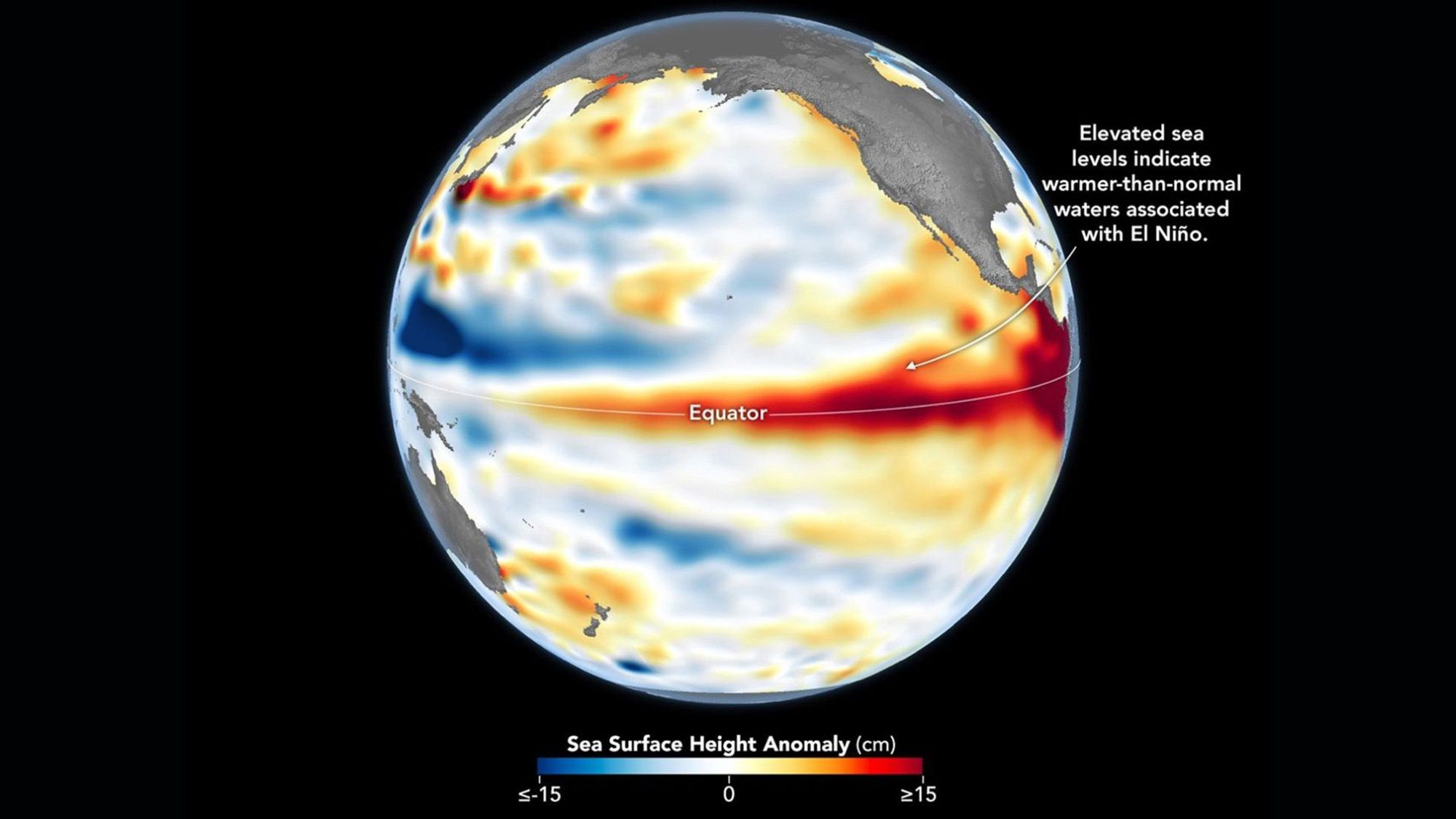
The band, called a Kelvin wave, marks a swell of higher-than-average sea levels that stretches hundreds of miles along the equator. The anomaly is caused by warmer waters linked to El Niño — the warm phase of a natural climate pattern whose current iteration could become one of the strongest ever recorded.

The Sentinel-6 Michael Freilich satellite captured the deviations from average sea surface height on June 8. Red areas indicate higher sea surfaces than usual, while blue areas mark areas with lower surface heights.

Developed and launched in 2020 by NASA and the European Space Agency and operated by the European Organisation for the Exploitation of Meteorological Satellites (EUMETSAT), Sentinel-6 Michael Freilich measures changes in sea surface height down to fractions of an inch every 10 days.

The data complements measurements of sea surface temperature that have shown Pacific waters warming at unpreceded rates over the past several months, leading scientists to declare the start of a new El Niño on June 11. When ocean water warms, it expands and takes up more space. That translates to an increase in the height of the water relative to the satellite and the center of Earth, which is then picked up by the satellite’s sensitive equipment. At some points along the equator, sea surfaces are now more than 6 inches (15 centimeters) higher than usual.


You may like

Kelvin waves like this one form when winds in the western Pacific near the equator weaken and temporarily reverse, blowing from west to east instead of east to west. That lets warm water gradually build up in the east, deepening the layer of warm surface waters and preventing colder waters from rising from below. The wave has now reached the western coast of South America.

NASA had already observed a few other Kelvin waves this year, suggesting an El Niño event was soon to follow. In January, Sentinel-6 Michael Freilich detected one near Micronesia that dissipated around mid-February. Another emerged in March and elevated sea levels near Peru by mid-May.

Get the world’s most fascinating discoveries delivered straight to your inbox.

Changes in sea surface temperature or height can alter atmospheric circulation patterns and affect the weather. El Niño often increases rainfall in the southwestern U.S., Colombia, Peru and Ecuador, while rainfall in the western Pacific tends to decrease. The most recent El Niño, which lasted from June 2023 to April 2024, boosted global mean temperatures that made 2024 the hottest year on record and the first to breach the 1.5 degrees Celsius (2.7 degrees Fahrenheit) warming limit — a guardrail set by the Paris Agreement beyond which the effects of climate change become more and more catastrophic.

The June 8 conditions in the western Pacific were similar to those that occurred 1997 during a particularly strong El Niño, according to a statement from NASA. 2026 has seen fewer Kelvin waves so far than 1997, but this year’s El Niño is still ramping up.

“For now, it looks like it’s going to be a big one — more so than I would have said last week — but we still need more observations to know what’s going to happen,” Severine Fournier, a sea level researcher at NASA’s Jet Propulsion Lab, said in the statement.


How much do you know about our blue planet? Test your terran knowledge with our Earth quiz!

Source link

Share. Facebook Twitter Pinterest LinkedIn Tumblr Email
Previous Article9 of the best technology conspiracy theories
Next Article Something is interfering with alien radio signals in space, new paper claims — and there’s an easy way to fix it
Editor
  • Website

Related Posts

Lifestyle

Lemur used in ‘lemur yoga’ session dies of human herpesvirus, study finds

August 15, 2026
Lifestyle

‘A fine line between reducing stigma and trivialising conditions’: Social media, self-diagnosis and the glamorization of ADHD

August 15, 2026
Lifestyle

New 2D memory device stores data on just a single electron

August 15, 2026
Add A Comment

Comments are closed.

Categories
  • Entertainment
  • Lifestyle
  • News
  • Sports
  • Tech
  • Travel
Recent Posts
  • Lemur used in ‘lemur yoga’ session dies of human herpesvirus, study finds
  • ‘A fine line between reducing stigma and trivialising conditions’: Social media, self-diagnosis and the glamorization of ADHD
  • New 2D memory device stores data on just a single electron
  • Before we ban kids from social media completely, here’s what we should try first | Jonathan Bellack and Mariana Olaizola Rosenblat
  • Scientists uncover a better way to beat ‘the bends’ — using deep-diving pigs
calendar
August 2026
M T W T F S S
 12
3456789
10111213141516
17181920212223
24252627282930
31  
« Jul    
Recent Posts
  • Lemur used in ‘lemur yoga’ session dies of human herpesvirus, study finds
  • ‘A fine line between reducing stigma and trivialising conditions’: Social media, self-diagnosis and the glamorization of ADHD
  • New 2D memory device stores data on just a single electron
About

Welcome to Baynard Media, your trusted source for a diverse range of news and insights. We are committed to delivering timely, reliable, and thought-provoking content that keeps you informed
and inspired

Categories
  • Entertainment
  • Lifestyle
  • News
  • Sports
  • Tech
  • Travel
Facebook X (Twitter) Pinterest WhatsApp
  • Contact Us
  • About Us
  • Privacy Policy
  • Disclaimer
  • UNSUBSCRIBE
© 2026 copyrights reserved

Type above and press Enter to search. Press Esc to cancel.