Close Menu
  • Home
  • UNSUBSCRIBE
  • News
  • Lifestyle
  • Tech
  • Entertainment
  • Sports
  • Travel
Facebook X (Twitter) WhatsApp
Trending
  • An ancient piece of the moon found in Africa hints at a long-ago collision that turned the lunar surface molten
  • Do you really have to wash rice before you cook it?
  • Neuroscientists are searching for the ‘cellular substrate of loneliness’
  • Bow-Wow, Ding-Dong, Pooh-Pooh: Expert explains early theories of how human language evolved — and their silly names
  • Famous child mummies in Andes may belong to kids who were sacrificed to ‘ritually anchor’ the Inca’s presence as their empire expanded
  • Artemis II crew captures rare double auroras on the dark side of Earth as they zoom toward the moon — Space photo of the week
  • Has all the water on Earth been peed before?
  • ‘This might be the point of no return’: Experts on the current measles outbreak and where we go from here
Facebook X (Twitter) WhatsApp
Baynard Media
  • Home
  • UNSUBSCRIBE
  • News
  • Lifestyle
  • Tech
  • Entertainment
  • Sports
  • Travel
Baynard Media
Home»Lifestyle»An ancient piece of the moon found in Africa hints at a long-ago collision that turned the lunar surface molten
Lifestyle

An ancient piece of the moon found in Africa hints at a long-ago collision that turned the lunar surface molten

EditorBy EditorJune 15, 2026No Comments3 Mins Read
Share Facebook Twitter Pinterest LinkedIn Tumblr Reddit Telegram Email
Share
Facebook Twitter LinkedIn Pinterest Email

A rare lunar meteorite that fell to Earth holds evidence of a previously unknown “impact event” that rocked the moon roughly 3.5 billion years ago, researchers say. Studying this ancient impact provides fresh insight into how the solar system was behaving in those early days — about the same time life on Earth began to appear.

In the new study, scientists looked at a lunar meteorite found in northwest Africa. The meteorite, called NWA 12593, contains information about three separate lunar impacts, but the researchers focused on the earliest of these crashes, the team reported in the journal Geology.

“On Earth, the first fossil evidence of life shows up around 3.5 billion years ago, meaning that life is emerging and evolving before then, ” Carolyn Crow, first author of the study and a planetary scientist at the University of Colorado Boulder, said in a statement. “The question that we often have, even going back further, is what was the impact record when life was emerging? It is important for understanding how life is taking hold… The cadence of these catastrophic events is an important part of the equation.”

In the study, the scientists used radiometric dating on the meteorite. This method charts the decay rate of radioactive materials in the sample, allowing the team to estimate the first impact at 3.5 billion years ago — roughly 1 billion years after the solar system formed.

The meteorite contained cubic zirconia, best known on Earth for its resemblance to diamond. But in the ancient meteorite, this material tells a different story: that the moon’s surface became molten through the impact, because cubic zirconia forms only at extremely high temperatures. While the material dissipates at the ultracold temperatures found on the moon, the scientists found its presence through traces of its recrystallized products.


You may like

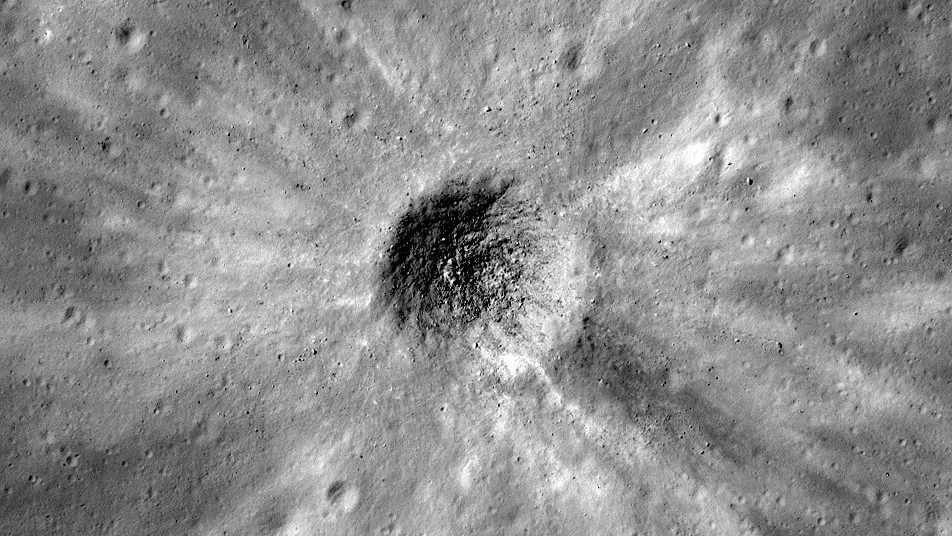
Moon's surface. A photo of a lunar crater, measuring about 600 feet (185 meters) across, captured by NASA's Lunar Reconnaissance Orbiter. Credit to Credit NASA and GSFC and Arizona State University

A large lunar impact crater snapped by NASA’s Lunar Reconnaissance Orbiter.

(Image credit: NASA/GSFC/Arizona State University)

The impact occurred at roughly the same time as other huge impacts, both on Earth and on a very large asteroid called Vesta, that have been identified in independent research. To find three impacts on three different worlds so long ago is rare, because erosion and other processes tend to erase the evidence.

“It’s not very common, which is why we’re very excited about it,” Crow said. “It’s pretty rare to have all three records line up like this.” The team expects that making deeper comparisons between the impacts will show more about how the solar system was changing 3.5 billion years ago, as the number of asteroids in the neighborhood diminished along with impacts.

Get the world’s most fascinating discoveries delivered straight to your inbox.

Scientists often say the early solar system was a collection of gas and dust that gradually grew into smaller, comet-like and asteroid-like bodies. Over time, a subset of those bodies got even larger (through collisions and accretions) to become today’s planets and moons.

The other two impacts on the meteorite were a breccia (rock melt) formed after the big collision 3.5 billion years ago and a third collision that sent the meteorite blasting off the moon and into an Earthbound trajectory.

Crow, C. A., Erickson, T. M., Economos, R., Lehman-Franco, K., Boyce, J. W., Richards, A. M., Diaz, C. A., Flowers, R. M., Brounce, M., Schoene, B., & Benowitz, J. A. (2026). Three-body evidence of ca. 3.7 Ga to 3.2 Ga bombardment across the inner solar system. Geology. https://doi.org/10.1130/g54386.1


How much do you know about the moon? Test your lunar smarts with our moon quiz!

Source link

Share. Facebook Twitter Pinterest LinkedIn Tumblr Email
Previous ArticleDo you really have to wash rice before you cook it?
Editor
  • Website

Related Posts

Lifestyle

Do you really have to wash rice before you cook it?

June 15, 2026
Lifestyle

Neuroscientists are searching for the ‘cellular substrate of loneliness’

June 14, 2026
Lifestyle

Bow-Wow, Ding-Dong, Pooh-Pooh: Expert explains early theories of how human language evolved — and their silly names

June 14, 2026
Add A Comment

Comments are closed.

Categories
  • Entertainment
  • Lifestyle
  • News
  • Sports
  • Tech
  • Travel
Recent Posts
  • An ancient piece of the moon found in Africa hints at a long-ago collision that turned the lunar surface molten
  • Do you really have to wash rice before you cook it?
  • Neuroscientists are searching for the ‘cellular substrate of loneliness’
  • Bow-Wow, Ding-Dong, Pooh-Pooh: Expert explains early theories of how human language evolved — and their silly names
  • Famous child mummies in Andes may belong to kids who were sacrificed to ‘ritually anchor’ the Inca’s presence as their empire expanded
calendar
June 2026
M T W T F S S
1234567
891011121314
15161718192021
22232425262728
2930  
« May    
Recent Posts
  • An ancient piece of the moon found in Africa hints at a long-ago collision that turned the lunar surface molten
  • Do you really have to wash rice before you cook it?
  • Neuroscientists are searching for the ‘cellular substrate of loneliness’
About

Welcome to Baynard Media, your trusted source for a diverse range of news and insights. We are committed to delivering timely, reliable, and thought-provoking content that keeps you informed
and inspired

Categories
  • Entertainment
  • Lifestyle
  • News
  • Sports
  • Tech
  • Travel
Facebook X (Twitter) Pinterest WhatsApp
  • Contact Us
  • About Us
  • Privacy Policy
  • Disclaimer
  • UNSUBSCRIBE
© 2026 copyrights reserved

Type above and press Enter to search. Press Esc to cancel.