Close Menu
  • Home
  • UNSUBSCRIBE
  • News
  • Lifestyle
  • Tech
  • Entertainment
  • Sports
  • Travel
Facebook X (Twitter) WhatsApp
Trending
  • ‘This might be the point of no return’: Experts on the current measles outbreak and where we go from here
  • NASA’s experimental X-59 jet breaks sound barrier for 1st time in step toward ‘quiet supersonic’ technology
  • Science news this week: El Niño arrives, the Artemis III crew are revealed, a ‘cold blob’ expands across the Atlantic, and a forgotten note from Richard Feynman gets deciphered
  • ‘I was really amazed’: Scientists find evidence that the Small Magellanic Cloud is being ripped apart by its larger sibling beyond the Milky Way
  • World’s rarest great ape decimated by 4 days of extreme rain, with 7% of population lost to cyclone
  • Trio of drastically different US lakes straddles the border between states — Earth from space
  • These patients’ hearts stopped a dozen times a day. An innovative procedure has transformed their lives.
  • Mysterious ‘cold blob’ in the Atlantic is a sign of the Gulf Stream weakening — and that’s bad news for the US East Coast
Facebook X (Twitter) WhatsApp
Baynard Media
  • Home
  • UNSUBSCRIBE
  • News
  • Lifestyle
  • Tech
  • Entertainment
  • Sports
  • Travel
Baynard Media
Home»Lifestyle»NASA’s experimental X-59 jet breaks sound barrier for 1st time in step toward ‘quiet supersonic’ technology
Lifestyle

NASA’s experimental X-59 jet breaks sound barrier for 1st time in step toward ‘quiet supersonic’ technology

EditorBy EditorJune 13, 2026No Comments4 Mins Read
Share Facebook Twitter Pinterest LinkedIn Tumblr Reddit Telegram Email
Share
Facebook Twitter LinkedIn Pinterest Email

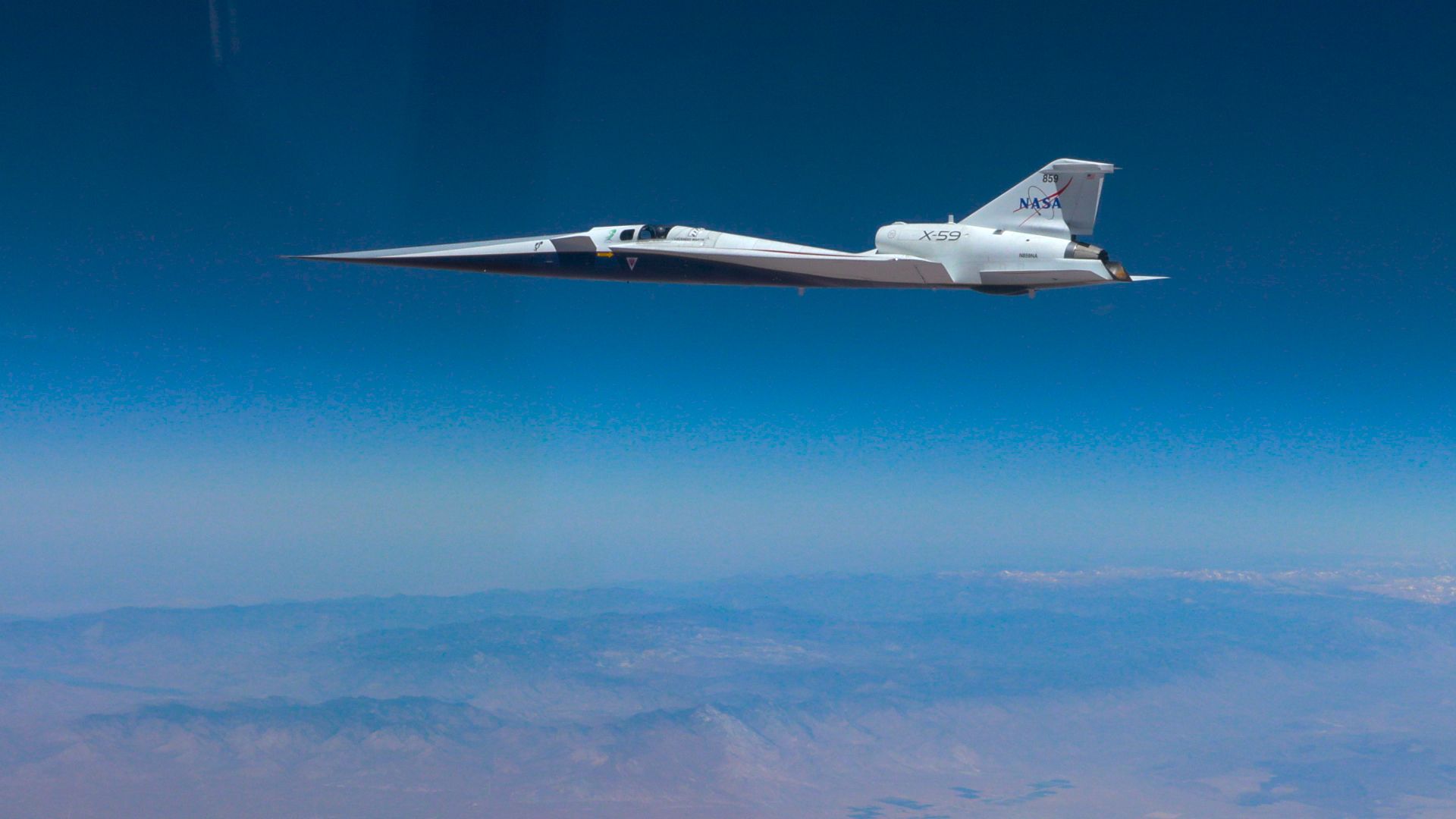
NASA’s X-59, an experimental supersonic aircraft developed in partnership with Lockheed Martin, has broken the sound barrier for the first time. The test represents an important step toward “quiet supersonic” flight, in which a craft surpasses Mach 1 — the speed of sound — with a small thump rather than a deafening crash.

On June 5, test pilot Jim “Clue” Less flew the craft from Edwards Air Force Base in California for an 81-minute round trip, NASA announced in a statement. During that time, the X-59 reached a speed of Mach 1.1 ‪—‬ 713 mph (1,147 km/h) ‪—‬ at an altitude of 43,400 feet (13,200 meters).

However, despite passing this key test, the craft’s “quiet” supersonic capabilities are still not well defined; during this flight, the X-59 was trailed by an F-15 fighter jet, whose loud supersonic boom cloaked the noise from the X-59. Further testing planned for later this year will better demonstrate the experimental aircraft’s progress on the noise-reduction front.

Breaking barriers

The world’s first supersonic flight took place in 1947, when U.S. Air Force test pilot Charles “Chuck” Yeager flew the Bell X-1 aircraft over California’s Mojave Desert. Yeager piloted the craft to a speed of Mach 1.06, opening a new frontier of possibilities in aviation — but not necessarily for commercial air travel.

“We always kind of joke that the X-1 broke the sound barrier and now we’re trying to fix it,” Catherine Bahm, NASA’s Low Boom Flight Demonstrator project manager, who oversees the X-59’s development, told the BBC in 2023.


You may like

When a plane moves forward, it pushes aside the air molecules in front of it. This causes the air to vibrate, creating sound waves that spread from the aircraft like the wake trailing a boat. When a craft breaks the sound barrier, the air pressure waves behind it compress and build into a shock wave, which releases energy as a thunderous “sonic boom.”

A view from inside the X-59 jet with an overlay on a landscape

This view from NASA’s X-59 eXternal Vision System shows the craft reaching Mach 1.077 on Friday, June 5, marking the aircraft’s first time reaching supersonic speed.

(Image credit: NASA)

A sonic boom can exceed 110 decibels ‪—‬ as loud as a fully operational steel mill and above the threshold where most people feel ear pain. Sonic booms have even been known to damage property, such as by shattering windows and, in at least one case, fish tanks. For this reason, in 1973 the Federal Aviation Administration banned non-military aircraft from breaking the sound barrier above U.S. soil.

Get the world’s most fascinating discoveries delivered straight to your inbox.

Although Air France and British Airways’ Concorde, which ran between London or Paris and New York City from 1976 to 2003, was the world’s first commercial supersonic flight, that aircraft was allowed to operate only because it broke the sound barrier over the Atlantic Ocean. It was ultimately decommissioned after one flight crashed during takeoff from France’s Charles de Gaulle airport, killing everyone aboard.

The X-59’s ultra-long, skinny nose is designed to minimize the shockwave its sonic boom creates. A plane that produces a quieter sonic “thud” could allow for faster-than-sound commercial domestic flights over land. That would mean passengers could, for example, get from Los Angeles to New York City in under three hours (compared with the current five-to-six-hour flight time). However, NASA has not yet released information about how many decibels X-59’s first sonic boom produced.

Beyond its commercial possibilities, quiet supersonic flight has obvious military applications, as it makes secret missions significantly stealthier. NASA plans to run X-59’s first “mission conditions” test flight, which will reach speeds of Mach 1.4 at an altitude of approximately 55,000 feet (17,000 m), in the coming weeks.

Source link

Share. Facebook Twitter Pinterest LinkedIn Tumblr Email
Previous ArticleScience news this week: El Niño arrives, the Artemis III crew are revealed, a ‘cold blob’ expands across the Atlantic, and a forgotten note from Richard Feynman gets deciphered
Next Article ‘This might be the point of no return’: Experts on the current measles outbreak and where we go from here
Editor
  • Website

Related Posts

Lifestyle

‘This might be the point of no return’: Experts on the current measles outbreak and where we go from here

June 13, 2026
Lifestyle

Science news this week: El Niño arrives, the Artemis III crew are revealed, a ‘cold blob’ expands across the Atlantic, and a forgotten note from Richard Feynman gets deciphered

June 13, 2026
Lifestyle

‘I was really amazed’: Scientists find evidence that the Small Magellanic Cloud is being ripped apart by its larger sibling beyond the Milky Way

June 12, 2026
Add A Comment

Comments are closed.

Categories
  • Entertainment
  • Lifestyle
  • News
  • Sports
  • Tech
  • Travel
Recent Posts
  • ‘This might be the point of no return’: Experts on the current measles outbreak and where we go from here
  • NASA’s experimental X-59 jet breaks sound barrier for 1st time in step toward ‘quiet supersonic’ technology
  • Science news this week: El Niño arrives, the Artemis III crew are revealed, a ‘cold blob’ expands across the Atlantic, and a forgotten note from Richard Feynman gets deciphered
  • ‘I was really amazed’: Scientists find evidence that the Small Magellanic Cloud is being ripped apart by its larger sibling beyond the Milky Way
  • World’s rarest great ape decimated by 4 days of extreme rain, with 7% of population lost to cyclone
calendar
June 2026
M T W T F S S
1234567
891011121314
15161718192021
22232425262728
2930  
« May    
Recent Posts
  • ‘This might be the point of no return’: Experts on the current measles outbreak and where we go from here
  • NASA’s experimental X-59 jet breaks sound barrier for 1st time in step toward ‘quiet supersonic’ technology
  • Science news this week: El Niño arrives, the Artemis III crew are revealed, a ‘cold blob’ expands across the Atlantic, and a forgotten note from Richard Feynman gets deciphered
About

Welcome to Baynard Media, your trusted source for a diverse range of news and insights. We are committed to delivering timely, reliable, and thought-provoking content that keeps you informed
and inspired

Categories
  • Entertainment
  • Lifestyle
  • News
  • Sports
  • Tech
  • Travel
Facebook X (Twitter) Pinterest WhatsApp
  • Contact Us
  • About Us
  • Privacy Policy
  • Disclaimer
  • UNSUBSCRIBE
© 2026 copyrights reserved

Type above and press Enter to search. Press Esc to cancel.