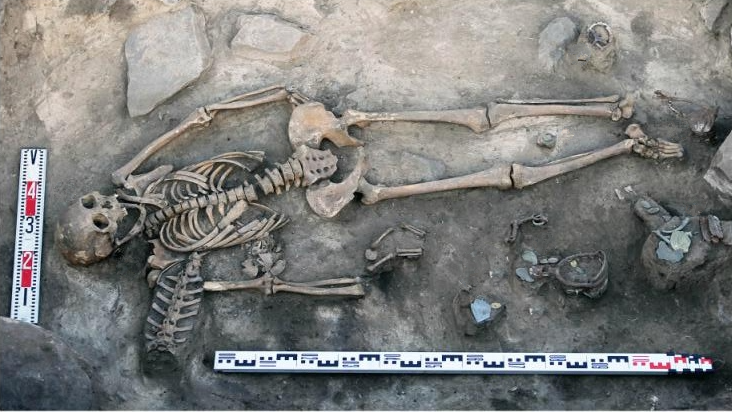
Archaeologists in Russia have discovered a rare elite burial of a medieval woman who was accompanied in death by a newborn child and a flayed horse. A mirror and silver stirrup found in the grave were decorated in the style of Chinese art, revealing multicultural connections in 10th-century Asia.
“It’s quite clear that this is far from an ordinary burial,” Andrey Poliakov, an archaeologist and director of the Russian Academy of Sciences’ Institute for the History of Material Culture, who led the excavation, said in a translated statement. “There are no more than a few dozen similar burials in the entire Sayan-Altai region” in Inner Asia.
Archaeologists discovered the burial in 2014 as part of an excavation ahead of railway construction in the Sayan Mountains, a range in southern Siberia that runs through southeastern Russia and northern Mongolia. They found several dozen graves and small settlements spanning multiple centuries. But their excavation of one stone-ringed mound yielded the unique grave of a woman who was about 40 years old when she died. She was buried with the skeleton of a newborn child, the spine of a sheep and a “horse skin” — the skull, limbs and skin of a horse — a rare ritual practice among medieval steppe nomads.
Because of the uniqueness of the grave and the multitude of artifacts that had to be stabilized after excavation, a full analysis of the tomb took more than a decade to complete. Two studies detailing the unusual burial and the horse equipment were published recently in the journal Bulletin of Novosibirsk State University, Series: History, Philology.
The woman had been buried with only a few personal items, including a pair of gilt-bronze earrings, fragments of a ritually broken mirror, an iron knife and a stone spindle whorl used for hand-spinning wool, the archaeologists wrote in the burial study. The decoration on the mirror resembled a winding vine with grape clusters — a motif on mirrors found in elite Tang dynasty (A.D. 618 to 907) burials in China.
The woman was buried with gold earrings, horse gear and a newborn child.
(Image credit: Press Service of the Institute of the History of Material Culture of the Russian Academy of Sciences)
Among the dozens of pieces of horse equipment found in the burial was a pair of stirrups. One of these stirrups was decorated in the style of Chinese art, with influences from Indian and Persian art styles, and functioned as a “ceremonial” stirrup. Nomadic tradition in this time period was to have one stirrup on display on the most presentable side — generally the left — the researchers noted in the horse equipment study.
While radiocarbon dating gave the archaeologists a broad time frame for the burial — between the ninth and 13th centuries — based on the style of the artifacts in the grave, the archaeologists determined that the woman and child were most likely buried in the 10th century.
Get the world’s most fascinating discoveries delivered straight to your inbox.
The huge number of multicultural artifacts found in the grave suggests the woman and child were part of the “highest aristocracy” of their society, the researchers wrote in the horse equipment study. But the woman probably didn’t use the objects in her daily life, they added; it is more likely they were family relics that her clan offered as grave goods.
The nearly complete set of antique horse paraphernalia found in the grave is a “very rare combination for the region,” study co-author Oleg Mitko, head of the Humanities Research Laboratory at Novosibirsk State University, said in the statement.
Amzarakov, P.B., Lazaretov, I.P., Poliakov, A.V., Mitko, O.A. (2026). Equipment of a riding horse from a medieval burial on the Idzhim River in the Usinskaya Basin. Bulletin of Novosibirsk State University, Series: History, Philology 25(3): 74-88. https://doi.org/10.25205/1818-7919-2026-25-3-74-88 / (2025). Gold-plated earrings and personal items from a medieval burial on the Idzhim River (Western Sayan, Usinsk Basin). Bulletin of Novosibirsk State University, Series: History and Philology 24(3): 115-129. https://doi.org/10.25205/1818-7919-2025-24-3-115-129
What do you know about the bones in your body? Test your knowledge with our human skeleton quiz!