
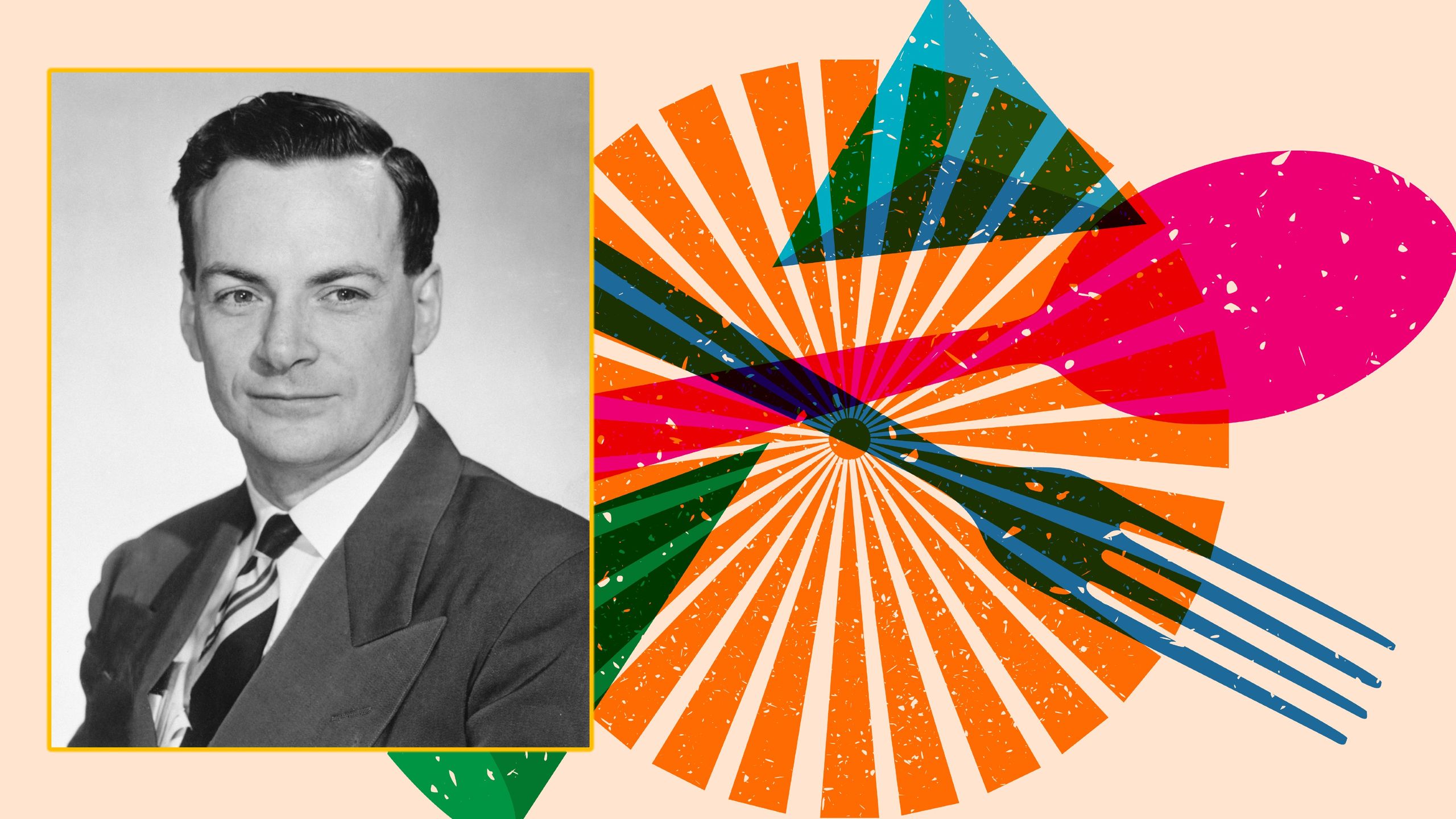
It started with a plate of ginger chicken.
In the late 1970s, physicist Richard Feynman — best known for his earlier work on the Manhattan Project — sat down for lunch with his friend Ralph Leighton at a restaurant in Glendale, California. Leighton was agonizing over ordering his usual favorite, or risking something new.
Feynman turned the choice into a math problem, and solved it on a piece of notebook paper. His equation showed exactly when Leighton — or any indecisive diner, for that matter — should stop taking risks and stick with what one knows is good.

For decades, Feynman’s notes on the “restaurant problem” were unreadable. But now, researchers reconstructed a decision-making problem from Richard Feynman’s previously undeciphered notes and proved him to be right. The findings were published on June 1 in the journal Proceedings of the National Academy of Sciences.
The problem with picking lunch
Imagine you’re visiting a new city for a week. Each night, you can either try an unknown restaurant or return to the best one you’ve already found. You want to maximize your total dining experience over the whole trip.
That kind of problem has a name in mathematics: an “optimal stopping problem.” The same logic shows up in apartment hunting and job searching. But Feynman argued you can always go back to a previous restaurant. The goal is to maximize your cumulative enjoyment, not just find the single best spot.

A page of Feynman’s handwritten notes on the Restaurant Problem.
(Image credit: Caltech / The Feynman Lectures on Physics)
Feynman’s notes showed that the optimal strategy involves a quality threshold — a minimum score you require before committing — that starts high and drops as your trip runs out.
Get the world’s most fascinating discoveries delivered straight to your inbox.
Brian Christian, a computer scientist and cognitive scientist at University of Oxford, began working on the problem about 13 years ago alongside his collaborator Tom Griffiths. They tracked down Feynman’s original notes through the Feynman Lectures website.
The team proved that Feynman’s solution was indeed optimal, then extended it to other versions of the problem: do people actually solve the problem this way?
They recruited 2,520 participants online and presented them with a digital version of the scenario: a grid of restaurants in a virtual city, each with a hidden quality score revealed only on the first visit. Participants aimed to maximize their total score over a fixed number of nights. Each person played just once.
“We wanted to really capture people’s gut intuitions,” Christian told Live Science. “When you just get thrown into this situation, what do you do?”
The answer: People don’t follow Feynman’s optimal curve in reality. Instead of the precise mathematical threshold, participants used a much simpler rule. Their quality bar started high and dropped by the same fixed amount each night regardless of how long the trip was or what the restaurant landscape looked like.
The simple strategy captured about 90% of the value that the optimal approach would yield.
“People are not doing the optimal thing. They’re doing something radically simpler,” Christian said. “And still the simple strategy is being tailored in a way that feels very situationally appropriate.”
The slope of people’s declining threshold was identical across every condition — a week-long trip or a month-long one, restaurants distributed evenly in quality or skewed toward extremes. What did shift was where people set their starting bar, adjusting it appropriately based on the landscape they’d seen.
In other words, people used a universal rule for how fast to lower their standards, but calibrated how high to set them in the first place.
An order of redemption
The results fit into an emerging framework in cognitive science called “resource rationality.” The idea that humans aren’t perfectly rational, but make good use of the limited time and brainpower they have.
“People don’t do the perfect thing, but they make nearly perfect use of their constrained resources,” Christian said. “I think this is a little bit more of a redemptive story about the human mind than we are used to from the 20th century.”
That’s a shift from the long tradition in behavioral economics emphasizing human irrationality and cognitive bias.
Christian says the findings also have implications for AI. Most AI systems assume people behave as perfectly rational agents. This study suggests that AI designed around how humans actually think — imperfectly — might work better.
Feynman died in 1988, never having published his restaurant analysis. But more than four decades after he scrawled those notes over lunch, the puzzle he left behind has finally been solved — and it turns out to say as much about the human mind as it does about what to eat.
Christian, B., Russek, E. M., & Griffiths, T. L. (2026). Resolving Feynman’s restaurant problem reveals optimal solutions and human strategies. Proceedings of the National Academy of Sciences, 123(23), e2509612123. https://doi.org/10.1073/pnas.2509612123
