
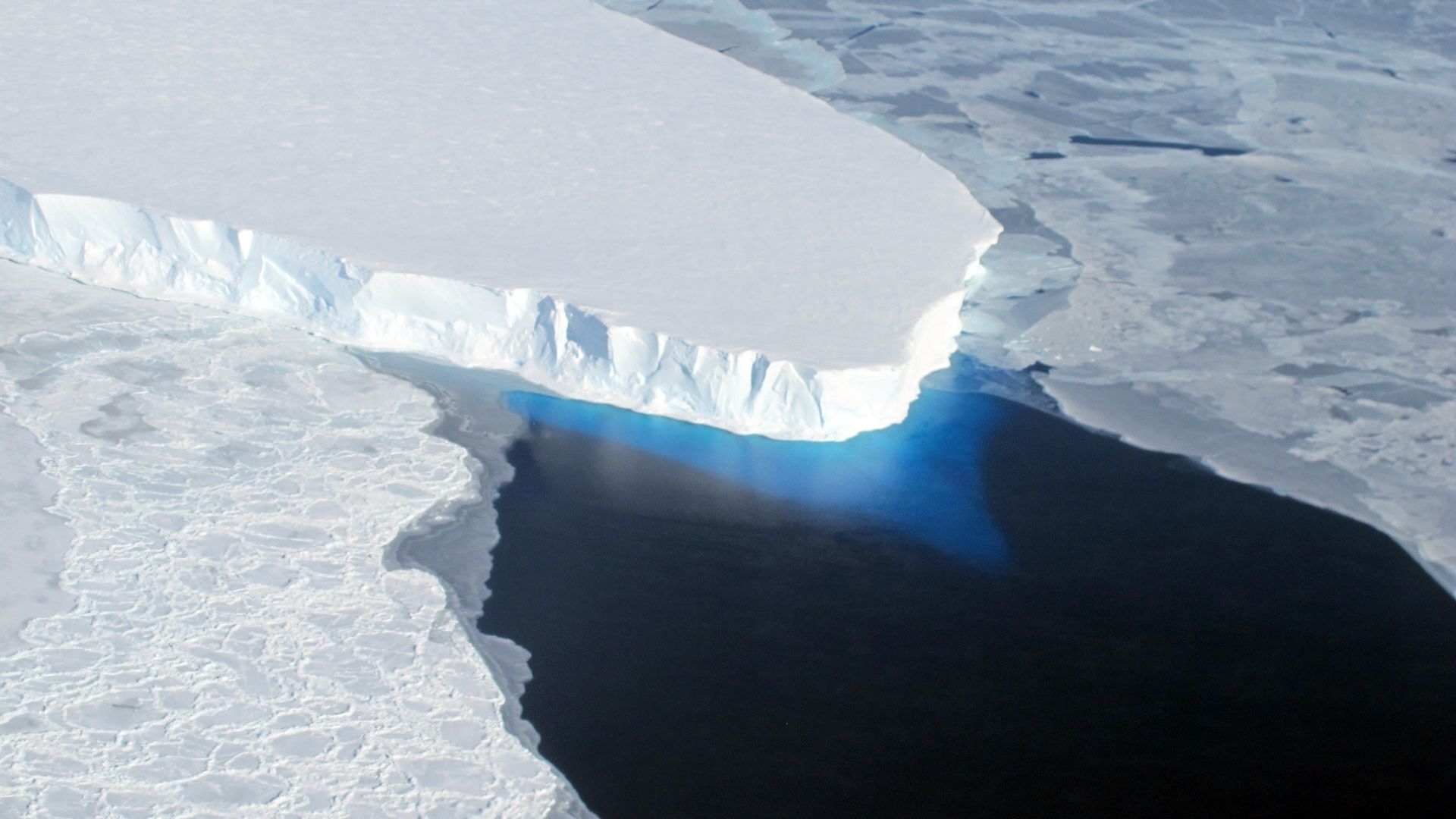
A vital ice shelf is about to break away from Antarctica’s “Doomsday Glacier,” further destabilizing one of the world’s largest and most vulnerable glaciers.
The Thwaites Glacier is nicknamed the “Doomsday Glacier” because its collapse would send so much ice into the Southern Ocean that global sea levels would rise by 2.1 feet (65 centimeters or 26 inches), flooding coastal communities worldwide. This collapse could take centuries, but there is an imminent threat to Thwaites’ eastern ice shelf, which will likely accelerate the glacier’s demise.
Researchers say that satellite images reveal that the Thwaites eastern ice shelf is about to detach from the glacier, New Scientist reported last week. While the glacier sits on land, the ice shelf is a floating body of ice that is attached to the glacier’s mouth. Researchers still have a lot to learn about the glacier, but this shelf acts as a buttress, restraining the flow of ice from the glacier into the sea.
Robert Larter, a marine geophysicist at the British Antarctic Survey, said that the ice shelf is very likely to break up in 2026. Larter runs the U.K. arm of the science coordination office at the International Thwaites Glacier Collaboration, where U.S and U.K. research agencies have investigated the glacier’s complex and rapidly changing environment
“The last bit of ice shelf in front of the glacier is poised to disintegrate,” Larter told Live Science in an interview. “We don’t know quite how this ice shelf is going to break up, but it’s definitely going to go.”
Around the size of Florida, Thwaites Glacier is the largest glacier in West Antarctica. The gigantic river of ice is more than 6,500 feet (2,000 meters) thick in some parts and 75 miles (120 kilometers) across — making it Earth’s widest glacier.
The glacier has been melting rapidly since the 1980s, losing hundreds of billions of tons of ice. That’s due to relatively warm ocean water flowing underneath the ice shelf and melting the glacier at its base, where ice sits on ground that’s below sea level. The glacier has retreated 8.7 miles (14 km) since 1992, according to the British Antarctic Survey.
Get the world’s most fascinating discoveries delivered straight to your inbox.
Modeling the demise of massive glaciers is a complex task, making it hard to put an exact date on when Thwaites Glacier will finally collapse. However, a study published March 9 in the journal Geophysical Research Letters found that the glacier could be losing 180 billion to 200 billion tons of ice per year by 2067.
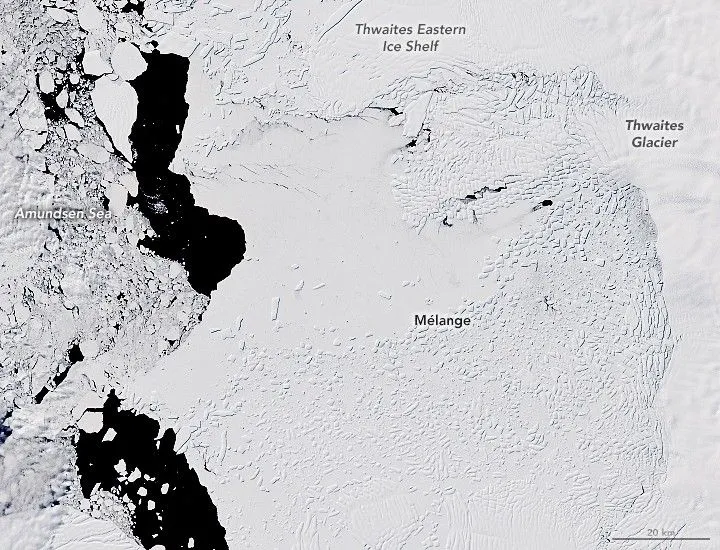
Researchers can track ice loss using satellite images.
(Image credit: NASA)
Thwaites Glacier’s slow collapse is part of a wider concern among scientists for the future of the West Antarctic ice sheet. Thwaites is a key pillar of the ice sheet, protecting other ice from slipping into the ocean. If the whole ice sheet were to go, sea levels would rise by 10.8 feet (3.3 m), according to the British Antarctic Survey. The collapse of ice sheets like this one are considered tipping points, or “points of no return,” in the fight against climate change — meaning that once they are crossed, they bring about permanent changes that cannot be reversed for many thousands of years.
The Thwaites eastern ice shelf is fracturing where the shelf is held in place by a ridge on the ocean floor, and at the mouth of the glacier. Larter said that movement on the western side of the shelf, where the ice is breaking away, has approximately doubled over the last eight months.
Much like other Antarctic sea ice — and the glacier itself — this shelf is undermined by warmer, saltier water being forced up from deep below the surface of the Southern Ocean. Larter noted that it’s more about the circulation of water than warming, but indications are that human-driven climate change is ultimately to blame.
“There is an active scientific debate about exactly how this works, but it seems pretty clear that in some way, the changes to the Southern Hemisphere westerly winds are what is driving warm water onto the continent,” Larter said. “And those wind changes are part of the wider pattern of climate change that we’re seeing.”
