
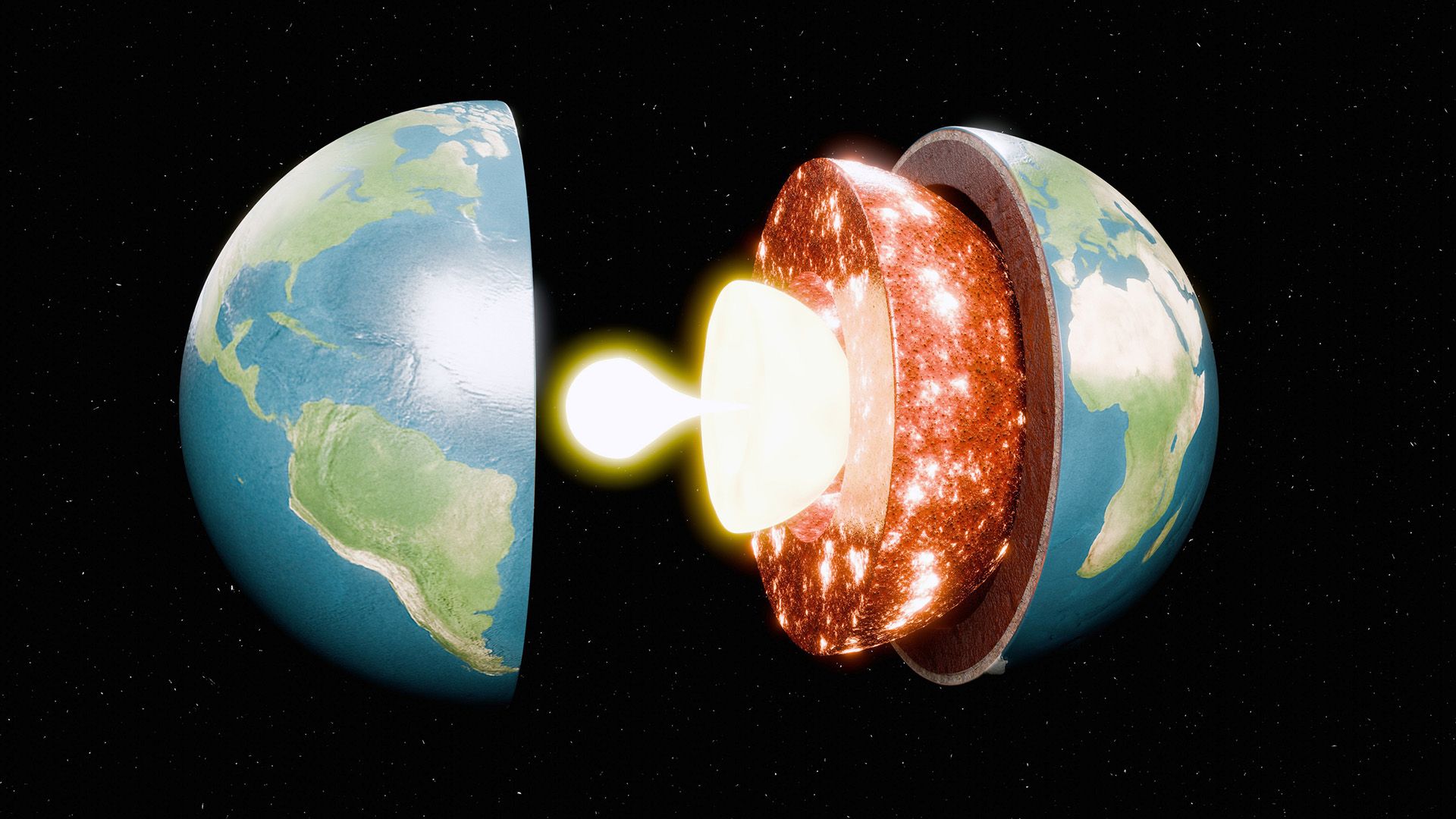
When Earth first formed around 4.5 billion years ago, it was a ball of molten rock. Over time, heavier elements, like iron and nickel, sank to the planet’s center, forming the Earth’s early core.
Today, Earth’s core remains an incredibly hot and dense sphere deep inside our planet. It consists of a liquid outer core, which starts at around 1,800 miles (2,900 kilometers) below Earth’s surface and extends for 1,400 miles (2,200 kilometers). There is also a solid inner core, which begins at around 3,200 miles (5,150 km) below ground, with a radius of roughly 758 miles (1,220 km).
But just how hot is Earth’s core? And how did scientists figure it out, if they can’t go that deep underground?
Sign up for our newsletter

(Image credit: Marilyn Perkins / Future)
Sign up for our weekly Life’s Little Mysteries newsletter to get the latest mysteries before they appear online.
Thanks to a combination of techniques, scientists have estimated that the temperature of the Earth’s core is about as hot as the surface of the sun: It reaches around 9,000 to just over 10,000 degrees Fahrenheit (roughly 5,000 to over 5,500 degrees Celsius). This temperature comes from the boundary between the inner and outer core, which is thought to be the hottest part of the core.
However, this temperature was not measured directly. Instead, it is inferred via experiments and theories that scientists have of the composition of the core.
Earth’s center is composed primarily of iron, roughly 85%, alloyed with nickel and other lighter elements; this material is in liquid form in the outer core and solid in the inner core. Scientists deduced these properties from a mix of laboratory measurements of iron alloys at high pressures, analyzing the composition of meteorites, and understanding how seismic waves bend or disappear as they travel through the planet’s interior.
Because Earth’s outer core is made mostly of liquid iron, temperatures in this region must be higher than iron’s melting temperature. At the planet’s surface, the melting point of pure iron is 2,800 F (1,538 C). But this number doesn’t take into account the “enormous pressures” of the deep interior, Quentin Williams, a mineral physicist at the University of California, Santa Cruz, told Live Science. Increasing pressures boost the melting point of iron and most other substances, which explains why the inner core is very hot, but remains solid due to its high pressure.
To determine the melting temperature of iron at astronomical pressures, scientists have conducted a number of experiments to simulate this environment. Some studies have squeezed a piece of iron between two sharpened diamonds (called diamond anvil cells) to generate high pressures while a laser heated the iron to high temperatures. Others have hit pieces of iron with high-velocity projectiles or shock-creating rays to simulate crushing pressures. The results from those experiments were then plotted and extrapolated to the pressures at the boundary of the inner and outer core, which led to the estimates ranging from around 9,000 to just over 10,000 F.
“To some extent, what we know about the Earth[‘s] core is all an educated guess,” Shichun Huang, a geology professor at Sun Yat-sen University in China, told Live Science. Many mechanisms, such as how the solid inner core crystalizes into a solid, are still a mystery.
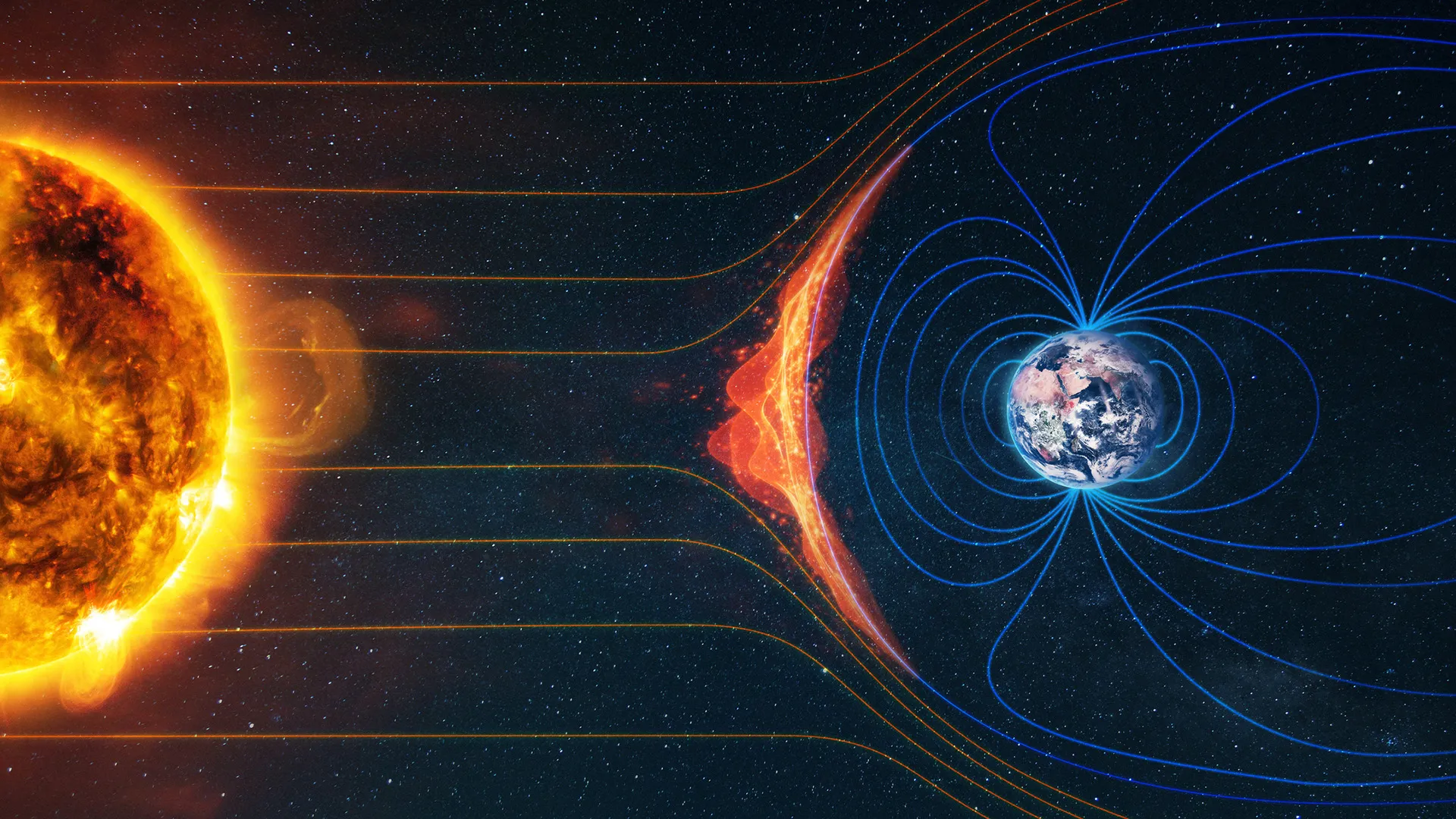
The outer liquid core generates Earth’s magnetic field, which protects the planet and life on it from dangerous solar winds.
(Image credit: Alones Creative via Getty Images)
Hot from the beginning
All of this heat hints at our planet’s unique history. When Earth formed, all sorts of material got pulled together, including the iron that makes up the core. That “gravitational potential was converted to heat,” Huang said.
Further, scientists think that some time during that formation, a Mars-size object hit our protoplanet and that this force deposited a lot of heat into the interior. Some scientists think that radioactive elements, like potassium, uranium and thorium, also contribute to the planet’s internal heat, although whether these elements are actually present in the deep Earth is debated, Huang said.
A hot core also contributes to Earth’s ability to host life. In contrast to other planets, Earth’s interior has held onto much of its original, primordial heat.
“We’re not really good at planet cooling,” Williams said, meaning that Earth has held onto much heat from its original formation, unlike other rocky planets in our solar system. As a result, our planet has properties like plate tectonics, which moves pieces of the Earth’s surface, bringing up nutrients and creating diverse habitats for life to evolve and thrive. The iron core that is part liquid also generates Earth’s magnetic field, which protects the planet and life on it from dangerous solar winds.
“If you care about life, you should care about the inside of the Earth,” Huang said. A blazing hot core in the center of our planet is what allows all of us to survive where we are today.
What is Earth made of? Find out with our inside Earth quiz!
TOPICS
