Close Menu
  • Home
  • UNSUBSCRIBE
  • News
  • Lifestyle
  • Tech
  • Entertainment
  • Sports
  • Travel
Facebook X (Twitter) WhatsApp
Trending
  • 950-year-old burial of a pet dingo is first clear archaeological evidence of humans ritually ‘feeding’ a grave anywhere in the world
  • Daunian kyathos: A 2,700-year-old ceramic cup from Italy decorated with an exuberant-looking, bug-eyed fellow
  • ‘Truly significant’: James Webb telescope reveals largest-ever map of the universe’s hidden megastructures
  • Webb and Hubble sink deep into the dazzling Whirlpool Galaxy — Space photo of the week
  • ‘Last titan’ of Thailand discovered, and it’s the longest-necked dinosaur on record from Southeast Asia
  • ‘We kept finding large, circular mass graves’ in the Sahara predating the ancient Egyptians, archaeologists report
  • Why aren’t brain transplants possible?
  • Can people catch infections from plants?
Facebook X (Twitter) WhatsApp
Baynard Media
  • Home
  • UNSUBSCRIBE
  • News
  • Lifestyle
  • Tech
  • Entertainment
  • Sports
  • Travel
Baynard Media
Home»Lifestyle»950-year-old burial of a pet dingo is first clear archaeological evidence of humans ritually ‘feeding’ a grave anywhere in the world
Lifestyle

950-year-old burial of a pet dingo is first clear archaeological evidence of humans ritually ‘feeding’ a grave anywhere in the world

EditorBy EditorMay 18, 2026No Comments4 Mins Read
Share Facebook Twitter Pinterest LinkedIn Tumblr Reddit Telegram Email
Share
Facebook Twitter LinkedIn Pinterest Email

A 950-year-old dingo burial in Australia has produced the first clear archaeological evidence of humans ritually “feeding” a grave anywhere in the world, a new study reports.

The symbolic feeding involved river mussels and continued for roughly 500 years, radiocarbon dating showed. This suggests that the people who buried the dingo — namely, ancestors of the Aboriginal Barkindji people, whose traditional lands surround the Darling River in western New South Wales — profoundly valued the animal and passed on this care to subsequent generations, researchers say.

“It’s a similar practice to what we see in many other cultures where descendants return to shrines and ancestral sites over the generations to bring gifts and offerings to the deceased,” study co-author Amy Way, a research archaeologist at the University of Sydney and the Australian Museum, told Live Science in an email. “It tells us that this relationship is really strong and retained through time.”


You may like

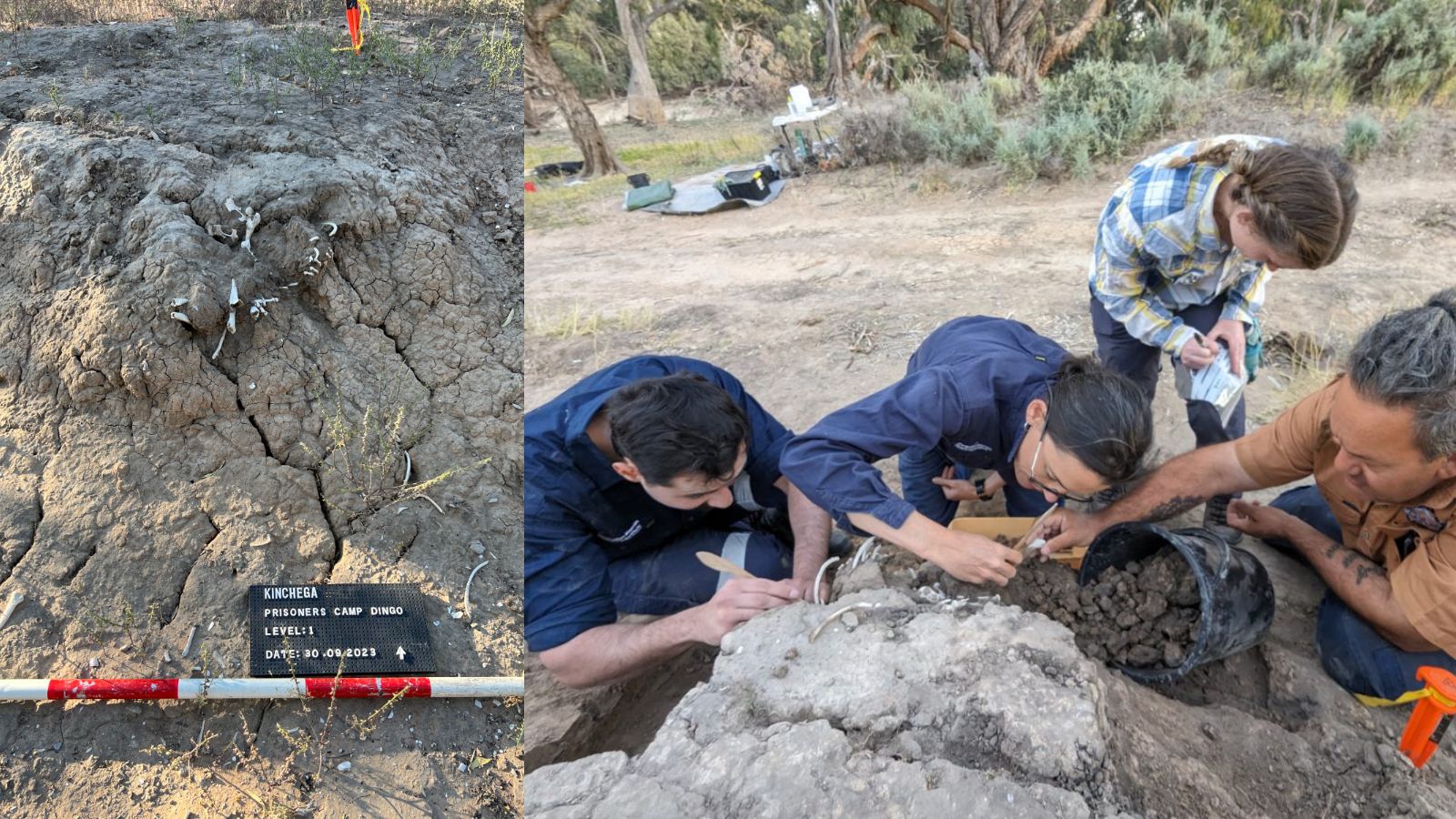
The dingo was buried in a pile of discarded mussel shells called a midden. This was not unusual for Barkindji ancestors, because they tamed dingoes to keep as pets and hunting helpers, and mussels were a common food that left heaps of waste, said study first author Loukas Koungoulos, a zooarchaeologist at the University of Western Australia. However, this is the first time that researchers have interpreted the addition of mussel shells to a midden as “feeding,” thanks to Barkindji Elders’ input.

“It is the first time that we have an Aboriginal perspective as to why people kept adding mussel shells to the site after the burial occurred,” Koungoulos told Live Science in an email.

Koungoulos, Way and their colleagues excavated the dingo at the request of the Menindee Aboriginal Elders Council. They worked alongside Barkindji custodians to analyze the burial, which was identified 25 years ago by a Barkindji Elder named Uncle Badger Bates and National Parks and Wildlife Service archaeologist Dan Witter.

“The dingo skull had eroded away since it was first identified in the early 2000s, and so the Elders Council felt it was very important to conserve the rest of the skeleton by working with archaeologists, before it too was lost to time and floods,” Way said.

Get the world’s most fascinating discoveries delivered straight to your inbox.

Two Barkindji custodian, Dave Doyle and Barbara Quayle, pose near a dingo burial.

Barkindji custodians Dave Doyle and Barb Quayle helped archaeologists during the excavation of the dingo burial.

(Image credit: Amy Way, Australian Museum)

A close examination of the dingo revealed that it was male and between 4 and 7 years old when it died sometime between 916 and 963 years ago. What remained of the skeleton was well preserved, though some bones showed light bite marks from a scavenging predator. The teeth were heavily worn due to the dingo’s relatively long life, and the right ribs and one leg carried signs of healed traumatic injuries that were consistent with being kicked by a kangaroo.

The dingo likely survived and recovered from these injuries thanks to the care of Barkindji ancestors, according to the study, published Monday (May 18) in the journal Australian Archaeology.

The researchers dated four mussel shell fragments from the midden, three of which were several hundred years younger than the dingo’s remains. The study proposes that mussel shells were added to the burial by generations of Barkindji people to honor and symbolically feed the dingo, known as a “garli” in the Barkindji language.

“The idea, as explained to me by the Barkindji, is that it involved a cross-generational remembering of this garli ancestor, which specifically involved generation after generation returning to the burial site to add mussel shells to the midden that was initiated at the time of the dingo’s burial,” Way said.

The results expand a region along the Darling River where archaeologists already knew that Aboriginal ancestors buried dingos but where they hadn’t documented the feeding practice.

“It’s a way of remembering important connections with the past,” Way said.

Koungoulos, L. G., Way, A. M., Jones, R. K., Player, S., Blore, C., Quayle, B., … O’Connor, S. (2026). Garli: A millennium-old dingo burial on the Baaka (Darling River), Kinchega National Park, Menindee Lakes, Western New South Wales. Australian Archaeology, 1–17. https://doi.org/10.1080/03122417.2026.2650909

Source link

Share. Facebook Twitter Pinterest LinkedIn Tumblr Email
Previous ArticleDaunian kyathos: A 2,700-year-old ceramic cup from Italy decorated with an exuberant-looking, bug-eyed fellow
Editor
  • Website

Related Posts

Lifestyle

Daunian kyathos: A 2,700-year-old ceramic cup from Italy decorated with an exuberant-looking, bug-eyed fellow

May 18, 2026
Lifestyle

‘Truly significant’: James Webb telescope reveals largest-ever map of the universe’s hidden megastructures

May 18, 2026
Lifestyle

Webb and Hubble sink deep into the dazzling Whirlpool Galaxy — Space photo of the week

May 17, 2026
Add A Comment

Comments are closed.

Categories
  • Entertainment
  • Lifestyle
  • News
  • Sports
  • Tech
  • Travel
Recent Posts
  • 950-year-old burial of a pet dingo is first clear archaeological evidence of humans ritually ‘feeding’ a grave anywhere in the world
  • Daunian kyathos: A 2,700-year-old ceramic cup from Italy decorated with an exuberant-looking, bug-eyed fellow
  • ‘Truly significant’: James Webb telescope reveals largest-ever map of the universe’s hidden megastructures
  • Webb and Hubble sink deep into the dazzling Whirlpool Galaxy — Space photo of the week
  • ‘Last titan’ of Thailand discovered, and it’s the longest-necked dinosaur on record from Southeast Asia
calendar
May 2026
M T W T F S S
 123
45678910
11121314151617
18192021222324
25262728293031
« Apr    
Recent Posts
  • 950-year-old burial of a pet dingo is first clear archaeological evidence of humans ritually ‘feeding’ a grave anywhere in the world
  • Daunian kyathos: A 2,700-year-old ceramic cup from Italy decorated with an exuberant-looking, bug-eyed fellow
  • ‘Truly significant’: James Webb telescope reveals largest-ever map of the universe’s hidden megastructures
About

Welcome to Baynard Media, your trusted source for a diverse range of news and insights. We are committed to delivering timely, reliable, and thought-provoking content that keeps you informed
and inspired

Categories
  • Entertainment
  • Lifestyle
  • News
  • Sports
  • Tech
  • Travel
Facebook X (Twitter) Pinterest WhatsApp
  • Contact Us
  • About Us
  • Privacy Policy
  • Disclaimer
  • UNSUBSCRIBE
© 2026 copyrights reserved

Type above and press Enter to search. Press Esc to cancel.