
Close Menu
  • Home
  • UNSUBSCRIBE
  • News
  • Lifestyle
  • Tech
  • Entertainment
  • Sports
  • Travel
Facebook X (Twitter) WhatsApp
Trending
  • New robotic heart mimics common, mysterious condition to help researchers study it
  • Canon EOS R6 III review: A wildlife wonder
  • Medieval babies and adults buried together in Sweden were not related, archaeologists discover — raising big questions about early Christian burial practices
  • NASA is creating a fifth state of matter on the ISS, thanks to an upgrade to a mini-fridge-sized quantum lab
  • New sodium metal battery design charges in just 4 minutes and retains its capacity for years
  • Quantum computing wielded to create extremely rare material critical to nuclear fusion
  • Scientists build tiny ‘diving suit’ for cockroaches, turning them into search-and-rescue cyborgs
  • Physicists develop the first working model of quantum mechanics using only ‘real’ numbers
Facebook X (Twitter) WhatsApp
Baynard Media
  • Home
  • UNSUBSCRIBE
  • News
  • Lifestyle
  • Tech
  • Entertainment
  • Sports
  • Travel
Baynard Media
Home»Lifestyle»Microplastics absorb heat in the atmosphere and contribute to global warming — as if they weren’t bad enough
Lifestyle

Microplastics absorb heat in the atmosphere and contribute to global warming — as if they weren’t bad enough

EditorBy EditorMay 12, 2026No Comments3 Mins Read
Share Facebook Twitter Pinterest LinkedIn Tumblr Reddit Telegram Email
Share
Facebook Twitter LinkedIn Pinterest Email

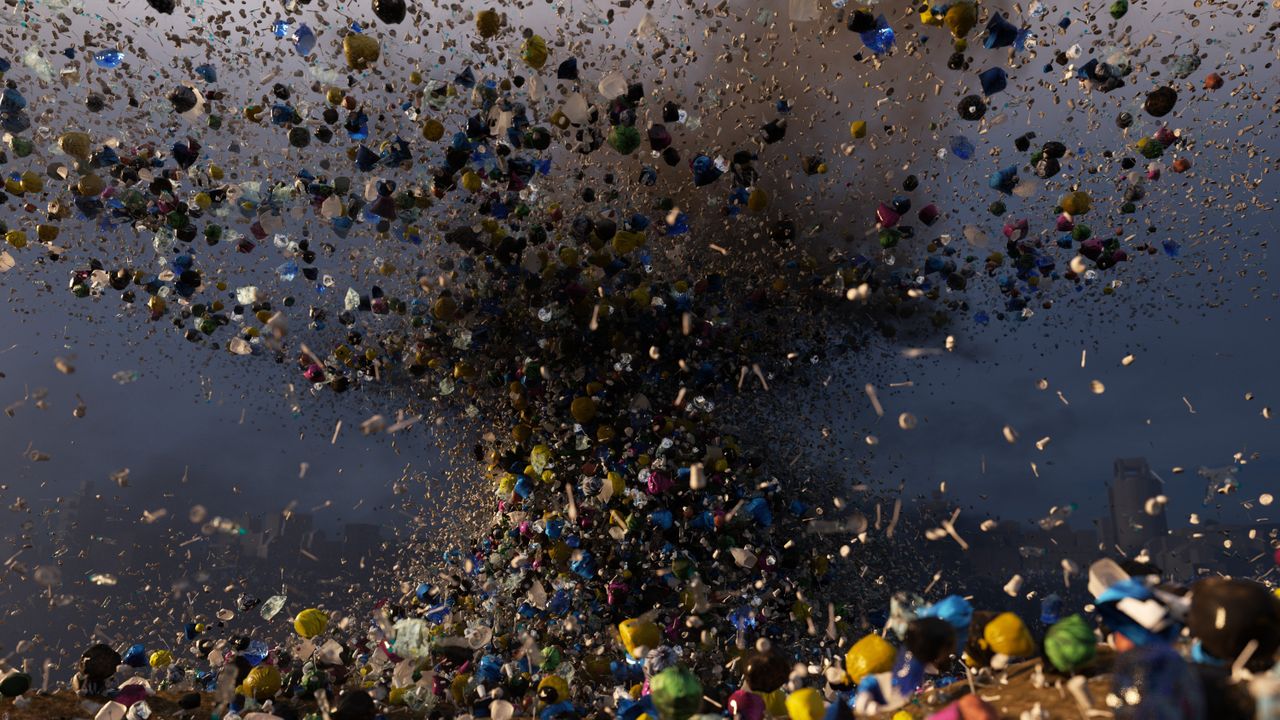
Microplastics are absorbing heat in the atmosphere and contributing to global warming, a new study reveals.

Microplastics are infamous for being everywhere, contaminating ecosystems and accumulating inside our bodies. Scientists have known for a while that plastics are also blown high into the atmosphere, where they are now pervasive, but it was unclear what impact they might be having up there.

Now, the new study, published Monday (May 4) in the journal Nature Climate Change, has found that overall, plastic particles create a warming effect. This is because, while very-light-colored plastics scatter sunlight back into space, darker-colored plastics absorb sunlight and radiation.


You may like

Study co-author Drew Shindell, a distinguished professor of Earth science at Duke University, told Live Science that the climate change impact of plastic particles is fairly small ‪—‬ comparable to the emissions of a small country. In numbers, this is the equivalent of around a couple of percent of the contribution from carbon dioxide (CO2) — the main driver of climate change — or a couple hundredths of a degree of warming. However, the researchers’ modeling was based on a limited understanding of the amount of plastic in the atmosphere, so the extent of the warming effect is uncertain.

“The key finding is really that the warming strongly outweighs the cooling,” Shindell said. “I think we have a lot of confidence in that because we did all of these measurements in the laboratory of how [microplastics and nanoplastics] interact with sunlight. What we don’t have so much confidence in and what’s still a big uncertainty is exactly how many of these are in the atmosphere.”

Microplastics come from larger plastic debris that breaks up and from plastic products that are designed to be microscopic in the first place, such as the tiny beads used in some facial scrubs and shower gels. A plastic is classified as a microplastic when it has a width of 1 micrometer to 5 millimeters (0.00004 to 0.2 inches). Anything less than 1 micrometer is classified as a nanoplastic.

To better understand how different colors of microplastic and nanoplastic particles behave, Shindell’s colleagues in Shanghai collected plastic debris and studied its reaction to sunlight and radiation. They also checked whether very light colors would darken in the atmosphere over time ‪—‬ and found that they did.

Get the world’s most fascinating discoveries delivered straight to your inbox.

“Sometimes if you get a parking pass or something that you put on your windshield, the plastic yellows with time because it’s out in the sunlight,” Shindell said. “We thought maybe particles of plastic do that, too.”

Once the team understood how the plastic particles behaved, Shindell and his colleagues in the U.S. used that data alongside data on plastic emissions to model their impact. This modeling was hampered by uncertainty surrounding the quantity and distribution of plastics in the atmosphere.

“People have mostly taken measurements near the ground because they were thinking of these as a health hazard, which they are, but the climate is influenced by not just the amount at the surface but throughout the atmospheric column,” Shindell said.

The analysis revealed that the warming effect from the microplastics and nanoplastics is about five times larger than their scattered cooling effect, establishing them as a previously unrecognized driver of global warming. And while the impact of microplastics on warming is tiny compared with the effect of burning fossil fuels, getting rid of plastic waste is another thing humanity could do to slow climate change, Shindell noted.

“It just adds another compelling reason why we should pay more attention to keeping plastic waste out of the environment,” he said.

Source link

Share. Facebook Twitter Pinterest LinkedIn Tumblr Email
Previous Article‘Insect apocalypse’ is already fueling malnutrition in some regions, first-of-its-kind study reveals
Next Article Goodbye PCOS: Polycystic ovary syndrome is getting a new name that doctors say better reflects the underlying disease
Editor
  • Website

Related Posts

Lifestyle

New robotic heart mimics common, mysterious condition to help researchers study it

July 11, 2026
Lifestyle

Canon EOS R6 III review: A wildlife wonder

July 10, 2026
Lifestyle

Medieval babies and adults buried together in Sweden were not related, archaeologists discover — raising big questions about early Christian burial practices

July 10, 2026
Add A Comment

Comments are closed.

Categories
  • Entertainment
  • Lifestyle
  • News
  • Sports
  • Tech
  • Travel
Recent Posts
  • New robotic heart mimics common, mysterious condition to help researchers study it
  • Canon EOS R6 III review: A wildlife wonder
  • Medieval babies and adults buried together in Sweden were not related, archaeologists discover — raising big questions about early Christian burial practices
  • NASA is creating a fifth state of matter on the ISS, thanks to an upgrade to a mini-fridge-sized quantum lab
  • New sodium metal battery design charges in just 4 minutes and retains its capacity for years
calendar
July 2026
M T W T F S S
 12345
6789101112
13141516171819
20212223242526
2728293031  
« Jun    
Recent Posts
  • New robotic heart mimics common, mysterious condition to help researchers study it
  • Canon EOS R6 III review: A wildlife wonder
  • Medieval babies and adults buried together in Sweden were not related, archaeologists discover — raising big questions about early Christian burial practices
About

Welcome to Baynard Media, your trusted source for a diverse range of news and insights. We are committed to delivering timely, reliable, and thought-provoking content that keeps you informed
and inspired

Categories
  • Entertainment
  • Lifestyle
  • News
  • Sports
  • Tech
  • Travel
Facebook X (Twitter) Pinterest WhatsApp
  • Contact Us
  • About Us
  • Privacy Policy
  • Disclaimer
  • UNSUBSCRIBE
© 2026 copyrights reserved

Type above and press Enter to search. Press Esc to cancel.