

When the dinosaur-killing meteor hit Earth 66 million years ago, many flowering plants transformed into “hopeful monsters” to endure the resulting environmental crisis. Now, new research suggests that this was not the only time these plants responded this way. In nine separate events over the past 150 million years, flowering plants have duplicated their whole genome to give themselves a better chance of survival in the face of catastrophe.
The work could help scientists understand what will happen to flowering plants, which include most of the crops people eat, as the climate changes and organisms endure another environmental upheaval.
For almost a century, whole-genome duplication has puzzled scientists. Organisms that have more than two sets of genomes are called polyploids. Humans, which have two sets of chromosomes, are diploids. Polyploids are sometimes called “hopeful monsters” because they are “monstrously” different from their parent organisms — but have the potential to survive conditions that their parents cannot and, therefore, offer hope to a species.
But these organisms are a paradox, Van de Peer said. “When you go outside and start collecting plants, there is a very high chance that you will collect polyploid plants,” which are plants that have undergone a whole genome duplication, he explained. “Nevertheless, when we analyze plant genomes, we find very little evidence for many whole-genome duplications that have survived in the longer term.”
That’s because whole-genome duplication is a risky gamble for a plant. “It’s not an easy thing, from a cell biology point of view, to deal with,” he said. “There are costs involved,” such as larger cells, reduced fertility and other consequences. For this reason, polyploids are often seen as evolutionary dead ends because these mutations are unlikely to endure.
Many of the crops we eat are polyploids that humans have subconsciously selected over time because of their bigger fruit or ability to survive environmental stresses, Van de Peer said. But polyploid individuals struggle to compete with other members of their species when conditions are stable, so they die out during good times. But during difficult periods, polyploids may be able to adapt better, he said.
“Bursts throughout the history of plants”
In the new study, published Friday (May 8) in the journal Cell, the researchers analyzed the genomes of 470 flowering plants, called angiosperms. They hunted within those genomes for the remnants of whole-genome duplication. Ultimately, they discovered 132 independent duplication events over the past 150 million years and used information from fossilized plants, among other methods, to date when these events took place.
In 2009, Van de Peer and colleagues showed that duplication in a handful flowering plant species clustered around the meteor that killed the dinosaurs. However, the latest research shows that the blossoming of polyploid angiosperms was not a one-off event; it has occurred many times in the past 150 million years. The researchers identified at least nine clusters of duplication incidents, all of which corresponded to important environmental events.
“We see clusterings of whole genome duplications in time, and every time it corresponds with a described, important geological event, whether it’s a global cooling period, whether it’s a global warming period, or whether there’s an extinction event,” Van de Peer said.
Kevin Bird, a researcher who studies the evolutionary genomics of polyploids at Kew Garden in London and was not involved in the new study, said the new research helps build on past work. “The study’s findings are a very exciting hint at how life survives and evolves through the most extreme periods in our planet’s history,” he said. “Given that the initial findings in 2009 were about a single cluster of ancient duplication events around 60-70 million years ago, it was a shock that they discovered evidence for as many as nine of these bursts throughout the history of plants.”
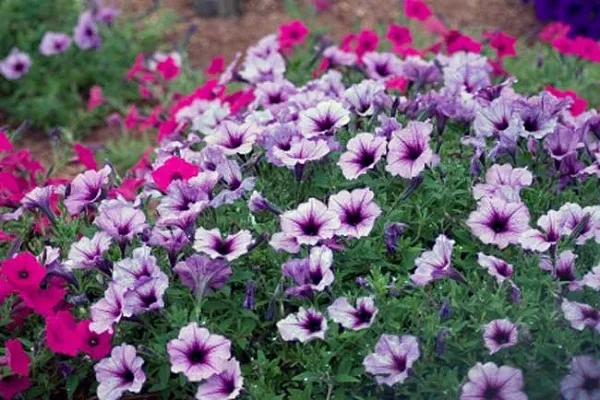
Experts believe that many flowering plants may have survived thanks to duplicating their genomes.
However, he noted that the research should be a starting point for further investigation. “Overall, the work is done very carefully with some of the best methods currently available, but there is always a lot of uncertainty when you’re projecting back hundreds of millions of years in the past,” Bird told Live Science.
In the future, as the climate changes, research into polyploids is likely to become increasingly important, scientists say.
“Polyploids are better able to cope with stress, and stressful conditions can also induce polyploidy,” said Douglas Soltis, a biologist at the Natural History Museum of Florida who was not involved in the research but who collaborates with Van De Peer. “The Anthropocene [human era] will be — and probably already is — a time of stress that will induce polyploidy and also select for polyploids.”
Bird agreed that climate change could trigger another burst of genome duplications, but he noted that it would take millions of years to see how this burst will shape plant evolution. “What we might expect to see in the present is that polyploid populations are better able to tolerate the weather volatility, intensification and habitat degradation brought on by climate change and other human disturbances to habitats,” he said.
Van De Peer and his team are artificially making polyploid plants and investigating how they respond to stress. “There must be a stress advantage in the polyploids, but there is so much that we still don’t know about that,” he said.
See how much you know about natural selection with our evolution quiz!
