
Mount Etna is like no other volcano on Earth, new research finds. In fact, the volcano may have formed in a bizarre way, reminiscent of how some seamounts, called petit-spot volcanoes, grow on the ocean floor, researchers reported April 7 in the journal JGR Solid Earth. Although these seamounts are tiny — just a few hundred feet tall — Mount Etna towers 11,165 feet (3,403 meters) above sea level.
“This actually represents a new type of volcanism,” Sarah Lambart, a petrologist at the University of Utah who was not involved in the new research, told Live Science.
Before this study, researchers split volcanoes into three types, Sébastien Pilet, a lecturer in Earth sciences at the University of Lausanne in Switzerland, told Live Science.
Mid-ocean ridge volcanoes form where the oceanic plate pulls apart and magma from below rises to form a new crust. Then, there are intraplate volcanoes, like the Yellowstone caldera or the volcanoes forming the Hawaiian Islands, where a “hotspot” in the mantle causes a concentrated zone of eruptions. Finally, there are subduction zone volcanoes, like Mount Rainier in Washington and Mount Fuji in Japan. These volcanoes form on the continental crust inland from a subduction zone, where an oceanic plate pushes under the continent, and they’re driven by the water in the oceanic plate causing rocks to melt in the subsurface.
Mount Etna, located on the Italian island of Sicily, fits none of these categories. It sits near where the African Plate is sliding under the Eurasian Plate, but it’s right on top of where the plates meet, rather than inland like most subduction zone volcanoes. Chemically speaking, Mount Etna’s lava also looks like hotspot volcano lava, even though there is no evidence for a hotspot underneath it.
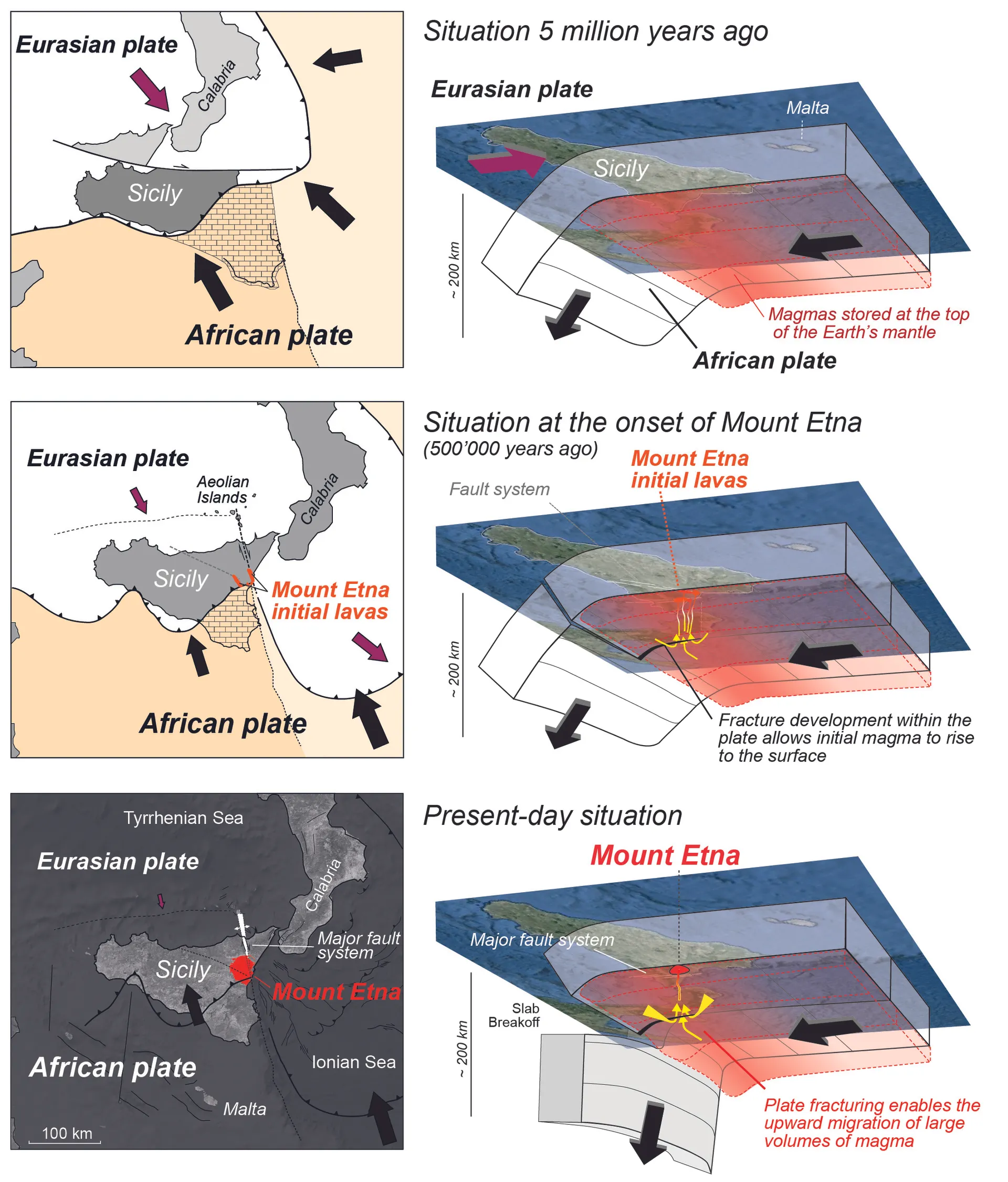
Mount Etna formation model, with the volcano starting to grow around 500,000 years ago.
(Image credit: University of Lausanne)
On top of that, Etna’s evolution has been weird. Early in the volcano’s history, it erupted small amounts of silica-rich lava. Later, it started spewing a lot of lava rich in alkali metals, like potassium and sodium. This is unusual, Pilet said; normally, silica-rich lava comes from magma reservoirs with a lot of melt, so they erupt in large volumes, while alkali-rich lava comes from less-melted rocks in the mantle and thus tends to erupt in small amounts.
To figure out what’s been happening at Etna, Pilet and his colleagues studied the geochemistry of the lava layers across the volcano’s history.
They found that Etna’s lava seems to arise from a melty layer at the top of the mantle known as a low-velocity zone, because seismic waves slow down in these regions. These low-velocity zones are likely widespread, Pilet said, but the melt rarely reaches the surface. What makes Etna special is its location in a complicated tectonic zone. The subducting plate isn’t diving under the Eurasian Plate evenly, Pilet said; it’s partially stuck, leading to the rock folding and deforming. “The folds are allowing the magma to rise up,” he said.
The initial magma had to travel from the low-velocity zone through the African Plate, and it reacted with the crust along the way to form large amounts of silica-rich lava, Pilet said. (Continental crust is rich in silica.) After that passage, a more direct conduit from the mantle to the surface brought up less-adulterated alkali lava from the low-velocity zone, but in smaller supply.
This finding is intriguing, Lambart said, because the role of magma’s interactions with the lithosphere, which includes the crust and upper mantle, in volcanic eruptions is underexplored. That means that, although Etna is one of a kind, the unique type of volcanism it represents might point to more widespread phenomena.
“The lithosphere might actually have a very important role in contributing one way or another to the magmatic activity we are seeing everywhere, not only Mount Etna,” she said.
Pilet, S., Reymond, J., Rochat, L., Corsaro, R. A., Chiaradia, M., Caricchi, L., & Müntener, O. (2026). Mount Etna as a leaking pipe of magmas from the low velocity zone. Journal of Geophysical Research Solid Earth, 131(4). https://doi.org/10.1029/2025jb032785
What do you know about volcanos? Test your knowledge with our volcano quiz!
