Close Menu
  • Home
  • UNSUBSCRIBE
  • News
  • Lifestyle
  • Tech
  • Entertainment
  • Sports
  • Travel
Facebook X (Twitter) WhatsApp
Trending
  • Lemur used in ‘lemur yoga’ session dies of human herpesvirus, study finds
  • ‘A fine line between reducing stigma and trivialising conditions’: Social media, self-diagnosis and the glamorization of ADHD
  • New 2D memory device stores data on just a single electron
  • Before we ban kids from social media completely, here’s what we should try first | Jonathan Bellack and Mariana Olaizola Rosenblat
  • Scientists uncover a better way to beat ‘the bends’ — using deep-diving pigs
  • Mars may have been losing its water more than 4 billion years ago, oldest-known Martian meteorite suggests
  • ‘The lance head was still inside the pelvis’: Mass grave found in Austria may hold casualties of unknown ancient Roman battle
  • ‘Full-on berserker mode’: Archaeologists solve mystery of medieval soldiers with gruesome square holes in their skull
Facebook X (Twitter) WhatsApp
Baynard Media
  • Home
  • UNSUBSCRIBE
  • News
  • Lifestyle
  • Tech
  • Entertainment
  • Sports
  • Travel
Baynard Media
Home»Lifestyle»Mystery of golden orb found in depths of ocean off Alaska finally solved: ‘Everyone was like, What the heck? What is that?’
Lifestyle

Mystery of golden orb found in depths of ocean off Alaska finally solved: ‘Everyone was like, What the heck? What is that?’

EditorBy EditorApril 27, 2026No Comments5 Mins Read
Share Facebook Twitter Pinterest LinkedIn Tumblr Reddit Telegram Email
Share
Facebook Twitter LinkedIn Pinterest Email

Mysterious Golden Orb Identified! – YouTube
Mysterious Golden Orb Identified! - YouTube


Watch On

A years-long mystery about a shiny blob found at the bottom of the ocean has finally been solved.

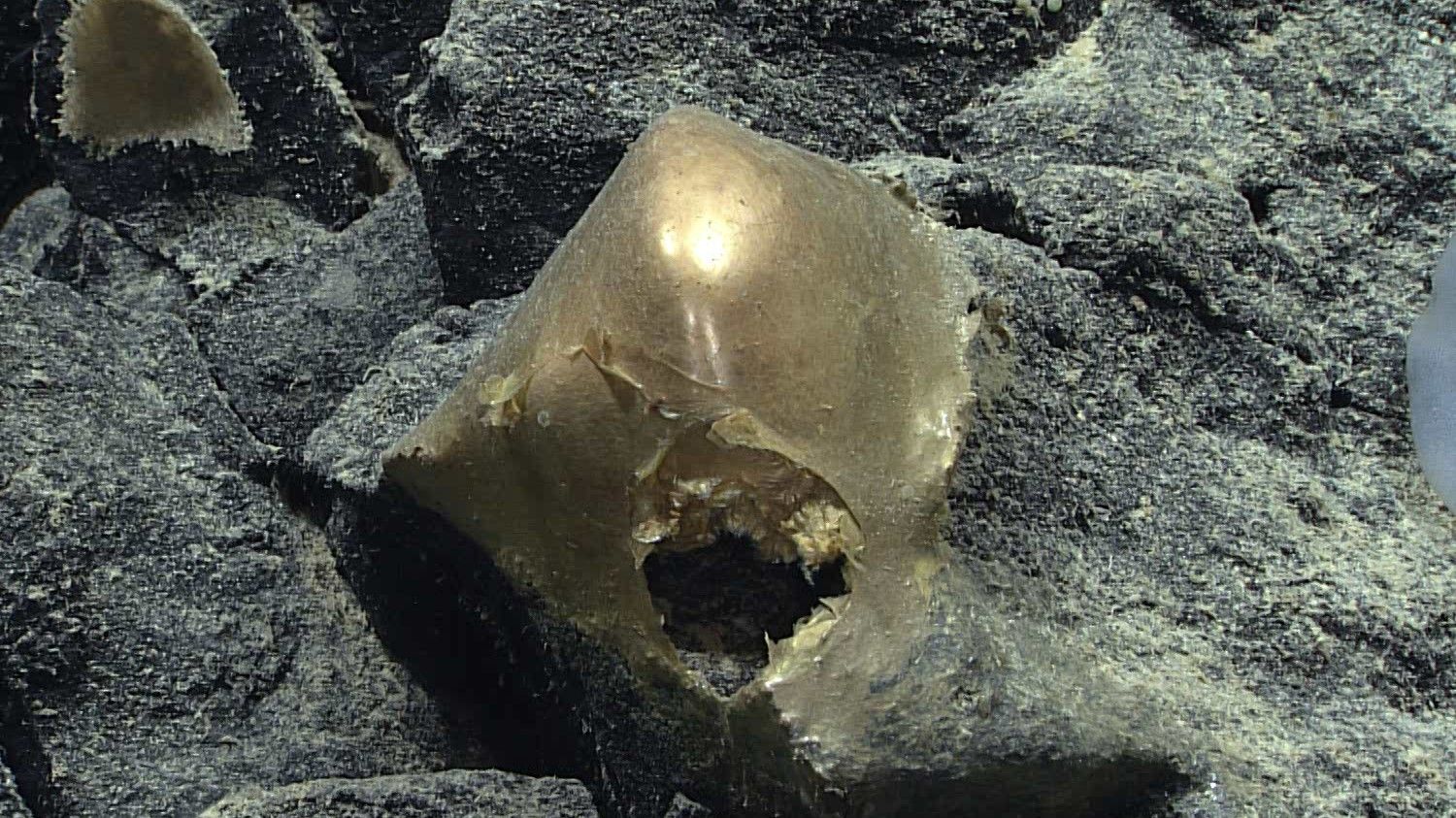
When the strange golden orb was discovered on a deep-sea dive in Alaska waters in 2023, marine biologists were stumped. The National Oceanic and Atmospheric Administration’s Seascape Alaska 5 expedition came across the smooth, soft object stuck tightly to a rock about 2 miles (3.2 kilometers) below the surface of the Pacific Ocean. Using a suction attachment, the remotely operated vehicle brought the object to the surface for further study on the ship waiting above, the Okeanos Explorer. But even upon closer examination, they couldn’t identify it.

There were many theories about what it could be. Perhaps it was an egg, a sponge or a mat of microbes.


You may like

“Everyone was like, ‘What the heck? What is that?,'” Allen Collins, a zoologist at the Smithsonian National Museum of Natural History in Washington, D.C., told Live Science.
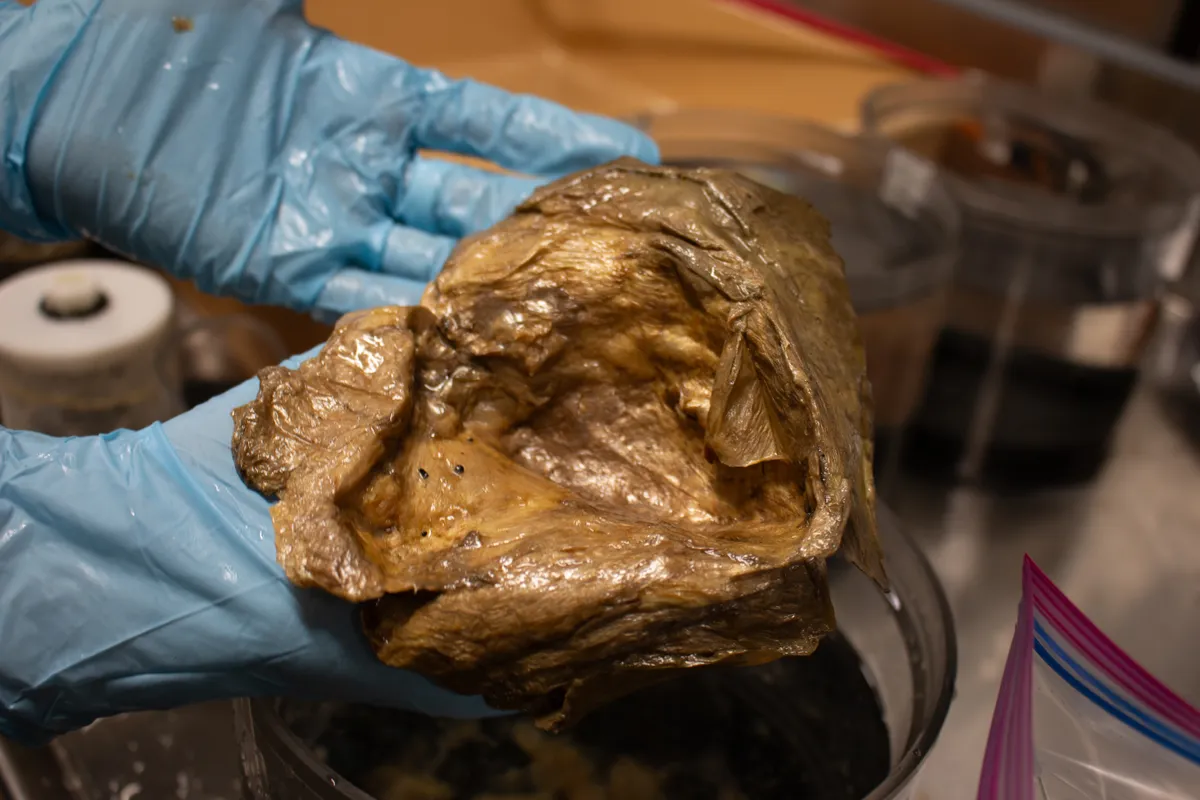
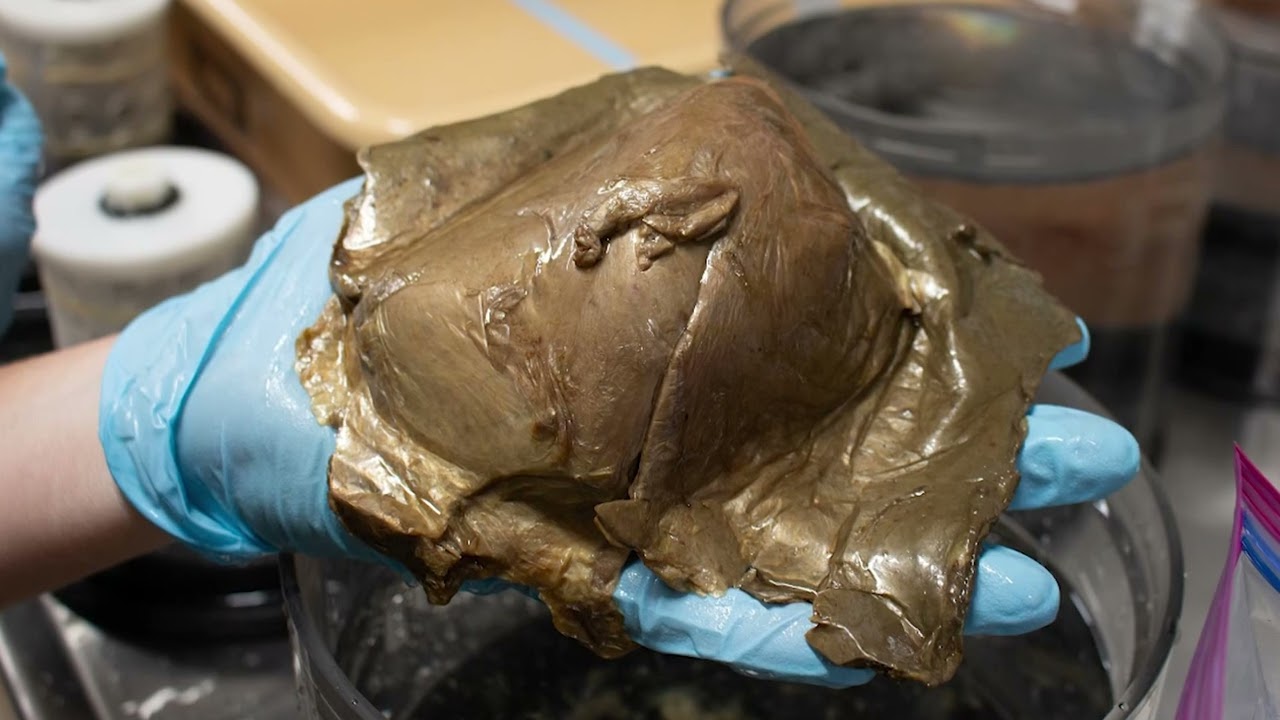
a blob of gold with someone with blue plastic gloves holding it

A close up image of the “golden orb” in the lab of the Smithsonian Institution. The orb was found on the seafloor off Alaska in 2023. (Image credit: NOAA Fisheries)

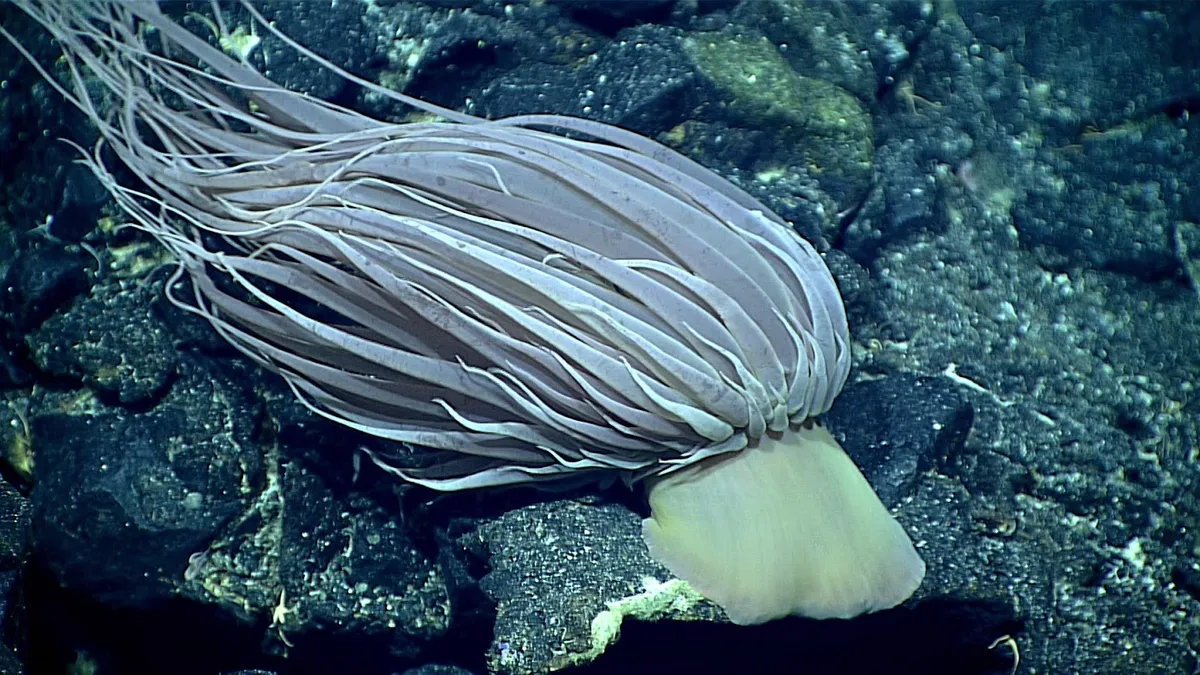
Now, he’s led an analysis that has finally revealed what the orb is ‪—‬ and it turns out that it’s something secreted by a mysterious deep-sea creature called Relicanthus daphneae.

“The first thing we were looking for was gross anatomy,” he said. “Is there a mouth somewhere? Can we find muscles? The sort of thing that would tell us that it’s some particular kind of an animal. And we didn’t find any of that.”

The next step was to put it under a microscope. This inspection revealed that the tissue contained nematocysts ‪—‬ the stinging cells that define the Cnidaria phylum, which includes more than 11,000 species of aquatic invertebrates, such as jellyfish, hydroids, sea anemones and corals.

Get the world’s most fascinating discoveries delivered straight to your inbox.

These stinging cells were spirocysts, which Collins said are unique to the Hexacorallia class. That cut it down to 4,000 or so species.

Next, the team tried genetic tests and detected DNA from lots of microbes, as well as from an anemone-like organism ‪—‬ R. daphneae.

This is when co-author Estefanía Rodríguez, curator of marine invertebrates at the American Museum of Natural History in New York, who had been studying R. daphneae specimens for many years, got involved. She recognized the tissue as a cuticle, which means the golden orb is the structure that an anemone secretes beneath it to cement itself to rock. The work is posted on the bioRxiv preprint server and hasn’t been peer-reviewed yet.

What to read next

an anenome with threads attached to a rock in the sea

The “orb” was secretions from the deep-sea anemone-like creature, Relicanthus daphneae. (Image credit: NOAA Ocean Exploration, Deepwater Exploration of the Marianas)

“It is wonderful that the authors were able to gather enough evidence from the sample to identify it, even though it was actually a remnant not a whole specimen,” Tammy Horton, a deep-sea taxonomist at the National Oceanography Centre in Southampton, U.K., told Live Science in an email.

She said the work demonstrates the importance of both DNA identification and obtaining specimens, because physical samples are needed to confirm the identity of little-known marine species.

“It’s great to have an answer to what the ‘golden orb’ is, and as is often the case in the deep sea, it’s a surprise,” said Jon Copley, a marine ecologist at the University of Southampton in the U.K. “From its looks alone, we didn’t guess it would be the remnants of an anemone-like animal.”

Scientists haven’t agreed on which group R. daphneae fits into yet. Genetic data from a 2019 study indicates it doesn’t sit in current taxonomic groups and is in a sister group to true anemones, so it should be called “anemone-like,” Copley said.

However, Rodríguez, who was part of the 2019 study’s team, is still convinced it is an anemone, she told Live Science. “Morphologically it is an anemone, and I do believe it’s an anemone,” Rodríguez said. “We just don’t have enough samples to show that yet.” She suspects it might be from an ancient line of anemones, which is why it is hard to place.

Regardless of which group it fits into, R. daphneae probably secretes a cuticle to attach to rock but can detach from it to move to a better location and then attach in the new place by creating a new cuticle, Collins explained. That is why the golden orb was left there.

“In some videos, you can see cuticle on the rock adjacent to where the anemone is,” he said, adding that in one case, you can spot a long trail along a rock where the anemone appears to have repeatedly started secreting a cuticle before moving on.

R. daphneae has mainly been seen near hydrothermal vents in the Pacific, Southern and Indian oceans, but that may be because scientists visit vents more often than other deep-ocean habitats, Copley said. He suspects the bizarre creatures may be more widespread, and now that we know they leave behind golden orbs, we may get a better idea of how far they spread.

Auscavitch, S. R., Reft, A., Collens, A. B., Mah, C., Best, M., Benedict, C., Rodríguez, E., Daly, M., & Collins, A. G. (2026). The Curious Case of the Golden Orb – Relict of Relicanthus daphneae (Cnidaria, Anthozoa, Hexacorallia), a deep sea anemone. bioRxiv (Cold Spring Harbor Laboratory). https://doi.org/10.64898/2026.04.17.719276

Source link

Share. Facebook Twitter Pinterest LinkedIn Tumblr Email
Previous ArticleHow everything you do is being monitored in an AI-fuelled ‘surveillance capitalism system’ that’s ramping up aggressively
Next Article NASA Curiosity rover uncovers rock with 7 new organic molecules on Mars
Editor
  • Website

Related Posts

Lifestyle

Lemur used in ‘lemur yoga’ session dies of human herpesvirus, study finds

August 15, 2026
Lifestyle

‘A fine line between reducing stigma and trivialising conditions’: Social media, self-diagnosis and the glamorization of ADHD

August 15, 2026
Lifestyle

New 2D memory device stores data on just a single electron

August 15, 2026
Add A Comment

Comments are closed.

Categories
  • Entertainment
  • Lifestyle
  • News
  • Sports
  • Tech
  • Travel
Recent Posts
  • Lemur used in ‘lemur yoga’ session dies of human herpesvirus, study finds
  • ‘A fine line between reducing stigma and trivialising conditions’: Social media, self-diagnosis and the glamorization of ADHD
  • New 2D memory device stores data on just a single electron
  • Before we ban kids from social media completely, here’s what we should try first | Jonathan Bellack and Mariana Olaizola Rosenblat
  • Scientists uncover a better way to beat ‘the bends’ — using deep-diving pigs
calendar
August 2026
M T W T F S S
 12
3456789
10111213141516
17181920212223
24252627282930
31  
« Jul    
Recent Posts
  • Lemur used in ‘lemur yoga’ session dies of human herpesvirus, study finds
  • ‘A fine line between reducing stigma and trivialising conditions’: Social media, self-diagnosis and the glamorization of ADHD
  • New 2D memory device stores data on just a single electron
About

Welcome to Baynard Media, your trusted source for a diverse range of news and insights. We are committed to delivering timely, reliable, and thought-provoking content that keeps you informed
and inspired

Categories
  • Entertainment
  • Lifestyle
  • News
  • Sports
  • Tech
  • Travel
Facebook X (Twitter) Pinterest WhatsApp
  • Contact Us
  • About Us
  • Privacy Policy
  • Disclaimer
  • UNSUBSCRIBE
© 2026 copyrights reserved

Type above and press Enter to search. Press Esc to cancel.