Close Menu
  • Home
  • UNSUBSCRIBE
  • News
  • Lifestyle
  • Tech
  • Entertainment
  • Sports
  • Travel
Facebook X (Twitter) WhatsApp
Trending
  • OpenAI’s internal AI model just solved an 80-year-old math problem ‪—‬ and mathematicians verified it
  • Skeletal remains of Queen Elisenda, one of the most powerful rulers in medieval Europe, unearthed in Barcelona — along with several others who bore unexplained stab wounds
  • Tests that measure ‘biological age’ aren’t helpful for tracking your health, scientists say
  • Japan hits 6G key milestone with high-frequency speeds topping 100 Gbps
  • War has brought Iran’s water crisis to a breaking point: ‘Things will collapse unless there is meaningful structural change’
  • Fingal’s Cave: Scotland’s ‘cave of melody’ where eerie echoes bounce off pillars of solidified lava
  • Controversial ‘JuMBO’ planets discovered by James Webb telescope may not be an illusion after all
  • Scientists found the optimal robot body, and it has 20 legs ‪—‬ watch it scale walls and move through trees
Facebook X (Twitter) WhatsApp
Baynard Media
  • Home
  • UNSUBSCRIBE
  • News
  • Lifestyle
  • Tech
  • Entertainment
  • Sports
  • Travel
Baynard Media
Home»Lifestyle»Anglo-Saxon burial holds an older sister cradling her little brother after they both died 1,400 years ago, possibly of an infectious disease
Lifestyle

Anglo-Saxon burial holds an older sister cradling her little brother after they both died 1,400 years ago, possibly of an infectious disease

EditorBy EditorApril 17, 2026No Comments3 Mins Read
Share Facebook Twitter Pinterest LinkedIn Tumblr Reddit Telegram Email
Share
Facebook Twitter LinkedIn Pinterest Email

Two Anglo-Saxon children interred together 1,400 years ago were brother and sister, an analysis of the skeletons’ DNA reveals — a confirmed familial link that is rare in Anglo-Saxon burials.

The siblings may have died at the same time from a fast-acting disease, according to a statement from the British archaeology show Time Team.

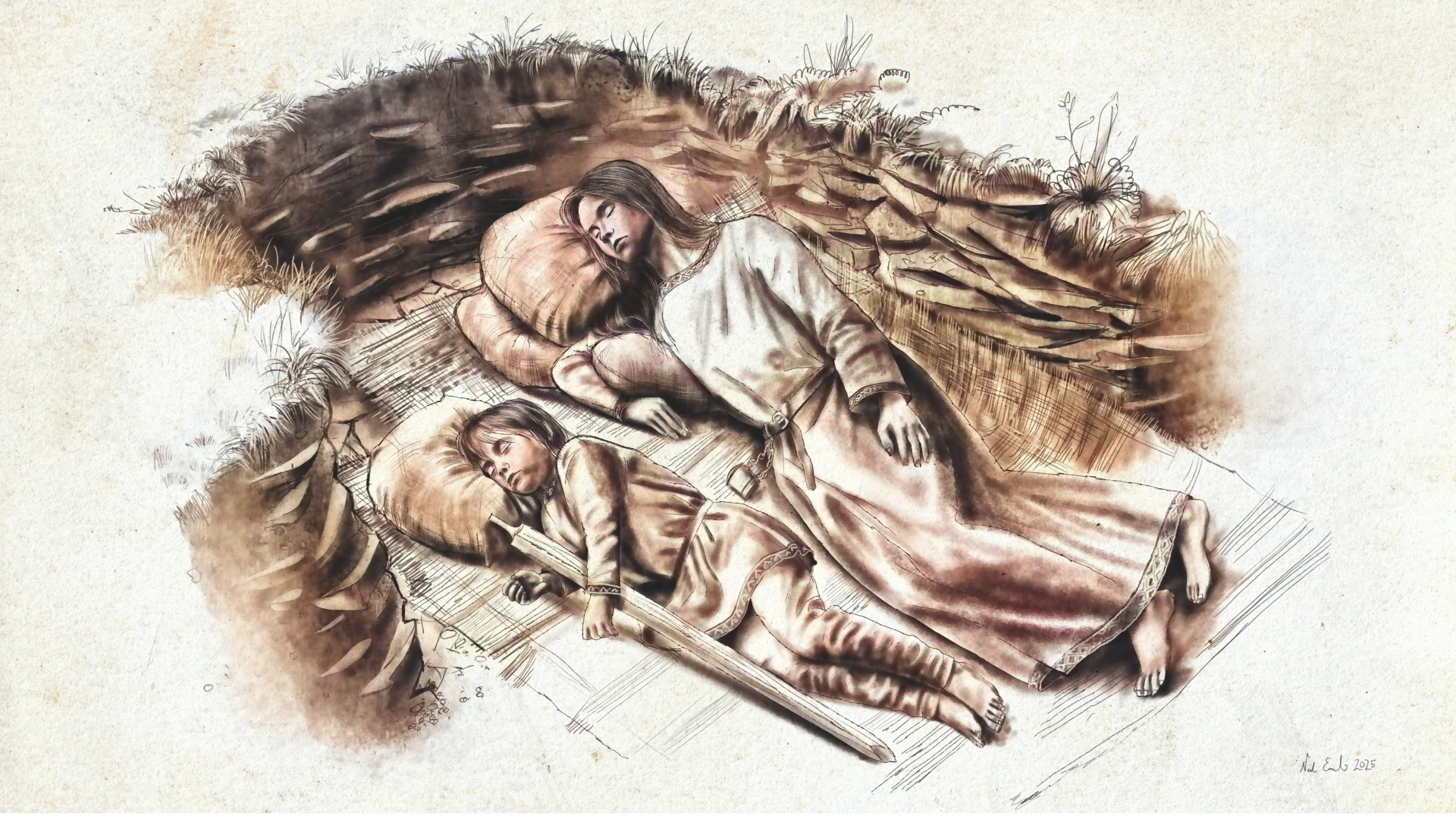
Archaeologists initially discovered the rare double burial in an Anglo-Saxon cemetery in Cherington, a village in southwest England, in September 2024. In the grave, the excavators found the skeleton of a 7- or 8-year-old boy holding an iron sword and the skeleton of a teenage girl buried with a necklace and a workbox — a cylindrical metal object that may have held thread and cloth — dated to the second half of the seventh century.


You may like

Time Team featured the excavation of the double burial in an episode released in January, but a DNA analysis of the skeletons was recently completed by scientists at the Francis Crick Institute in London. The results were announced on the April 14 episode of the Time Team podcast.

The DNA confirmed “we do have a boy and a young girl,” Jacqueline McKinley, the osteoarchaeologist with Wessex Archaeology who excavated the burial, said in the podcast. “But I know what their relationship is now — they were brother and sister.”

The siblings appear to have been buried in the same grave at the same time. The older sister was turned toward her little brother and was found at a slightly higher level, suggesting she had been propped up on pillows that have since disintegrated. It is “a very telling position,” McKinley said. “To me, that is a signal of what her role was before he died. She was somebody who would look after him, look over him.”
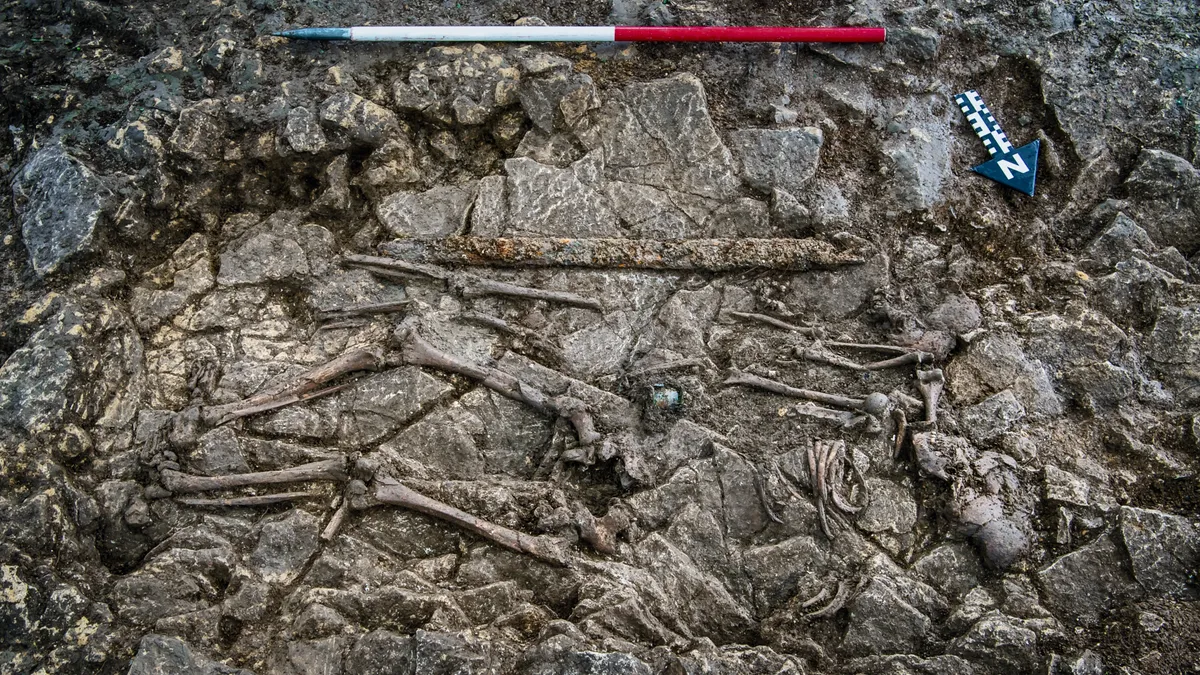
archaeological excavation of a double burial with two skeletons

The double burial in southwest England was first excavated in September 2024. (Image credit: © Harvey Mills / Time Team)

Because the siblings died at the same time, McKinley suspects a rapid-acting infectious disease may have been to blame. “I think she probably did catch something from him, and that’s why they died at the same time,” she said. It’s not clear, however, how the siblings died.

Get the world’s most fascinating discoveries delivered straight to your inbox.

Further DNA analysis may be able to clarify if a pathogen was responsible for the siblings’ deaths. But McKinley pointed out that the bacteria that cause some life-threatening conditions, such as sepsis or meningitis, would not leave behind their DNA, limiting confirmation of the siblings’ cause of death.

McKinley is currently working on an Anglo-Saxon cemetery nearby in Wiltshire, which also contained double burials. At that site, however, the DNA analysis done so far has not shown any first- or second-degree relationships, such as siblings, parents and children, grandchildren and grandchildren, or uncles and nieces, she said. Rather, the relationships between people buried in double graves are helping confirm historical information that Anglo-Saxon households included adoption, fostering and extended family networks.

The discovery of siblings in an Anglo-Saxon grave “opens up a whole new vista,” Helen Geake, a Time Team archaeologist and Anglo-Saxon specialist, said in the podcast. “Immediately, your thoughts go to the wider family and what an awful tragedy this must have been to lose two children at the same time.”

Source link

Share. Facebook Twitter Pinterest LinkedIn Tumblr Email
Previous ArticleTrump administration expands visa restrictions in Western Hemisphere
Next Article Bill to fund Medicaid fraud prosecutions eviscerated by House GOP
Editor
  • Website

Related Posts

Lifestyle

OpenAI’s internal AI model just solved an 80-year-old math problem ‪—‬ and mathematicians verified it

May 30, 2026
Lifestyle

Skeletal remains of Queen Elisenda, one of the most powerful rulers in medieval Europe, unearthed in Barcelona — along with several others who bore unexplained stab wounds

May 29, 2026
Lifestyle

Tests that measure ‘biological age’ aren’t helpful for tracking your health, scientists say

May 29, 2026
Add A Comment

Comments are closed.

Categories
  • Entertainment
  • Lifestyle
  • News
  • Sports
  • Tech
  • Travel
Recent Posts
  • OpenAI’s internal AI model just solved an 80-year-old math problem ‪—‬ and mathematicians verified it
  • Skeletal remains of Queen Elisenda, one of the most powerful rulers in medieval Europe, unearthed in Barcelona — along with several others who bore unexplained stab wounds
  • Tests that measure ‘biological age’ aren’t helpful for tracking your health, scientists say
  • Japan hits 6G key milestone with high-frequency speeds topping 100 Gbps
  • War has brought Iran’s water crisis to a breaking point: ‘Things will collapse unless there is meaningful structural change’
calendar
June 2026
M T W T F S S
1234567
891011121314
15161718192021
22232425262728
2930  
« May    
Recent Posts
  • OpenAI’s internal AI model just solved an 80-year-old math problem ‪—‬ and mathematicians verified it
  • Skeletal remains of Queen Elisenda, one of the most powerful rulers in medieval Europe, unearthed in Barcelona — along with several others who bore unexplained stab wounds
  • Tests that measure ‘biological age’ aren’t helpful for tracking your health, scientists say
About

Welcome to Baynard Media, your trusted source for a diverse range of news and insights. We are committed to delivering timely, reliable, and thought-provoking content that keeps you informed
and inspired

Categories
  • Entertainment
  • Lifestyle
  • News
  • Sports
  • Tech
  • Travel
Facebook X (Twitter) Pinterest WhatsApp
  • Contact Us
  • About Us
  • Privacy Policy
  • Disclaimer
  • UNSUBSCRIBE
© 2026 copyrights reserved

Type above and press Enter to search. Press Esc to cancel.