
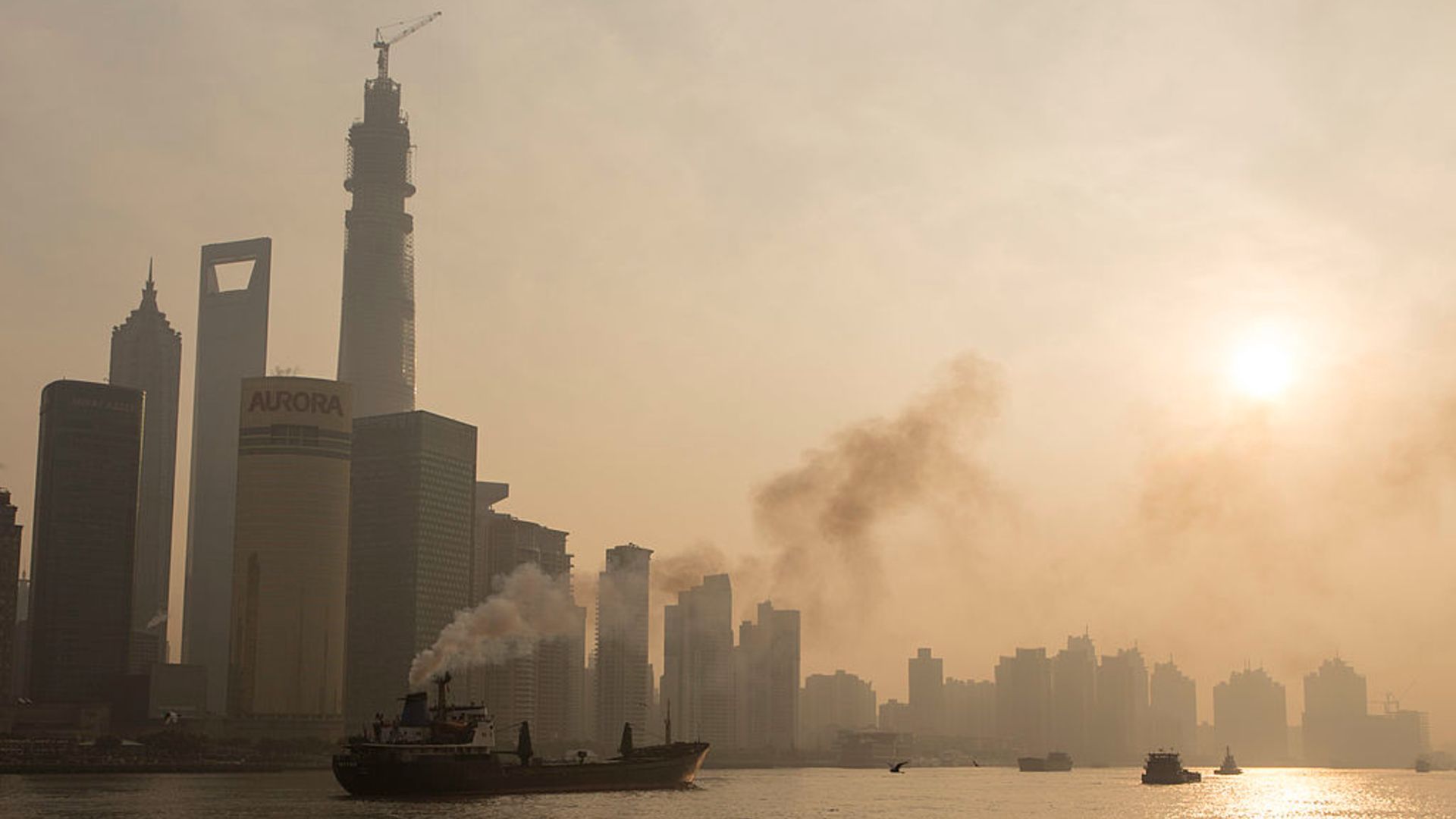
China’s significant reduction in air pollution may have had unexpected benefits in the Arctic: A new study shows that it diminished storms fueled by aerosols and, in turn, reduced sea ice loss. However, at the same time, this huge drop in aerosols may have accelerated global warming, experts say.
“The Chinese people suffered under bad air quality for decades,” Bjørn Samset, a senior researcher at the CICERO Centre for International Climate Research in Norway, told Live Science. “This pollution temporarily slowed global warming and gave the rest of us a bit more time to adapt to a warmer climate. What is happening now is that we’re seeing the full effects of greenhouse-gas-driven warming, which we would sooner or later have to face anyway.”
In late January 2019, wind patterns over the North Pacific shifted, and a series of five powerful cyclones swept into the Bering Sea in rapid succession. Each one drove warm southerly winds across the ice, breaking it apart and pushing it northward. Air temperatures across the northern Bering Sea ran 21.6 to 28.8 degrees Fahrenheit (12 to 16 degrees Celsius) above normal. By early March, ice cover had shrunk by 82%. This represented a retreat of about 154,440 square miles (400,000 square kilometers) — the largest decline ever recorded by satellites at that time of the year.
Scientists have long known that cyclones can devastate Arctic sea ice. What they’ve been less sure about is what sends those storms there in the first place.
The new study, published March 18 in journal npj Climate and Atmospheric Science, offers an unexpected answer: From 2000 to 2014, smog billowing from Chinese smokestacks may have been steering winter storms northward across the North Pacific, funneling more of them into the Arctic and destroying ice in the Bering Sea.
To understand how soot and sulfate particles over Shanghai could influence ice off the coast of Alaska, it helps to think about what happens inside a storm. Every mid-latitude cyclone — the swirling, comma-shaped systems that generate much of the Northern Hemisphere’s winter weather — runs on a kind of heat engine. Warm, moist air evaporates near the ocean surface, rises and condenses into clouds, releasing heat that fuels the storm’s circulation.
Aerosols — the tiny particles that make up industrial haze — disrupt this engine in a subtle-but-consequential way. Water vapor normally condenses around a relatively small number of particles, forming large droplets that fall quickly as rain on the storm’s southern flank. If the air is full of aerosols, however, each particle becomes a seed for a cloud droplet. The result is a vast number of smaller droplets that don’t readily coalesce into raindrops. Rainfall on the storm’s southern flank is suppressed, and moisture travels farther along the storm’s conveyor belt toward its northeastern flank, where it releases its heat — in exactly the right place to nudge the whole system poleward.
Lead author Dianbin Cao, a researcher at the Chinese Academy of Sciences’ Institute of Tibetan Plateau Research, and colleagues combined four decades of observational data with climate model simulations to examine how aerosol levels over East Asia influenced winter cyclone tracks across the North Pacific. Comparing 14 years of elevated aerosol loading between 2000 and 2014 against 15 lower-aerosol years from the preceding decades, the researchers found that cyclone tracks shifted northward by up to 1.23 degrees by the time the storms dissipated — enough to nearly double the number of cyclones crossing into the Arctic.

This aerosol-driven push on storm systems is “stronger than I might have suspected,” said Alex Crawford, an Arctic climate scientist at the University of Manitoba who studies cyclone-sea ice interactions but was not involved in the study. “They’ve done a really good job of demonstrating the mechanism by which aerosols can impact extratropical cyclones.”
When these storms arrive in the Bering Sea, their effects can be dramatic. A cyclone’s counterclockwise winds shove ice back toward the Chukchi Sea, between Alaska and Russia. Waves break ice floes apart. Southerly gales bring warmer air that can, even in the depths of winter, tip temperatures above freezing, as happened so acutely in 2019.
There is a potential silver lining, however. China’s air pollution cleanup, launched in 2013, has proved to be one of the most effective environmental interventions in history, slashing the country’s sulfate aerosol emissions by roughly 75% in about a decade. The study suggests this reduction “could potentially mitigate the poleward migration of the storm track driven by global warming” — sparing the Arctic some of the damage from extratropical cyclones.
But the bigger picture is more complicated. Aerosols also cool the planet by reflecting solar radiation back into space and by making clouds brighter. As they disappear, their cooling effects vanish too, thereby unmasking decades of suppressed greenhouse gas warming. A 2025 study led by Samset, who was not involved in the new study, found that East Asian aerosol reductions have measurably accelerated global warming.
The same aerosol reductions that may ease the cyclone-driven pressure on the Bering Sea are simultaneously unmasking the full effects of global warming.
What this climatic tug-of-war will mean for Arctic sea ice remains to be seen, but Dan Westervelt, an atmospheric scientist at Columbia University’s Lamont-Doherty Earth Observatory and a co-author on Samset’s 2025 study, thinks the warming effect will win out. “Unmasking warming will probably dominate, as it is more persistent and can occur during all seasons, while the storm-track changes are probably more episodic,” he told Live Science.
Westervelt said the study indicates that aerosols exert a greater and more complicated influence on Earth’s climate than previously appreciated. “The speed of the aerosol reductions in East Asia is underappreciated,” he said. “Emissions decreases that took three decades in North America and Europe are taking one decade in East Asia. What impact this has on cyclones and Arctic warming is going to be really interesting to study, and critical for climate mitigation and adaptation.”
Cao, D., Xu, D., Lin, Y., Deng, Y., Chen, X., Zhang, Q., Gao, M., & Zhang, X. (2026). Anthropogenic aerosols can shape the winter mid-latitude cyclone tracks. Npj Climate and Atmospheric Science. https://doi.org/10.1038/s41612-026-01377-w
