Close Menu
  • Home
  • UNSUBSCRIBE
  • News
  • Lifestyle
  • Tech
  • Entertainment
  • Sports
  • Travel
Facebook X (Twitter) WhatsApp
Trending
  • Aspen trees provide a natural buffer against wildfires, even as fire season intensifies, study shows
  • Ancient bullets reveal where a Roman camp hid in the Pyrenees of Spain before being ambushed
  • First deaths from Cyclospora outbreak reported in Michigan
  • Scientists uncover big clue as to how Antarctica’s mysterious Blood Falls came to be
  • ‘Poop pills’ may ease insomnia by reprogramming the gut microbiome, early study hints
  • Did fungi give mammals an evolutionary edge after the dinosaur-killing asteroid hit? New evidence revives a provocative hypothesis
  • Diagnostic dilemma: Rare ‘spinal stroke’ struck an 8-year-old and temporarily paralyzed her
  • Buck Moon 2026: July’s full moon rises tonight, setting up a month of solar and lunar eclipses
Facebook X (Twitter) WhatsApp
Baynard Media
  • Home
  • UNSUBSCRIBE
  • News
  • Lifestyle
  • Tech
  • Entertainment
  • Sports
  • Travel
Baynard Media
Home»Lifestyle»Saturn’s chaotic atmosphere revealed in most comprehensive view yet by James Webb and Hubble telescopes
Lifestyle

Saturn’s chaotic atmosphere revealed in most comprehensive view yet by James Webb and Hubble telescopes

EditorBy EditorMarch 29, 2026No Comments3 Mins Read
Share Facebook Twitter Pinterest LinkedIn Tumblr Reddit Telegram Email
Share
Facebook Twitter LinkedIn Pinterest Email

Saturn may be famous for its rings, but it has long fascinated scientists for another reason: its restless atmosphere, which is shaped by fierce winds, stubborn megastorms and strange weather patterns that can linger for years.

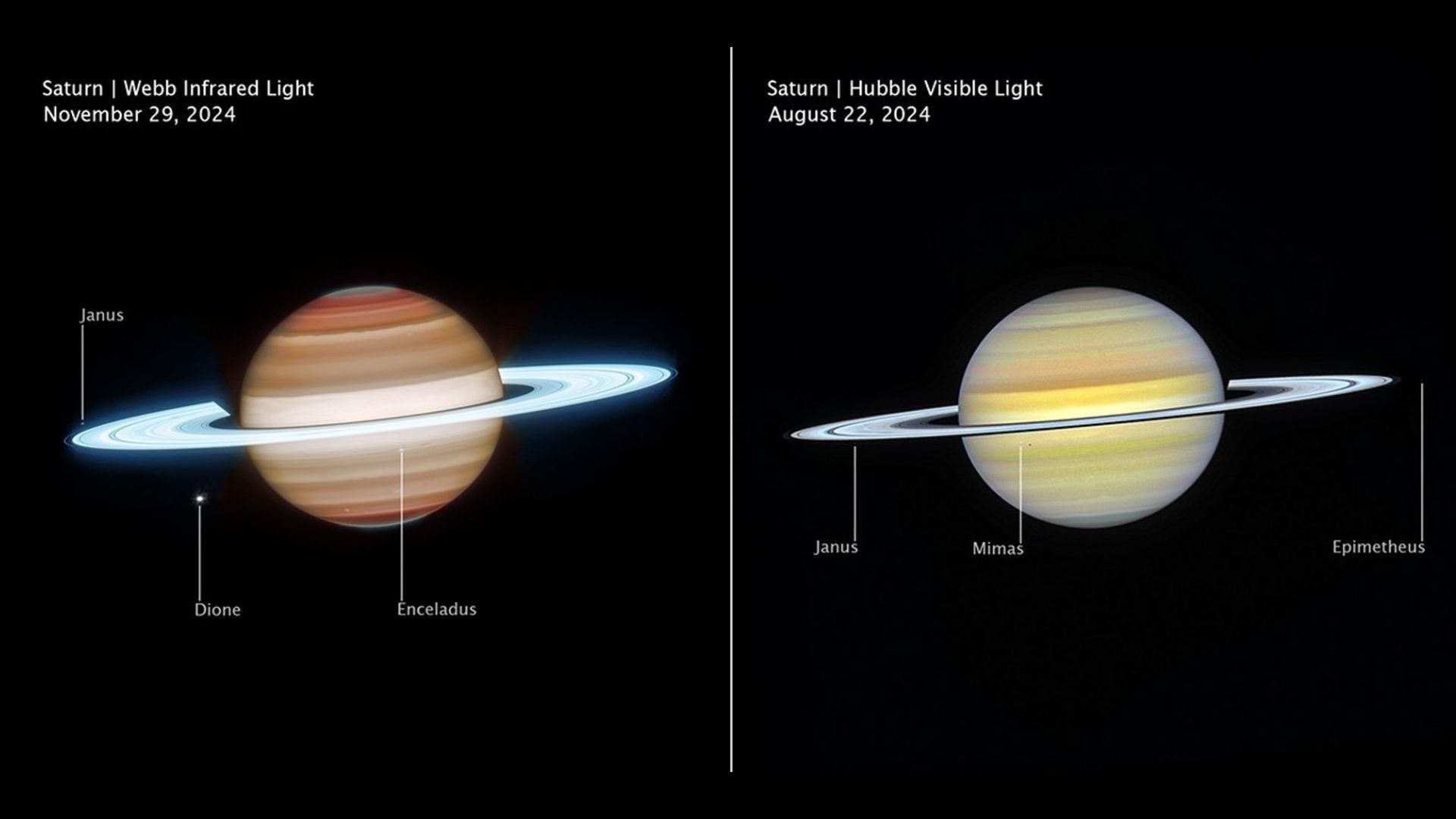
Now, two new views from the James Webb and Hubble space telescopes are cutting through the ringed planet’s clouds, giving researchers what NASA calls the “most comprehensive view of Saturn to date.” Together, the images let researchers “slice” through Saturn’s atmosphere at different heights.

The paired observations capture one of Saturn’s strangest landmarks: the famous hexagon at the north pole. According to NASA, the faint edges of the six-sided jet stream appear in both images. These pictures could be some of the last high-resolution views of the hexagon until the 2040s, as Saturn’s north pole is about to tip into 15 years of winter darkness.

Article continues below


You may like

Studying Saturn’s atmosphere not only allows scientists to understand how large, planet-size storms grow and thrive but also gives further insight into how the planet formed and evolved over billions of years.

A planet seen two ways

In August 2024, Hubble took its visible-light image of Saturn as part of the Outer Planet Atmospheres Legacy program, a decade-long project that tracks the outer planets annually. The James Webb Space Telescope (JWST) captured its infrared image a few months later, in November 2024. Those observations, taken 14 weeks apart, showed the ringed planet shifting from northern summer toward its 2025 equinox.

The two telescopes saw very different Saturns.

While Hubble captured Saturn’s pale-yellow bands and brilliant-white rings, JWST’s infrared image revealed even more striking details. In the infrared view, Saturn’s rings transformed into glowing blue “because they are made of highly reflective water ice,” NASA representatives said in a statement. Saturn’s poles also shone a strange gray-green, emitting light at wavelengths of about 4.3 microns. These emissions could be from either light scattering off of high-altitude aerosols or auroras, NASA suggested. (The telescope recently caught giant auroras shining on Uranus.)

Get the world’s most fascinating discoveries delivered straight to your inbox.

As Saturn tilts into its southern springtime, both space telescopes will continue to keep their eyes on its atmosphere, perhaps revealing more about the planet’s weather dynamics. Until then, Saturn is keeping some of its most interesting secrets hidden in the clouds.


Solar system quiz: How well do you know our cosmic neighborhood?

See how well you know the planets in our solar system with our quiz!

Source link

Share. Facebook Twitter Pinterest LinkedIn Tumblr Email
Previous ArticleMichigan punches ticket to men’s Final Four
Next Article Orange Eyes Smoking Ban as a Crackdown on Homelessness
Editor
  • Website

Related Posts

Lifestyle

Aspen trees provide a natural buffer against wildfires, even as fire season intensifies, study shows

August 4, 2026
Lifestyle

Ancient bullets reveal where a Roman camp hid in the Pyrenees of Spain before being ambushed

August 4, 2026
Lifestyle

First deaths from Cyclospora outbreak reported in Michigan

August 3, 2026
Add A Comment

Comments are closed.

Categories
  • Entertainment
  • Lifestyle
  • News
  • Sports
  • Tech
  • Travel
Recent Posts
  • Aspen trees provide a natural buffer against wildfires, even as fire season intensifies, study shows
  • Ancient bullets reveal where a Roman camp hid in the Pyrenees of Spain before being ambushed
  • First deaths from Cyclospora outbreak reported in Michigan
  • Scientists uncover big clue as to how Antarctica’s mysterious Blood Falls came to be
  • ‘Poop pills’ may ease insomnia by reprogramming the gut microbiome, early study hints
calendar
August 2026
M T W T F S S
 12
3456789
10111213141516
17181920212223
24252627282930
31  
« Jul    
Recent Posts
  • Aspen trees provide a natural buffer against wildfires, even as fire season intensifies, study shows
  • Ancient bullets reveal where a Roman camp hid in the Pyrenees of Spain before being ambushed
  • First deaths from Cyclospora outbreak reported in Michigan
About

Welcome to Baynard Media, your trusted source for a diverse range of news and insights. We are committed to delivering timely, reliable, and thought-provoking content that keeps you informed
and inspired

Categories
  • Entertainment
  • Lifestyle
  • News
  • Sports
  • Tech
  • Travel
Facebook X (Twitter) Pinterest WhatsApp
  • Contact Us
  • About Us
  • Privacy Policy
  • Disclaimer
  • UNSUBSCRIBE
© 2026 copyrights reserved

Type above and press Enter to search. Press Esc to cancel.