Close Menu
  • Home
  • UNSUBSCRIBE
  • News
  • Lifestyle
  • Tech
  • Entertainment
  • Sports
  • Travel
Facebook X (Twitter) WhatsApp
Trending
  • Colorado teen’s survey links social media to teen girl mental health crisis
  • ‘Mentally active’ sitting may reduce dementia risk, study finds
  • Hubble images taken 25 years apart show big changes in the iconic Crab Nebula —‬ Space photo of the week
  • Advocates for Youth hosted abortion doula training for teens as young as 14
  • Bill would provide more funding for high school trades programs
  • What would happen to Earth if the sun suddenly vanished?
  • Ted Cruz stays neutral in Texas Senate runoff between Cornyn and Paxton
  • ICE Deportations in Orange County
Facebook X (Twitter) WhatsApp
Baynard Media
  • Home
  • UNSUBSCRIBE
  • News
  • Lifestyle
  • Tech
  • Entertainment
  • Sports
  • Travel
Baynard Media
Home»Lifestyle»Hubble images taken 25 years apart show big changes in the iconic Crab Nebula —‬ Space photo of the week
Lifestyle

Hubble images taken 25 years apart show big changes in the iconic Crab Nebula —‬ Space photo of the week

EditorBy EditorMarch 29, 2026No Comments3 Mins Read
Share Facebook Twitter Pinterest LinkedIn Tumblr Reddit Telegram Email
Share
Facebook Twitter LinkedIn Pinterest Email

Quick facts

What it is: The Crab Nebula (also called M1), a supernova remnant

Where it is: 6,500 light-years away, in the constellation Taurus

When it was shared: March 23, 2026

The Hubble Space Telescope‘s surprising longevity is giving astronomers a chance to see not only what distant objects look like up close but also how they change over time.

This week, NASA dropped a stunning example: A comparison of two Hubble images from 1999/2000 and 2024 shows how the Crab Nebula — the remains of an exploded star — has expanded and evolved over a quarter century of Hubble images.

There are few more iconic objects in the night sky than the Crab Nebula, a cosmic cloud that links ancient astronomy with modern space telescopes. In the year 1054, a supernova in the constellation Taurus lit up the daytime sky for several weeks — an event recorded by early astronomers in Japan, China and the Middle East. This “guest star” eventually faded from view but it remains one of the best-documented cosmic explosions in human history.

Article continues below


You may like

Centuries later, in the mid-18th century, the Crab Nebula was discovered in the constellation Taurus. Astronomers, including Edwin Hubble in the 1950s, linked the Crab Nebula to the 1054 supernova. The smoking gun was the discovery of a pulsar — a rapidly rotating neutron star, the typical leftovers of a supernova — at the center of the Crab Nebula.

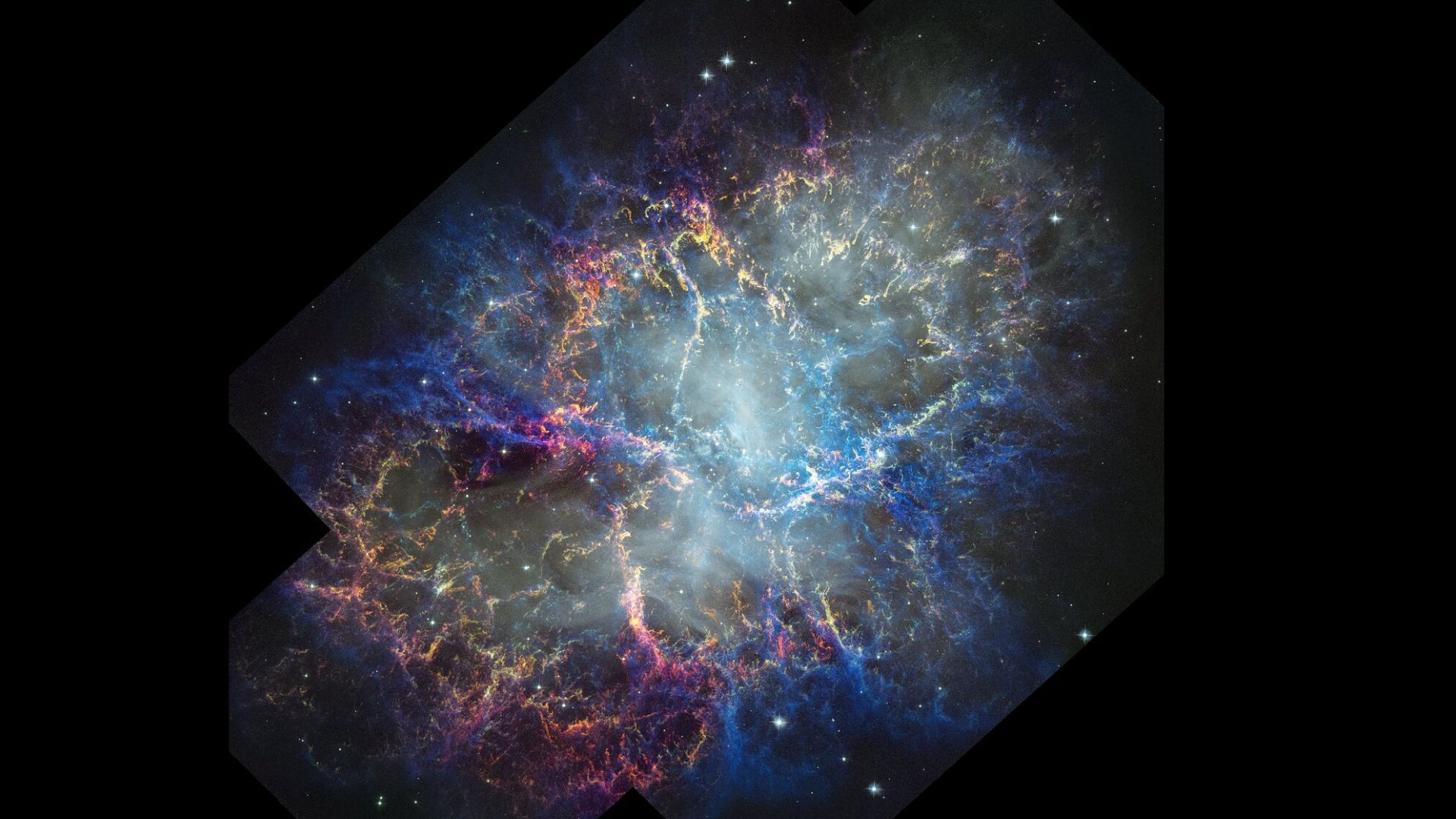
A glowing nebula of pink, blue and orange is seen in the darkness of space

The newest image of the Crab Nebula from the Hubble Space Telescope. (Image credit: NASA, ESA, STScI, W. Blair (JHU). Image Processing: J. DePasquale (STScI)))

That pulsar has been busy powering the nebula’s expansion in the 25 years since it was first photographed by the Hubble Space Telescope. The telescope’s latest observations of the Crab Nebula, published earlier this year in The Astrophysical Journal, have allowed astronomers to measure the outward movement of the nebula’s intricate filaments.

The differences between the two images may seem slight, but the filaments are expanding at about 3.4 million mph (5.5 million km/h). The expansion is driven not by shock waves from the initial explosion — as many supernova remnants are — but by the pulsar, whose powerful magnetic field propels charged particles outward. This energy source drives the nebula’s expansion and illuminates its glowing filaments.

The 1999 Hubble image shows the Crab Nebula slightly smaller than it appeared in 2024

The 1999/2000 Hubble image shows the Crab Nebula smaller than it appeared in 2024 (Image credit: NASA, ESA, STScI,)

The images, which make use of Hubble’s high-resolution Wide Field Camera 3 (installed by astronauts in 2009), allow scientists to see 3D structures and details, with blue regions indicating the hottest, lowest-density gas and yellow and red tones revealing energized sulfur and oxygen. (The 1999/2000 photo has also been reprocessed to match the resolution of Wide Field Camera 3.)

Get the world’s most fascinating discoveries delivered straight to your inbox.

“We tend to think of the sky as being unchanging, immutable,” William Blair, an astronomer at Johns Hopkins University who led the new observations, said in a NASA statement. “However, with the longevity of the Hubble Space Telescope, even an object like the Crab Nebula is revealed to be in motion, still expanding from the explosion nearly a millennium ago.”

Hubble is not the only telescope that has managed to snap this spectacular supernova remnant. In 2023, the James Webb Space Telescope also captured a staggeringly detailed shot of the Crab Nebula, which later helped scientists map out the cosmic dust within its expanding shell, according to NASA.


Source link

Share. Facebook Twitter Pinterest LinkedIn Tumblr Email
Previous ArticleAdvocates for Youth hosted abortion doula training for teens as young as 14
Next Article ‘Mentally active’ sitting may reduce dementia risk, study finds
Editor
  • Website

Related Posts

Lifestyle

What would happen to Earth if the sun suddenly vanished?

March 29, 2026
Lifestyle

Astronauts will ‘absolutely be test subjects’: NASA’s moon plans pose big questions — and big risks

March 29, 2026
Lifestyle

‘Major disruption in Neanderthal history’: 65,000 years ago, all Neanderthals in Europe died out except for one lineage

March 29, 2026
Add A Comment

Comments are closed.

Categories
  • Entertainment
  • Lifestyle
  • News
  • Sports
  • Tech
  • Travel
Recent Posts
  • Colorado teen’s survey links social media to teen girl mental health crisis
  • ‘Mentally active’ sitting may reduce dementia risk, study finds
  • Hubble images taken 25 years apart show big changes in the iconic Crab Nebula —‬ Space photo of the week
  • Advocates for Youth hosted abortion doula training for teens as young as 14
  • Bill would provide more funding for high school trades programs
calendar
March 2026
M T W T F S S
 1
2345678
9101112131415
16171819202122
23242526272829
3031  
« Feb    
Recent Posts
  • Colorado teen’s survey links social media to teen girl mental health crisis
  • ‘Mentally active’ sitting may reduce dementia risk, study finds
  • Hubble images taken 25 years apart show big changes in the iconic Crab Nebula —‬ Space photo of the week
About

Welcome to Baynard Media, your trusted source for a diverse range of news and insights. We are committed to delivering timely, reliable, and thought-provoking content that keeps you informed
and inspired

Categories
  • Entertainment
  • Lifestyle
  • News
  • Sports
  • Tech
  • Travel
Facebook X (Twitter) Pinterest WhatsApp
  • Contact Us
  • About Us
  • Privacy Policy
  • Disclaimer
  • UNSUBSCRIBE
© 2026 copyrights reserved

Type above and press Enter to search. Press Esc to cancel.