
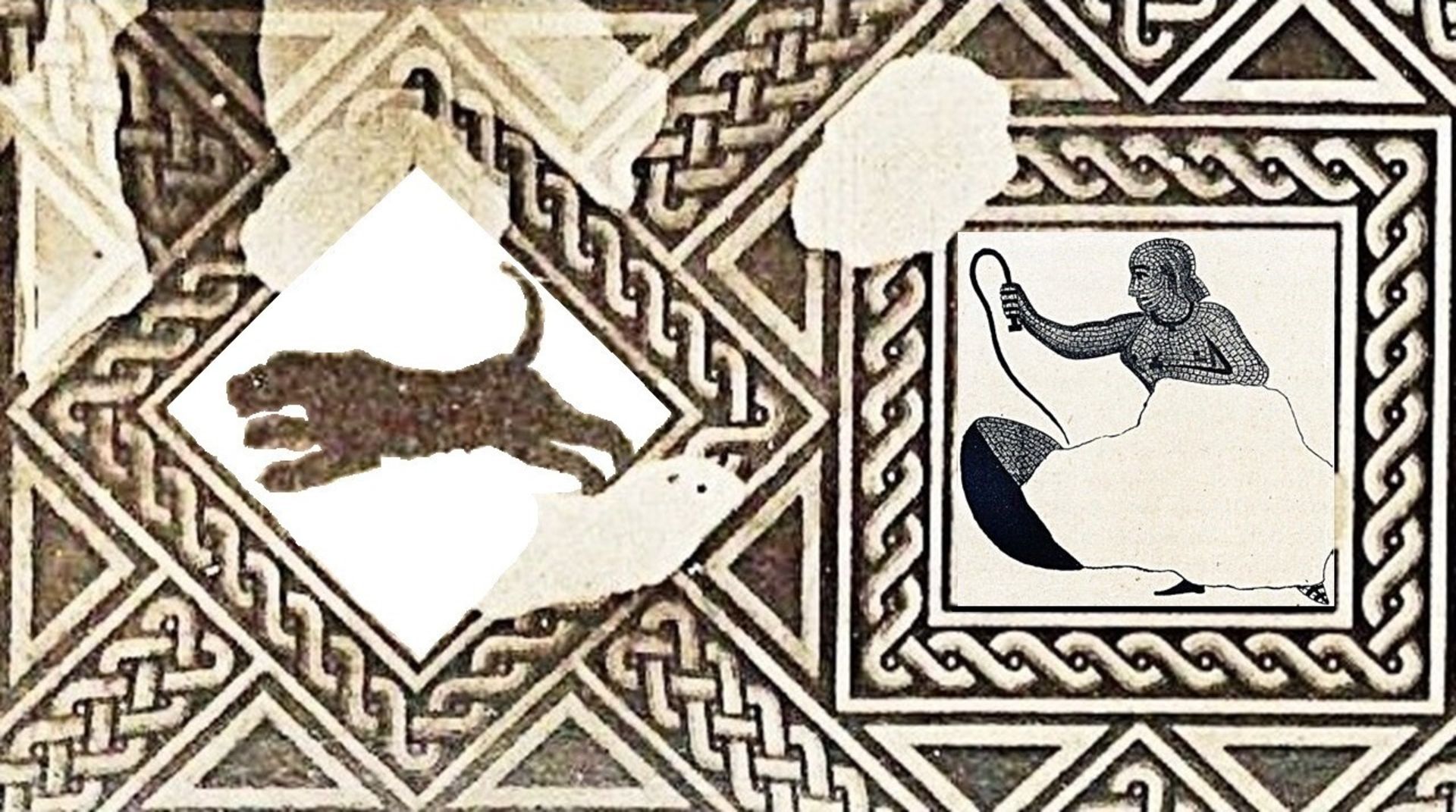
For the first time ever, an image of a Roman woman battling a beast in an arena has been identified.
While ancient texts say that some women battled beasts in the arenas of the Roman Empire, this is the first visual evidence that this occurred, according to a new study published March 22 in The International Journal of the History of Sport. The women who battled beasts were known as venatrice or huntresses.
Article continues below
The mosaic was found in Reims, France, in 1860. Most of it was destroyed during bombing in World War I, but there is a surviving drawing illustrated by Jean Charles Loriquet, the archaeologist who discovered the mosaic. Loriquet published the drawing in his 1862 book, but it has received minimal scholarly attention, Alfonso Mañas, a sports researcher at the University of California, Berkeley, wrote in the new study.
The mosaic shows a mix of beasts, beast hunters and gladiators, each of which is surrounded by diamond- or square-shaped decorations that archaeologists call “medallions.” Dating to the third century A.D., it was found in a house that likely belonged to a wealthy individual who sponsored beast-fighting shows held in arenas, Mañas told Live Science in an email.
The mosaic was probably on the floor of the feasting hall “so that the guests of the host could admire the mosaic during the banquet,” Mañas said.
Originally, researchers weren’t sure if the individual was female, so they identified the figure as an “agitator, an inexistent arena role, or a paegniarius, a kind of clown with a whip,” Mañas wrote in the study. But there are several clues that the person is female and a huntress, Mañas said. An agitator is a person who supposedly used whips to encourage the beasts to fight, however there is no solid evidence that this position existed. An paegniarius fought with a whip and a stick and wore an armguard. The fact that the woman doesn’t have a stick or armguard indicates that she is not a paegniarius.
I think that women were regular participants in arena events and that they’re underrepresented in surviving textual and visual evidence.
Alison Futrell, professor of history at the University of Arizona
Mañas said that there is no doubt that this depicts a woman, noting that the drawing shows that the person has sizable breasts.
As for her role, Mañas thinks she was a beast hunter, rather than a prisoner condemned to death. A prisoner condemned to death would be given no weapon and would often be tied up. This woman holds a whip and doesn’t not seem to be restrained.
Is the drawing accurate?
Most of the mosaic was destroyed in World War I, so it’s impossible to verify if Loriquet’s drawing is accurate, Thomas Scanlon, a professor emeritus of classics at the University of California, Riverside who was not involved with the study, told Live Science in an email.
Scanlon praised the journal article but wasn’t convinced about the identification. “The article is well documented, but my concern is that the actual mosaic is not extant, but was destroyed in WWI, so the images are from an old [drawing] which may not be reliable in detail,” Scanlon said.
In his article, Mañas tried to address this problem by comparing the drawing of the mosaic with a small piece of the mosaic that survived the bombing and is currently in the Musée Saint-Rémi. The surviving fragment appears to closely match the drawing, Mañas wrote.
Alison Futrell, a professor of history at the University of Arizona, found the article convincing. “I agree with the author,” she told Live Science in an email, adding that “I think that women were regular participants in arena events and that they’re underrepresented in surviving textual and visual evidence.”
Topless beast hunter
We don’t know the huntress’s name or much else about her. She may have volunteered to be a beast hunter, or she may have been convicted of a crime that did not warrant execution, and instead was sentenced to be trained and perform as a beast hunter, Mañas wrote in the article.
Although this is the only surviving image of a Roman huntress, there are at least two known surviving sculptures of female gladiators. Those images also depict the women topless and without helmets to help show that they are women.

Like the female gladiators, it seems female beast hunters would “always fight topless, with bare breasts, because [otherwise] spectators from the stands would have had problems to notice that they were actually women, and [to] arouse an erotic effect on those spectators, to excite them sexually, was one of the aims sought by their performance,” Mañas wrote in the article. The women would have had to be of low social status since it would have been unacceptable for a woman of higher status to appear topless in the arena, Mañas said.
The bottom half of the female beast hunter is not shown in the drawing; it may have been destroyed already when Loriquet found the mosaic in 1860. Therefore, it is unclear if she competed completely nude or wearing something like a loincloth, Mañas noted.
The mosaic dates to the third century, while historical records indicate that female gladiators were banned throughout the Roman Empire in A.D. 200. This suggests that this ban did not affect female beast hunters, Mañas said.
While female gladiators tended to be controversial in the Roman world because many people felt that fighting another person should be restricted to men, the idea of women hunting beasts was less controversial, Mañas said. The Roman goddess Diana engaged in hunting, he added, which made the idea of women hunting beasts more acceptable to Romans.
