
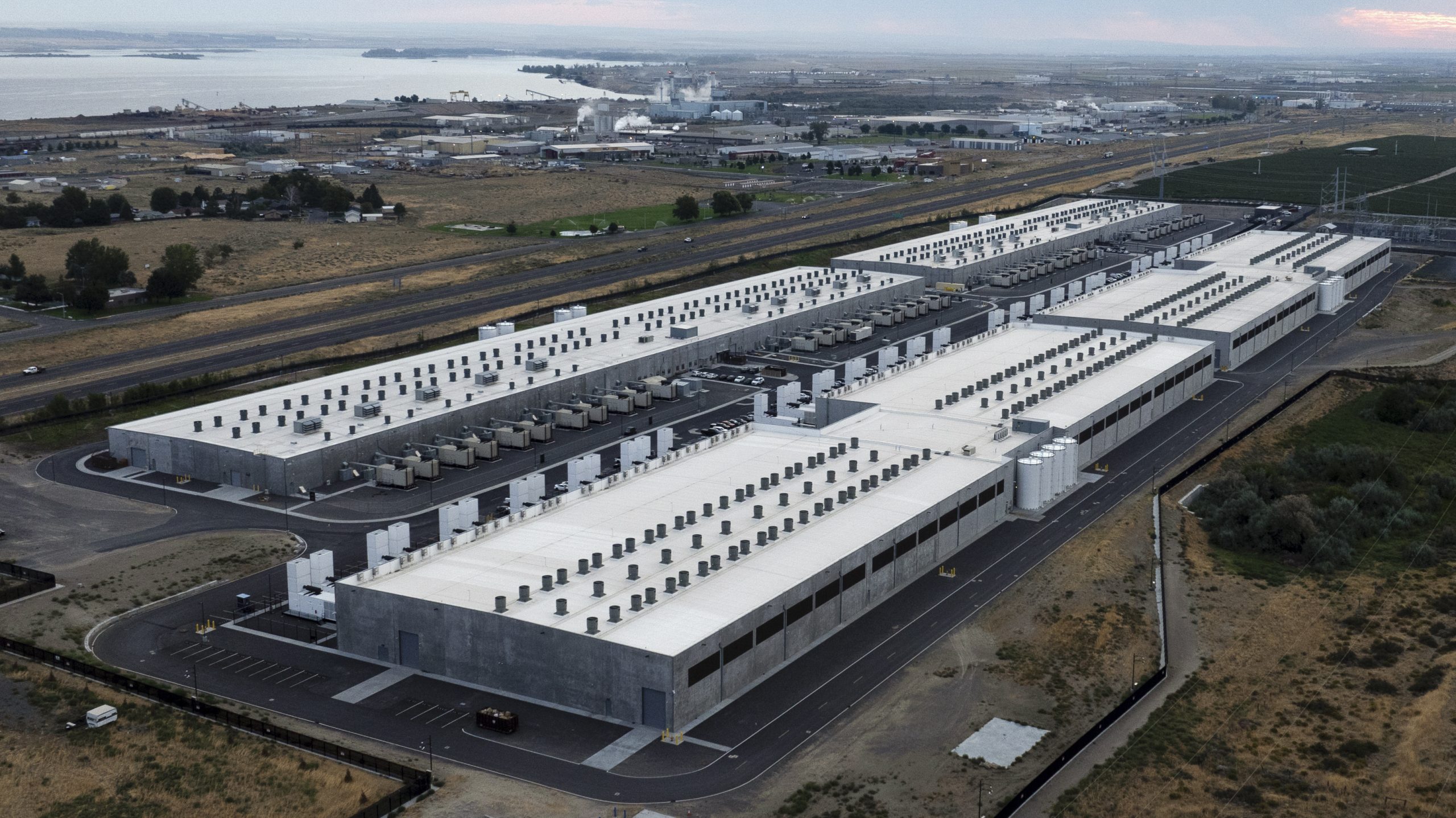
A coalition of Minnesotans opposed to the development of data centers has a wishlist for the current legislative session with a hierarchy of priorities.
Banning local officials from signing non-disclosure agreements, or NDAs, would be nice, they say. Ditto for requiring public hearings and disclosures prior to the approval of data center permits.
What the group wants above all, though, is a moratorium on proposed projects in Hermantown, Pine Island, Monticello, Farmington, North Mankato and other cities.
“We’re begging, urging the state to pause,” said Rebecca Gilbertson, who lives about a half-mile from a planned Google data center in Hermantown.
Gilbertson joined advocates from each of the five cities at the Capitol last week to lobby lawmakers for curbs on data center development. She said the coalition’s visit came after feeling stonewalled at city halls, where elected officials or staff have been ushering projects through local permitting processes over public objections.
Related: Why local officials in Minnesota are signing nondisclosure agreements
The group, mostly from Greater Minnesota, left the Capitol with a mixed bag of reactions. Bans on NDAs have gained traction in committees, but the coalition saw little urgency among lawmakers for a moratorium on development.
Absent the moratorium, they said the NDA ban would feel like a welcome consolation arriving too late.
Why would it feel too late?
At the behest of developers, city leaders around the state have already signed NDAs connected to data centers.
“The damage is done,” said Louis Schwartzkopf, who has been advocating against North Mankato’s stalled project.
NDAs are common tools — too common in the eyes of those advocating against them — used in economic development. They allow plans to simmer behind the scenes before any public scrutiny can boil over at public meetings. The normalization of NDAs prompted a St. Louis County commissioner to propose a ban on them last year.
Business groups, however, argue that NDA bans would stymie development.
“Without some level of confidentiality during those early conversations, companies may be unwilling to explore potential projects in Minnesota while evaluating investments across multiple states or competing communities within the same region,” wrote a group of economic organizations in a letter submitted to the Legislature.
Those advocating for a ban see it as a way to rebuild trust in government. Although her city’s officials didn’t sign NDAs connected to data centers, Jenna Van Den Boom testified in support of barring the agreements because she believes it’ll help communities in the future.
“I think it still definitely needs to be addressed for our state,” the Monticello resident said. “You’re supposed to be able to trust and work with your local officials. You elect them to represent you, and it feels like who is representing us at this point?”
Like many of the coalition members, Eszter Varga isn’t a regular at the Capitol. But data center plans in Farmington compelled her to get involved.
She compared the situation to a statewide gold rush. Developers are grabbing land, she said, in hope of attracting an end user for data centers, with too few checks in place to make sure it’s being done responsibly.
That’s why Varga and the others want a moratorium most of all — to carve out more time for legislation to catch up with development.
“It could be used for the Legislature to clean up, figuratively and literally, the act,” she said. “Let’s put them in the proper places and make sure there are regulations that protect the environment in how these data centers operate.”
What’s the status of legislation on data centers?
A moratorium bill introduced by Sen. Jennifer McEwen, DFL-Duluth, would halt local permits for data centers until the state’s Public Utilities Commission submits a report to the Legislature on energy usage, water usage and other impacts. The bill would delay development until at least a year after the report’s submission, theoretically pushing back local approvals into 2029.
While the bill was referred to the Senate’s Energy, Utilities, Environment and Climate Committee earlier this month, it hasn’t garnered a hearing. It also has no companion bill in the House, making passage a long shot this session.
NDA bans are making more progress, helped by bipartisan support. Bills recently made it out of committees in both the House and Senate.
Lawmakers even noted the odd-couple nature of the bills, which are bringing novel pairings from across the aisle. A bill introduced by Sen. Erin Maye Quade, DFL-Apple Valley, and Sen. Steve Drazkowski, R-Mazeppa, prompted Sen. Heather Gustafson, DFL-Vadnais Heights, to quip, “Can we all celebrate a Maye Quade-Drazkowski bill?”
The bill would prohibit local governments from entering into certain NDAs. Gustafson and enough of her colleagues approved the bill with amendments, sending it along to the Judiciary and Public Safety Committee.
Its companion House bill drew a companion comment: Speaking at a hearing on the bill that she is co-sponsoring with Rep. Drew Roach, R-Farmington, Rep. Emma Greenman, DFL-Minneapolis, remarked that there are “not many bills in the Legislature that are Greenman-Roach bills.”
Related: Fact brief: Can data centers lead to higher energy prices?
The House Elections Finance and Government Operations Committee passed the bill, sending it to the floor for a vote.
Another bill on NDAs, this one introduced by Sen. Grant Hauschild, DFL-Hermantown, is on the schedule for the Senate’s State and Local Government Committee on Tuesday. It appears to differ in a couple of ways from the Maye Quade-Drazkowski bill.
The Maye Quade-Drazkowski bill isn’t limited to data center NDAs nor to elected officials. Any person acting in a local government’s capacity, from staff to elected officials to appointed officials, could be prohibited from signing an NDA.
Distinguishing itself, Hauschild’s bill would apply specifically to data center developments and elected officials.
Aubree Derksen of Pine Island, where Google is planning a data center, said that NDA bills alone aren’t enough. She, along with other members of the coalition, wants a moratorium on data center development. Still, the bipartisan support that she sees developing around NDAs gives her some hope.
“That is one encouraging thing we’re seeing this session,” she said. “At the local level, with residents in particular across the board, there is unison that there shouldn’t be NDAs. The moment a resident hears you signed an NDA, trust is gone.”
