
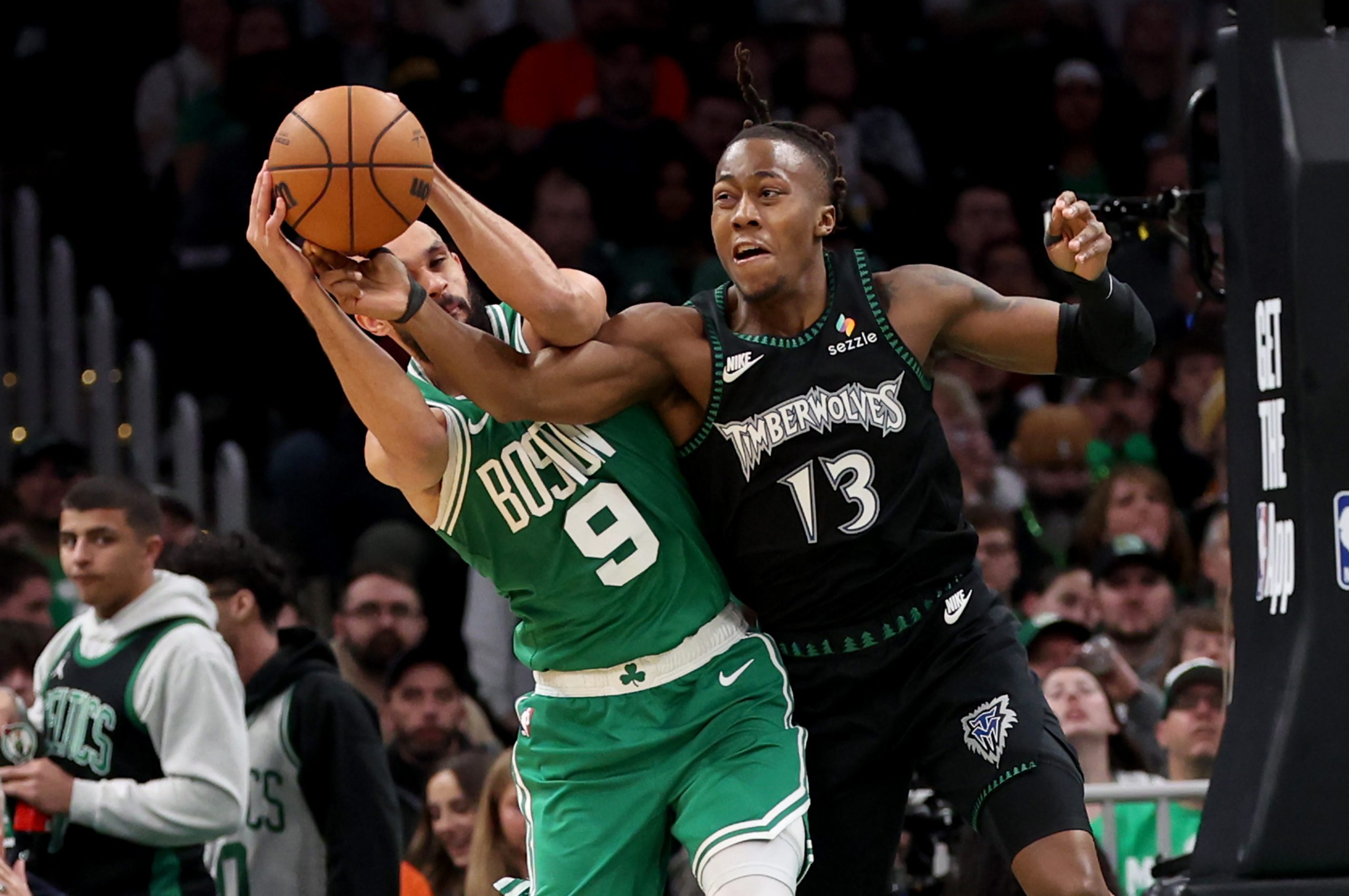
Ayo Dosunmu was not the primary reason why the Minnesota Timberwolves improbably throttled the Boston Celtics in a nationally televised road game Sunday night for their first win at TD Garden in 21 years.
Beset with a bum shoulder and sprained ankle that kept him out the previous two games, Naz Reid knocked the rust off his shooting stroke with six clanks in seven attempts through two-and-a-half quarters, then blitzed the Celtics for 11 points, seven rebounds and two blocks in a second half where the Wolves held a 26-point advantage in the 16:48 he was on the court.
Bones Hyland continued to scorch the twine from beyond the arc and beneath the rim as an invaluable bench sub during the four-game absence of superstar Anthony Edwards, as he poured in a team-high 23 points with his court jester’s delightful sense of mischief.
Jaden McDaniels hit buckets and bodied up the Celtics cadre of talented wings with the kind of nasty attitude that feels like it should leave a sulfurous smell. Kyle “Slo Mo” Anderson moseyed his octopi’s appendages into creative crevices of the game in his inimitable manner, playing good Samaritan to his teammates and bad cop to his foes. And even Jaylen Clark was freed from sending postcards from purgatory as the tenth man in an eight-man rotation and got back to invading his opponents’ personal space on defense.
But the influence of Ayo has been delicately but persistently pervasive on this team since Wolves president of basketball operations Tim Connelly somehow shanghaied the Chicago Bulls into forking him over in exchange for a bundle of bit parts at the trading deadline six weeks ago. The six-foot, five-inch combo guard has been quick, perceptive, decisive, confident, versatile, generous of spirit, and, perhaps best of all, contagious.
Related: Unfortunate blip or sobering reality check? What to make of Timberwolves’ latest sorry stretch of basketball
It is accurate to call Ayo, who plays with an alacrity that keeps his trademark Yoruban braids bobbing off his shoulders, a tone-setter. It is more accurate to call him a tone-re-setter, a tone repairman. For a Wolves team that frequently forgets how much it can thrive with a faster pace that yields a more instinctual deliberation sans self-consciousness, his performance is an unceasing reminder, a handy template for corrective reference.
After the Celtics undid a first-half’s worth of the Wolves’ noble grit with an 11-0 run to start the third quarter, Ayo started fiddling with the knobs of teamwork.
He took a casual pass from Julius Randle after Randle’s defensive rebound and sped down the court in four seconds, splitting two Celtics defenders and a converging third for an easy layup.
He chased down a loose ball for a rebound and had a pull-up three-pointer unleashed – it clanked the front iron – in five seconds. When Donte DiVincenzo used a Rudy Gobert screen to drive the baseline and draw defenders to him beneath the hoop, Dosunmu cut straight down the paint as DiVincenzo was exiting, receiving the pass for an easy layup. (Catch the color commentator noting that “Dosunmu plays the right way” at the end of the clip.)
Within the next two minutes, Bones would sub in for DiVincenzo and Naz replaced Randle, giving Ayo a pair of fellow speed merchants to leverage now that his own movement was on the Celts’ radar. But he used the outside shooting threat of Bones and Naz to space the floor, attacked the paint off the dribble and began dishing dimes to Gobert and McDaniels, like this one, and this one on back-to-back possessions.
When he sat for the first time in the second half with 4:14 remaining in the third quarter, the Wolves early struggles left him with his team minus-7 during that rotation. But he had dissolved those early doldrums with a whirlpool of playmaking, including five points, four rebounds and rugged defense. As he sat, his three remaining teammates were ready to sustain the thrust with the incoming Clark and Slo Mo.
When it was over, Ayo had stuffed the stat sheet with 17 points, 8 rebounds, six assists, two blocks and a steal, the Wolves a plus-8 in his 32:11 on the court. In the four games since Ant was sidelined with inflammation in his right knee, Ayo has been the bridge between the starters and the bench, elevating both with his energy and example. The Wolves have allowed the NBA’s fewest points per possession in those four games, winning three, and Ayo’s play with Naz, Bones and Slo Mo has been the unlikely crux of that success.
I had hoped to speak with Ayo during the Wolves shootaround practice before the game in Boston on Sunday, but a national reporter from Peacock took prominence on that front, so I sought out the ever clever and insightful lead assistant coach Micah Nori.
Asked how much Ayo has fulfilled the coaching staff’s early expectations for him, Nori referenced the hold left by the departure of Nickeil Alexander-Walker, who signed a lucrative free agent deal with Atlanta during the offseason. He ticked off the variety of benefits NAW provided – strong fiber on defense, an ability to both slash to the basket and hit a three-pointer, the ability to flex between the duties of a point guard and a shooting guard – and noted that the initial plan of “trying to replace Nickeil by committee” hadn’t worked. Ayo, he concluded, “basically has given us the components we were missing in one player.”
Plus pace. When I mentioned that I’d never seen a Timberwolves player fly faster down the floor than Ayo, he nodded. “One-hundred percent. What you see there, he’ll go get the rebound and push; but he also gets the high outlet (pass) and he’s gone; he’s waiting for no one.
“A lot of time (after a rebound), we’ll throw the ball over to Ant, or find Julius, and it kind of slows us down. But he’s in that mode where he knows 3-on-2 is better than 5-on-5, as is 4-on-3 and obviously, best, 2-on-1. So when he sees (the potential for) that advantage, he has extreme confidence, is super quick and can finish. That’s great; any time we can get out and have opportunities for easy baskets in transition it is a win for us. And, to your point, he does it as well as anybody we’ve had.”
The extreme confidence Nori cites is the way Ayo is most different from NAW, who sparred with uncertainty and occasionally got nervous about the challenges he set for himself even as he steadily flourished under coach Chris Finch. (Finch, who had NAW his rookie season in New Orleans, specifically asked that NAW be included in the trade that brought him here along with Mike Conley.)
After the Wolves lone loss (thus far) during Ant’s recent injury absence, at home against Portland last week, Ayo was asked about how his teammates were acclimating to his pushing the pace and acclimating with his teammates and how his insertion into the starting lineup changes his approach.
“I think the pace has definitely increased because guys are familiar with playing around me in terms of understanding that when I get it, I’m going to run; not necessarily for me to score, but to kick it ahead and allow other people to create and to stay in the flow of the offense, so down the stretch they have confidence in it and their ability at least to finish,” he replied. “So definitely I have noticed that.”
As for doing more with Ant out, he answered, “Just going out there and doing whatever the team needs. I think pretty much my whole basketball career that’s how I have always played, from high school to (the University of) Illinois. Just being able to do a little bit of everything, whether it is scoring, rebounding, assisting, defending. That’s what I always took pride in, so of course when Ant went out I had more opportunity to be on the ball and showcase my playmaking; showcase a little bit more than I would have if he was here. But for the most part I just go out there and play the right way each and every game.”
In the locker room after the win over the Celtics in Boston, the frank confidence also came through when I asked if he had patterned his game after any player while growing up.
“Nobody really, because I changed. When I was younger, I was slim. I played (against kids) like, two grades older, so I had to use my quickness and shooting ability. Then I got older and stronger so I had to change as my body changed. I started to become a big guard that can finish and play both ends of the court,” he replied.
It sounded like he enjoyed the idea of no role models, just making it up as he went along, I said.
“For sure; that was just basketball,” he said, licking at his lower lip that had started to bleed a little bit after being hit during the game. “Like, when I was growing up I never watched any cartoons or the Disney channel; I watched ESPN. I had a basketball court in the backyard, so I would watch the games and then go to the backyard and try different moves. Then take it to the playground.”
So his ability to go full speed and still lay the ball in with finesse has to be a playground thing, right?
“That’s, I’m not going to lie, that’s just God. I just be trying to step up and that’s how I play basketball,” Ayo said.
Related: ‘Incredible talent’: Minnesota women power postseason basketball
But you still have to do it over and over to get it right, don’t you?
“Well you have to have imagination; try it in the gym then move it move it over to the game. That’s the main thing: imagination,” said Ayo. In another locker stall about 10 feet away, Terrence Shannon Jr., whose prime NBA skill is getting to and finishing at the rim, was doing everything in his power not to burst into the conversation.
Then I asked Ayo about floaters. Many players can perfect a floater from a certain distance, but his have more range in their accuracy, from anywhere from 3 to 10 feet out from the basket.
“The floaters came from me being smaller and having to get the ball up over defenders who were older, taller and stronger than me. Get it up: Float, float, float,” he said, mimicking the delicate wrist flip. “But then I got big so now I can float and go and get some layups.”
Growing up, Ayo had the ideal blend of elements to hone him for hoops at an NBA level: Cutthroat competition in the crucible of the urban playground and a stable, loving family to keep him moored to a long-term perspective.
He and his closest friends were consumed with hoops while being raised on the south side of Chicago. One of them, Darius Brown, was killed at age 13 in a drive-by shooting – he was not gang-affiliated, just wrong place at the wrong time – in a park going to play basketball. Ayo has a tattoo in his honor. They both played on a youth team coached by Ayo’s father, Quam Dosunmu, of the Yoruba people from Nigeria. (Ayo means “joy” in the Yoruba language.)
Ayo is the youngest of four children, a self-proclaimed “mama’s boy” who would visit her at her salon after school. His older sisters both protected and loved him but cut him down to size when he appeared too cocksure.
The result is a 25-year old hooper who claims his blazing finishes are aided by God and simply states that his goal is to become an elite two-way player in the NBA. But who also keeps a daily journal of his life and emotions, and who said after he was traded to Minnesota – having spent his entire life playing youth, high school, college and pro basketball in the state of Illinois – that “I wanted to make sure I embraced all my feelings. I didn’t want to bottle anything up – I don’t think that is the right way to go about things.”
There have been inevitable bumps in the road, and there will be more. “A lot of times in Chicago (with the Bulls) their scheme was to be up at the level with their bigs, so you have help instantly,” Nori explained. “Our help is later with Rudy in drop (coverage) and Finchy prefers more initial ball pressure, fighting over screens and continuing to pursue. To me, that has been his biggest adjustment.”
Finch recently remarked on Ayo’s lack of boxing out on rebounds – and Ayo said after the Boston win that the film critique on the Portland loss concentrated on rebounding. Then there was the lazy in-bounds pass Ayo made underneath his own basket that the Celtics stole and turned into points.
But after Ayo launched a game-high 17 shots in the win over Phoenix – Ayo’s first Timberwolves start with Ant out – Finch said none of them were wasted and praised his shot selection and his positioning to bail the team out late in the shot clock.
Bottom line, the Wolves made a painful executive decision to let NAW go but don’t seem likely to repeat the process when Ayo’s contract runs out at the end of this season.
“I think what gets lost a little bit is he has come into a situation where there is no adjustment period for anybody and essentially hit the ground running and has fit in pretty seamlessly,” Nori said. “He is a great young man and hopefully with these last 11 games and playoffs he’ll continue to help and we’ll be able to find a way to continue for next year.”
