
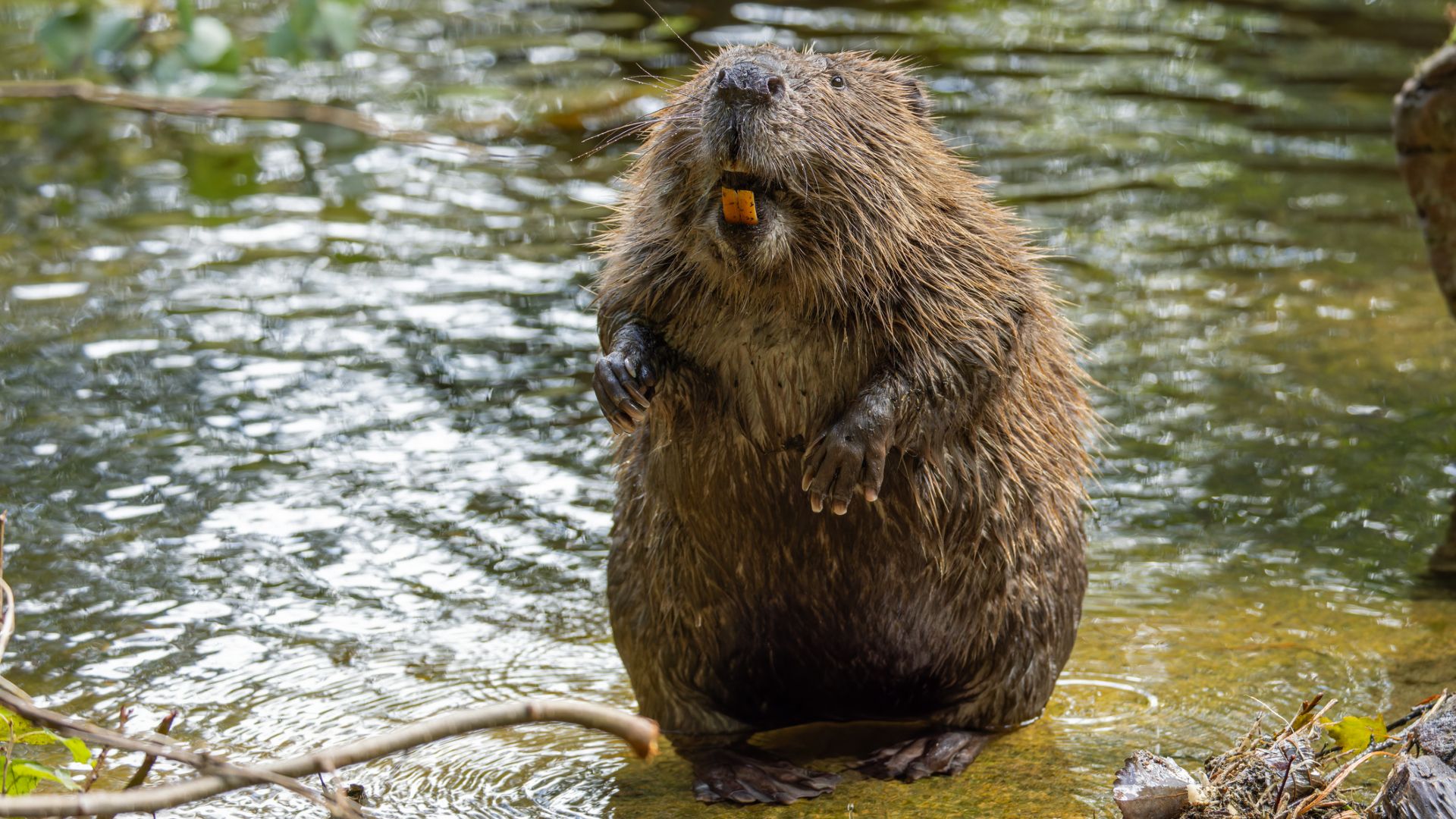
Beavers’ dams and ponds can turn a stream corridor into a net annual carbon sink, drawing in more carbon than it released over the course of a year, a new study finds.
The finding has big implications for the reintroduction of Eurasian beavers (Castor fiber) across Europe after centuries of being hunted to near extinction. If similar patterns hold elsewhere, the animals could help to mitigate climate change by sequestering the greenhouse gas without any costly infrastructure.
Article continues below
Calculating a carbon budget
In the study, published March 18 in the journal Communications Earth and Environment, the researchers examined a 0.5-mile (0.8 kilometers) beaver-influenced stream in northern Switzerland.
Before the beaver wetland was established in 2010, the stream acted as more of a floodplain, with lots of trees. When the beavers were introduced, they removed many of the trees for their dams, opening up the canopy for smaller plants.
The scientists measured carbon in the water, escaping into the atmosphere and being stored in sediments, biomass and deadwood. They did this by collecting core samples from the sediment and surrounding forest, along with plant samples from the algae growing along the stream. The researchers also calculated water flow of the stream, which helped them determine water levels, salt content, and how much sediment moved through the area.
The results showed that the wetland was a net sink that sequestered 108 to 146 tons (98 to 133 metric tons) of carbon per year. This amount of carbon saved is equivalent to 832 to 1,129 barrels of oil consumed.
The team estimated that across the floodplains suitable for beaver recolonization in Switzerland, the resulting wetlands could offset between 1.2% and 1.8% of Switzerland’s annual carbon emissions.
The researchers were careful not to oversell what the animals can do, especially as only one site was studied and carbon storage can vary with climate, geology, vegetation and the amount of room beavers have to spread. But Hallberg argued that beavers can offer a low-cost assist in making infrastructure more sustainable.
“Working with natural processes from the outset is not just ecologically sound, it is also economically sensible,” he said.
Emily Fairfax, an assistant professor in the Department of Geography, Environment and Society at the University of Michigan who was not involved in the study, welcomed the findings. She said the study helps to counter a common misconception that because wetlands can emit carbon, restoring them might not seem worth it.
“The way that they described the beaver ponds as these durable carbon sinks, I think is really important,” she told Live Science. “This is a really powerful tool for supporting the wetland restoration that needs to happen, and also for taking some of the skepticism off of beavers … People are pretty quick to paint beavers as a problem and look for a reason to heavily control them. And I think this study does a really good job of showing we don’t have to do anything other than let the beavers be beavers.”

Beavers bouncing back
Beavers were hunted to near-extinction across huge parts of their range in both Europe and North America, taking their wet, carbon-rich wetlands with them. Now, as populations recover, researchers are starting to understand their role in carbon sequestration.
Hallberg said it is difficult to produce a solid estimate of how much carbon could be removed through large-scale beaver restoration in either North America or Europe because suitable habitat and carbon inputs vary from place to place. But he pointed to earlier work from Colorado’s Rocky Mountain National Park estimating that active beaver wetlands can account for as much as 23% of total carbon storage in the landscape.
Fairfax noted that “if we were to restore beavers seriously,” the resulting carbon gains would be large enough that “we couldn’t ignore it,”
She added that the new study findings may even underestimate the carbon sequestered by the beavers, because healthier beaver wetlands can make riverscapes more resistant to catastrophic wildfires, preventing some carbon from being released in the first place.
“The joke in the beaver science world is, if you’ve got a problem, there’s a beaver for that,” she said.
Hallberg, L., Larsen, A., Ceperley, N., D’Epagnier, R., Brouwers, T. F., Schaefli, B., Thurnheer, S., Barba, J., Angst, C., Dennis, M., & Larsen, J. R. (2026). Beavers can convert stream corridors to persistent carbon sinks. Nature. https://doi.org/10.1038/s43247-026-03283-8
